Long-distance oil, gas, water and heating pipelines are built one girth weld at a time, and every girth weld is simultaneously a potential leak path, a fatigue initiation site and an inspection cost centre. On a large transmission project a single spread may complete hundreds of girth welds per day, and the economics of the whole job turn on two things: weld quality that passes AUT/RT the first time, and arc-on time that keeps the schedule moving. Mechanised and automatic pipeline welding machines were developed precisely to win both battles at once. This guide explains the four machine families that together cover an entire pipeline welding spread — the single-torch external welding machine, the dual-torch external welding machine, the internal welding machine and the automatic TIG (argon-arc) welding machine — and how ENGINE WELDER / DENVO engineers them for real construction and prefabrication duty.
Why Automatic Welding Wins on Pipeline Girth Welds
Manual shielded metal arc welding (SMAW) is flexible, but its outcome depends on the welder’s stamina, position and judgement. On a 48-inch, 25 mm wall pipeline, a fixed-position root, hot pass, fill and cap sequence is a brutal workload, and quality drifts through a shift. Automatic pipeline welding replaces that variability with programmed motion and locked parameters:
- Consistency: the torch travels and oscillates identically at every clock position, so every weld in the spread is made to the same recipe.
- Deposition rate: continuous wire feed and optimised dwell time raise fill-and-cap productivity by a large multiple over stick welding.
- First-time pass rate: controlled heat input and arc position reduce lack-of-fusion and porosity, cutting repair rates and re-inspection cost.
- Traceability: digital control stores the parameters used on every joint — a welded record that answers the client, the inspector and the regulator.
- Labour leverage: one operator with a touch screen runs a machine that would otherwise need a crew of highly skilled manual welders.
The Four Machine Families at a Glance
A complete pipeline welding spread combines machines by role: internal machines lay the root pass from the inside of the pipe, external machines fill and cap from outside, and automatic TIG takes over where metallurgy or cleanliness leaves no margin. The ENGINE WELDER pipeline automatic welder family is built around four core products.
| Family | Model | Pipe range | Welding units | Primary role |
|---|---|---|---|---|
| Single-torch external | DW-EW-I | Φ219–Φ1422 mm | 1 torch | Hot pass, fill & cap; prefab and field |
| Dual-torch external | DW-EW-II | Φ219–Φ1422 mm | 2 torches | High-speed fill & cap on grade |
| Battery internal | DW-EH48/56 | Φ1219–Φ1422 mm | 8 units | Root pass, off-grid / remote sites |
| Flexible internal | DW48/56-8H-D | Φ1219–Φ1422 mm | 8 units | Root pass, mountains and steep terrain |
| Automatic TIG | Orbital TIG head | Per wall thickness | 1 head | Root and critical passes, high-alloy / clean service |
1. The Single-Torch External Welding Machine (DW-EW-I)
The single-torch external machine is the workhorse of both the prefabrication yard and the field spread. Its design priority is simplicity and adaptability: a stiff track, a light carriage, a precise drive and positional parameters that change automatically as the torch travels around the pipe.
- Toothed-hole steel band track: a rigid, lightweight, split-ring band that bolts on quickly and resists deflection around large-diameter pipe.
- Lightweight welding carriage: low mass, dust-protected and easy to clamp, so it adapts to a range of pipe diameters without changing the machine.
- Single rack-and-pinion drive: smooth engagement with no lost motion or slip, protecting torch position accuracy at every clock position.
- Multi-axis torch adjustment: vertical and horizontal torch position are set independently so the arc can be centred on the weld pool symmetry.
- Automatic positional parameters: voltage, current, travel speed, oscillation width and dwell time all change with torch position, covering flat, vertical and overhead zones without manual intervention.
- Colour touch-screen HMI: parameters can be set, displayed, edited and stored, with upload and download of welding programs.

Because the split ring track and carriage are shared with the dual-torch machine, a spread can standardise on one track system and switch between single and dual configurations as the workload dictates. For general prefabrication, mid-diameter transmission lines and mixed-diameter work, the single-torch machine delivers the best quality-per-dollar balance.
2. The Dual-Torch External Welding Machine (DW-EW-II)
When the schedule is the constraint — high-grade long-distance transmission pipelines, national key projects and high-specification prefabrication shops — the dual-torch machine doubles the number of arcs working the joint. Two torches run in a coordinated pattern while an arc-tracking system holds them on the seam.
- Dual-torch, dual-mode: straight oscillation and angle oscillation are selectable, so the same head covers narrow-gap and conventional bevels.
- Arc tracking with automatic correction: the system follows the seam in real time and steers the torch, keeping beads uniform and reducing defect rates.
- Integrated digital control: welding power source and control cabinet communicate digitally for fast, precise, stable response.
- Operator-friendly HMI: parameters are adjusted directly on screen, lowering the skill barrier for setup and changeover.
- Multi-channel process data: process recipes can be stored, recalled, imported and exported across channels for systematic optimisation.
- Common consumables: wear parts are standardised to cut spares inventory and maintenance cost.
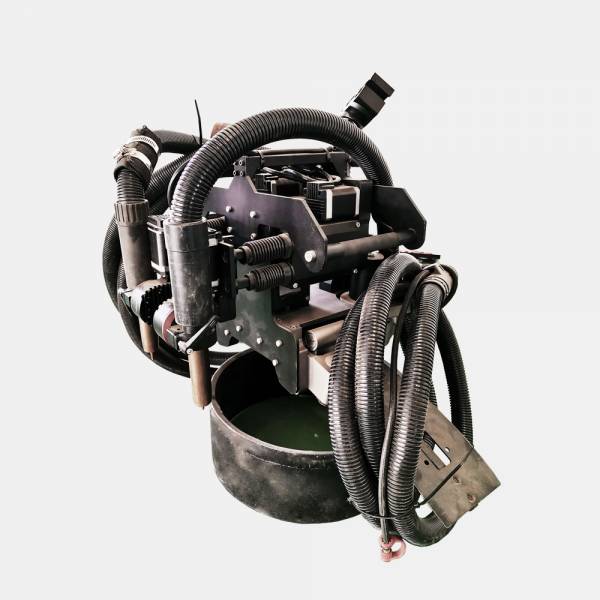
The practical result on a 40-inch, 25 mm wall joint is a materially shorter fill-and-cap cycle: two torches working the same circumference compress the arc-on time, freeing days on a spread where the calendar, not the welder, is the limiting resource.
3. Internal Welding Machines: Laying the Root from Inside
The root pass decides the internal profile of the pipe, and the internal profile decides flow efficiency, corrosion behaviour and pigging. An internal welding machine travels inside the pipe, expands to centre itself on the joint and fires multiple welding heads simultaneously to lay a uniform root from the inside out. ENGINE WELDER builds two versions for two different site realities.
Battery Internal Welding Machine — DW-EH48/56
The battery machine exists for the site where there is no grid and no generator to spare. It carries its own power and is operated by wireless remote, so it reaches pipes in remote, mountain and off-grid networks.
| Parameter | DW-EH48/56 |
|---|---|
| Pipe range | Φ1219–Φ1422 mm |
| Power form | Electric + hydraulic, lithium battery pack |
| Welding units | 8 |
| Travel speed | 0–40 m/min |
| Gradeability | ≤30° |
| Bend passage | 5D horizontal 90° / 30° vertical |
| Root welding time | ≤90 s per pass |
| Working pressure | 5–7 MPa |
| Wall thickness | 10–35 mm |
| Altitude | ≤4000 m |
| Temperature / humidity | −40 to +65 °C / ≤90% |
| Weight | 2950 kg |
| Dimensions | 5200 × 1200 × 1100 mm |
| Shielding-gas tank | 30 L |
Flexible Internal Welding Machine — DW48/56-8H-D
The flexible machine trades battery independence for a more compact body and stronger bending performance — the answer to mountain pipelines, steep grades and urban utility tunnels where the machine must negotiate tight bends to reach the joint.
| Parameter | DW48/56-8H-D |
|---|---|
| Pipe range | Φ1219–Φ1422 mm |
| Power form | High-torque servo electric drive + battery pack |
| Welding units | 8 |
| Travel speed | 0–60 m/min |
| Gradeability | ≤30° |
| Bend passage | 5/6 × D |
| Root welding time | ≤120 s per pass |
| Wire diameter | Φ0.9–Φ1.2 mm |
| Rated working pressure | 5–7 MPa |
| Rated working voltage | DC 24 V |
| Altitude | 0–3500 m |
| Temperature | −50 to +65 °C |
| Weight | 2400 kg |
| Dimensions | 4600 × 1250 × 1200 mm |

Both machines share the engineering that makes an internal root viable: a hydraulic expansion system that centres the body and corrects ovality and mismatch before the arc starts, a fast-response electromagnetic brake that locates the carriage reliably, and wireless remote operation that keeps personnel clear of the joint. Fit-up and root welding together take roughly five minutes on the flexible machine — a compact, repeatable cycle that suits fast-track schedules.
4. Automatic TIG (Argon-Arc) Welding for Pipeline Root and Critical Passes
Gas metal arc welding dominates pipeline fill and cap, but there are joints where only automatic TIG will do. Austenitic stainless, duplex and high-alloy line pipe, thin-wall and small-diameter tube, cryogenic and hydrogen service, and any application with strict internal cleanliness or capping requirements all push the root pass towards TIG, where an argon-shielded, non-consumable tungsten electrode produces a clean, oxide-free, fully penetrating root with precise heat control.
An automatic TIG machine for pipeline duty packages an orbital head, a programmable power source, arc-voltage control, cold-wire feed and shielding-gas management into one system. The operator sets the recipe once; the head then rotates at constant speed, modulating current and oscillation to hold the pool. For root passes the result is a smooth internal bead with controlled penetration — ideal for corrosion-resistant alloy service and for lines that will be internally inspected by high-resolution AUT.
- Metallurgical control: low, stable heat input protects sensitisation resistance in stainless and duplex grades.
- Cleanliness: no spatter and a slag-free, oxide-free bead, which matters for food-grade, pharmaceutical and cryogenic pipework.
- Thin-wall capability: precise current regulation avoids burn-through on small-bore and thin-wall tube where GMAW is hard to control.
- Repeatability: stored programs reproduce the same root on every joint, independent of operator fatigue.
5. Building a Complete Welding Spread
The four families are not competitors — they are team-mates. A typical high-productivity spread for large-diameter transmission pipe runs an internal welding machine for the root, then one or two dual-torch external machines for hot pass, fill and cap. On smaller or mixed-diameter work a single-torch external machine covers everything from prefabrication to tie-in, and automatic TIG is called in for the alloy and clean-service joints. External welding power comes from an engine-driven generator set such as the HW1000, which can supply two automatic external welding units simultaneously — the same machine that also powers grinders, lights and preheat equipment on the right-of-way.
6. Quality, Data and Traceability
Automatic welding turns each joint into data. Parameter libraries indexed by material, diameter, wall thickness and position let the operator recall a qualified recipe in seconds. Weld logs capture what was actually used, so the spread can demonstrate compliance, diagnose a repair and hand over a digital weld map to the client. On projects where repair rates are measured in fractions of a percent, this data discipline is not a luxury — it is the difference between a profitable spread and an unplanned shutdown.
7. Selection Framework
- Large-diameter transmission, tight schedule: internal root + dual-torch external fill/cap, with engine-driven power on site.
- Remote / off-grid pipe, large diameter: battery internal machine for the root; external machines fed by an engine-driven genset.
- Mountain and steep terrain, tight bends: flexible internal machine for the root, chosen for its compact body and bend passage.
- Prefabrication yard: single-torch external machines on rotating stations, or dual-torch for maximum throughput.
- Stainless, duplex, small-bore, cryogenic or hydrogen service: automatic TIG for the root and critical passes.
Conclusion
Single-torch and dual-torch external welding machines, internal welding machines and automatic TIG systems each solve a different part of the pipeline welding problem — root integrity from the inside, throughput and consistency from the outside, and metallurgical precision where the service demands it. Beijing Anjie Weida Technology Co., Ltd. (DENOH Group) engineers and manufactures the ENGINE WELDER pipeline automatic welding family for transmission, utility and prefabrication duty worldwide, with engineering-led selection support, complete documentation and responsive after-sales service. For a spread configuration study, technical data sheets or export pricing for your pipeline programme, contact our engineering team — we answer with data, not brochures.
Contact Beijing Anjie Weida Technology Co., Ltd. (DENOH Group)
Tel (Beijing office): 010-86468776
Email: sales@denohgroup.com
Phone / WhatsApp / WeChat: 13521628344
Website: www.denohgroup.com
Pipeline auto welder range: https://www.denohgroup.com/products/pipeline-auto-welder/
Our engineering team responds to inquiries within one business day with model recommendations, technical data sheets and a quotation for your pipeline automatic welding requirements.