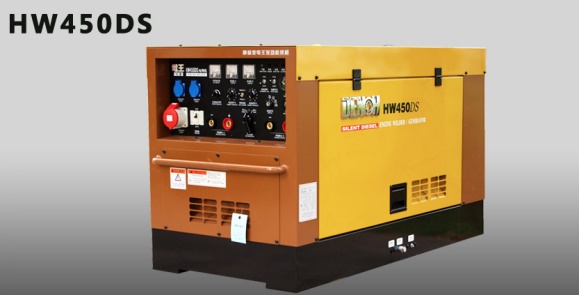
Shipyard berths, dry docks and container terminals share one awkward characteristic: the steel that needs repair is almost never close to a usable welding receptacle. Quay cranes sit at the edge of an apron with no spare feeder capacity, hull sections are staged on hardstanding hundreds of metres from the workshop, and a barge under repair may be floating alongside with nothing but a shore gangway. In that environment the welding power source has to bring its own electricity, tolerate salt-laden air, and keep two welders productive at once. This article looks at how the HW450DS silent diesel engine welder is configured for that duty, what its published ratings actually mean on a repair berth, and how crews structure a shift around it.
1. Why Marine Repair Punishes Ordinary Welding Plant
A shore-powered inverter is an efficient machine in a fabrication bay. Move it to a berth and three problems appear at once. First, cable volt-drop: a 100 m run of extension cable at partial load costs enough voltage that arc starting on low-hydrogen electrodes becomes unreliable, and welders compensate by winding current up, which drives spatter and undercut. Second, availability: terminal power is prioritised for crane and reefer loads, and a maintenance crew rarely gets a dedicated circuit. Third, mobility: a dock repair moves along the hull as the survey progresses, and re-running cable every two hours is unproductive time nobody budgets for.
An engine driven welder removes all three constraints by generating at the point of work. The trade-off is that the machine must now be judged on more than welding current — engine duty, fuel autonomy, noise, footprint on a congested apron, and its ability to feed grinders and pumps alongside the arc all become selection criteria.
2. The HW450DS Power Architecture
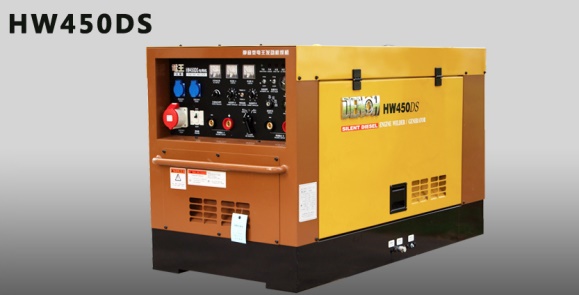
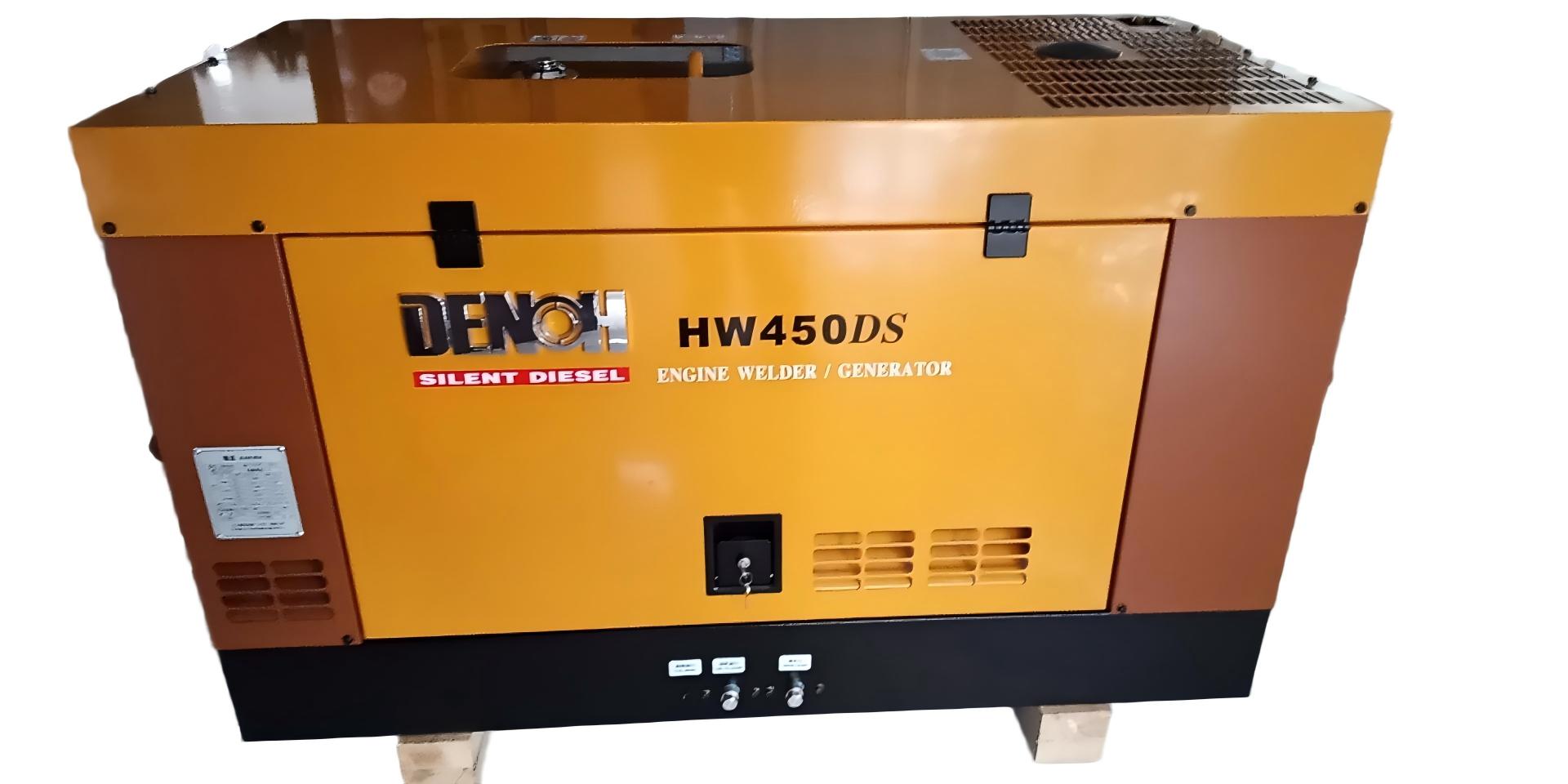
The HW450DS-EW is built around a Kubota D1105 three-cylinder, four-stroke, water-cooled diesel of 1123 cc displacement, rated 29.5 HP at 3000 rpm, directly coupled to a brushless welding generator. Direct coupling matters in marine work: there is no belt to glaze in humid air and no brush gear to track with salt deposits, which is a common failure mode on older brushed sets used near the waterline. The enclosure is rated IP23 with Class F insulation, and the whole unit is packaged at 1530 x 710 x 865 mm and 510 kg — small enough to sit on a standard flatbed or be craned onto a pontoon.
| Parameter | HW450DS-EW Rating | What It Means On A Berth |
|---|---|---|
| Rated welding output | 12.38 kW | Continuous arc power without derating the engine |
| Rated current / voltage | 360 DCA / 34.4 DCV | Comfortable for 4.0 mm low-hydrogen fill passes |
| Open circuit voltage | 80 DCV | Supports cellulosic root work and reliable restarts |
| Duty cycle | 50% | Matched to manual repair rhythm with grinding between runs |
| Single-operator range | 60-400 DCA | Covers 2.5 mm tack work to heavy 5.0 mm plate passes |
| Dual-operator range | (30-200) x 2 DCA | Two independent arcs, no interference between stations |
| Auxiliary power | 15.0 kW / 380 V / 21.7 A, 80% duty | Runs grinders, pumps, lighting alongside welding |
| Engine | Kubota D1105, 3-cyl, 1123 cc, 29.5 HP | Water-cooled, direct coupling, electric start |
| Fuel tank | 37 L | Supports a full repair shift without refuelling stops |
| Dimensions / weight | 1530 x 710 x 865 mm / 510 kg | Fits congested aprons and pontoon decks |
| Battery | 12 V – 48 Ah | Electric start in cold, damp morning conditions |
3. Working Two Arcs From One Machine
The dual-holder capability is the feature that changes shift planning. Two welders each draw from an independent 30-200 DCA channel, so a hull plate insert can be progressed by two operators working opposite sides of the same seam without one arc pulling the other’s voltage. On a doubler plate or a crane boom lattice repair, that halves the elapsed time on the critical item, which in a dry dock is the metric that matters — dock days cost far more than welding consumables.
There is a practical envelope to respect. Two hundred amps per side is ample for 3.2 mm electrodes and comfortable for 4.0 mm at moderate travel speed, but heavy 5.0 mm downhand fill on thick sections should be run single-operator on the 60-400 DCA range. Crews that plan this properly split the job list into a dual-operator group (tacking, small inserts, stiffener attachment, handrail and grating repair) and a single-operator group (main structural fill and cap passes).
4. Consumable and Process Matching
Marine repair rarely uses one consumable. A typical berth job list mixes structural steel, weathered plate with mill scale and coating residue, and occasional pipework. The 80 V open-circuit rating supports cellulosic electrodes for root passes on pipe and for burning through less-than-perfect surface condition, while the descending characteristic gives the stable short-arc behaviour low-hydrogen electrodes need for fill and cap.
- Root passes on pipe and small bore: cellulosic electrodes, single-operator mode, current toward the upper part of the recommended band to maintain a keyhole.
- Structural fill and cap: low-hydrogen basic electrodes, baked and held in a quiver; run single-operator on heavy sections and dual-operator on stiffeners and brackets.
- Higher-configuration units: single-holder semi-automatic self-shielded flux-cored operation is available, which is useful for long fillet runs on deck stiffening where deposition rate drives the schedule.
- Weathered or coated plate: grind back to bright metal using the auxiliary supply, then weld; do not compensate for poor preparation by raising current.
5. The Auxiliary Supply Is Not A Footnote
Fifteen kilowatts of 380 V auxiliary output at 80% duty is enough to run two 230 mm angle grinders, a needle gun, task lighting and a small submersible pump concurrently. On a berth that removes an entire second machine from the mobilisation list. Because engine capacity allows welding and 380 V AC to be drawn at the same time within the rated envelope, a preparation team can grind and gouge on one side of the job while welding proceeds on the other.
Two operating notes are worth writing into the method statement. Keep total auxiliary draw inside the rating rather than assuming headroom, because inductive starting currents from pumps and compressors are what actually trip protection. And route auxiliary leads away from welding returns to avoid induced noise on any inspection equipment sharing the same supply.
6. Field Case: Quay Crane Boom Lattice Repair
A container terminal identified corrosion-driven section loss on the lattice diagonals of a ship-to-shore crane boom during a routine structural survey. The repair had to be executed in a 72-hour window between vessel calls, at height, with no shore supply available on the boom itself.
| Item | Detail |
|---|---|
| Scope | 14 lattice diagonal members, doubler plates and partial member renewal |
| Material | S355 structural steel, 10-16 mm sections |
| Machine placement | Single HW450DS on the apron, welding leads routed up the boom walkway |
| Working mode | Dual-operator (30-200 DCA x 2) for doubler attachment; single-operator for renewal butt welds |
| Consumables | Low-hydrogen 3.2 mm and 4.0 mm, quiver-controlled |
| Auxiliary usage | Two grinders plus LED task lighting from the 380 V output |
| Fuel | 37 L tank refilled once per 24-hour period across the window |
| Outcome | Repair closed inside the 72-hour window; NDT acceptance on first submission for all renewal butts |
The scheduling lesson from that job is straightforward. The dual-operator mode did not simply add a second welder — it allowed doubler attachment and member renewal to run as parallel work fronts from a single power source and a single fuel logistics chain, which is what kept the crane off the maintenance list inside one berth gap.
7. Maintenance in Salt-Laden Air
Coastal service shortens service intervals. A brushless, directly coupled generator removes the two components that historically failed first, but the engine and enclosure still need attention.
- Daily: check coolant and engine oil level; blow down the radiator core with dry compressed air; inspect welding lead insulation at the drum and at the holder.
- Weekly: clean the air filter element; drain water from the fuel filter bowl; check battery terminals for salt-driven corrosion and re-grease.
- Monthly: inspect anti-vibration mounts and enclosure fasteners; verify the auto stop-start energy saving function engages and releases cleanly; check earth continuity of the work return clamp.
- Seasonally: change engine oil and filters per the engine schedule; inspect the exhaust system for corrosion; verify insulation resistance of the welding output circuit.
- Storage: park under cover with the enclosure closed, keep the fuel tank near full to limit condensation, and disconnect the battery if the unit will stand for more than three weeks.
8. Selection Summary
The HW450DS suits marine and port repair where the deciding factors are two simultaneous arcs, on-board 380 V auxiliary capacity, a footprint that fits a working apron, and an engine package that starts and runs reliably in humid, saline conditions. Where a single very heavy arc dominates the workload, a larger unit in the ENGINE WELDER diesel range is the better match; where the work is light, dispersed and frequently carried by hand, a gasoline model is easier to mobilise. Match the machine to the dominant task, not to the occasional peak.
Talk To An Application Engineer
For welding procedure support, dual-operator configuration advice, or a site-specific ENGINE WELDER equipment proposal for shipyard, port or offshore maintenance work, contact our technical team:
- Telephone: 010-86468776
- Email: denoh@126.com
- Enquiry page: https://www.denohgroup.com/contact/
Send your material grades, joint thicknesses, expected number of simultaneous welders and site power situation, and we will return a matched model recommendation with an indicative consumable and fuel plan.