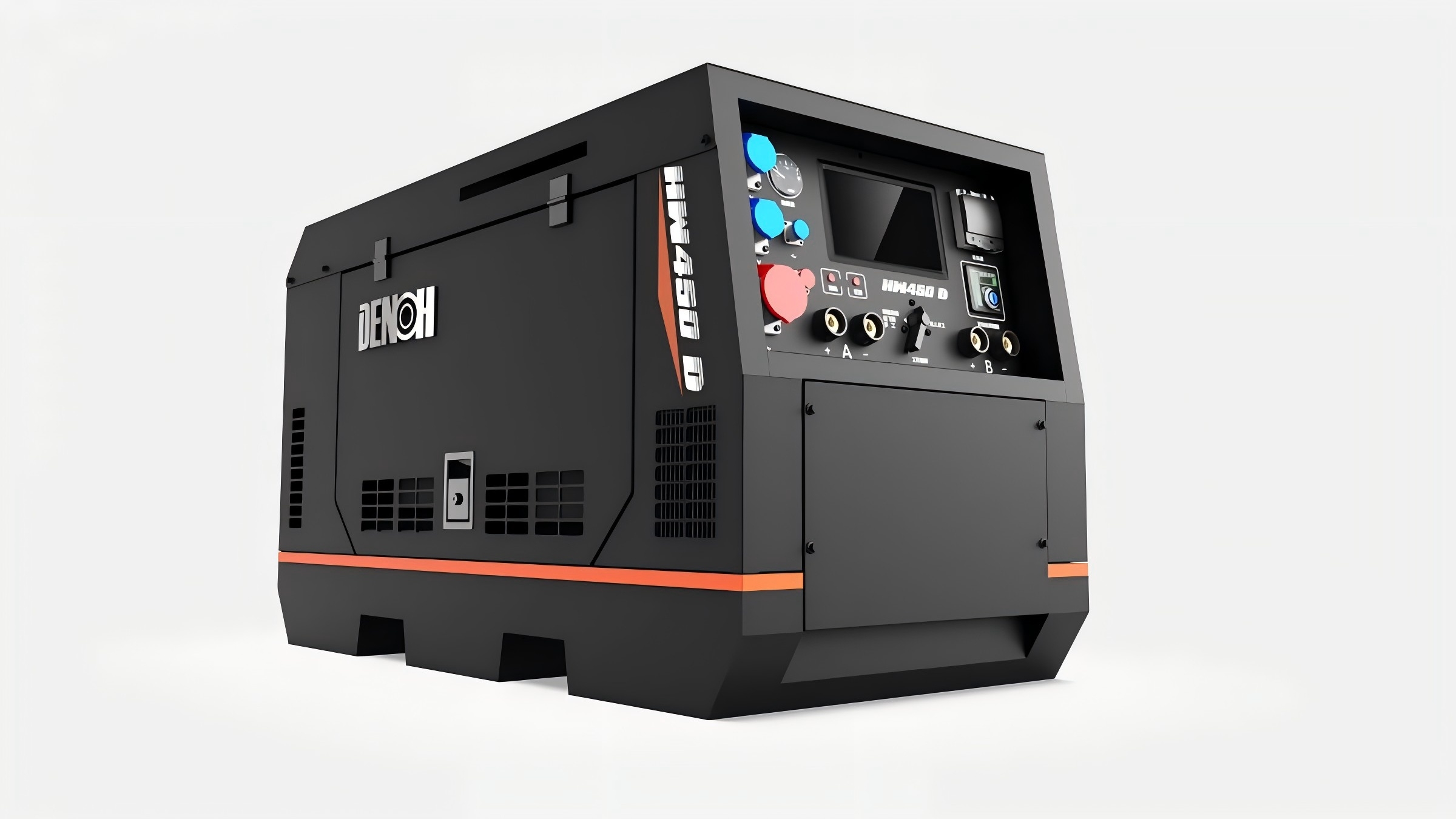
In remote construction sites, power supply and welding current rarely come from the same place. Crews typically haul a generator for tools and a separate welding machine, then fight the weight, fuel and maintenance of two units. The ENGINE WELDER HW450D takes a different route: it is a 400 A diesel engine-driven double-head welding generator that delivers both weld current and auxiliary three-phase power from one chassis. This article looks at why the double-head format matters, how its power platform is built, and what that means for structural steel and pipeline tie-in work.
1. Why a double-head engine welder earns its place on site
A single-operator engine welder can weld or power tools, but rarely both at full capacity at the same time. The HW450D is designed for two welders to work in parallel, each with an independent current setting, or for one operator to merge both outputs into a single high-amperage arc. In practice this changes crew planning: a girder joint that needed one welder on a long shift can be split between two, or a tie-in can be welded while a helper runs a grinder and a floodlight from the same machine.
The rated welding output is 12.4 kW with a single-handle current range of 60–400 DCA and a double-handle range of 40–200 DCA per operator. On the auxiliary side, the unit provides 15.0 kVA at 400 V AC, enough to run site tools, lighting and small pumps without a second generator. For contractors who bill by the day, eliminating a second machine is a measurable reduction in fuel, transport and service overhead.
2. The power platform: Buck topology with IGBT digital chopping
The main circuit of the HW450D uses a Buck (step-down chopping) topology as its core platform, controlled by IGBT digital chopping. In plain terms, the engine drives the generator, and a digital stage converts that raw output into a precisely regulated welding arc. Because the regulation is electronic rather than mechanical, the arc responds quickly to changes in arc length and workpiece resistance, which keeps the bead consistent as the operator moves.
This design also supports a flat (CV) characteristic mode with a rated usage of 9.6 kW, a no-load voltage of 85 V and a voltage adjustment range of 15–35 DCV. The CV mode is what makes the machine suitable for semi-automatic and full-automatic welding heads, not only stick electrodes. A single HW450D can therefore serve manual welding, semi-automatic welding and fully automatic welding robots on the same job.
3. Arc quality: DFJ low-splash control and dual closed-loop regulation
Two technologies work together to keep the arc stable. The first is a dual closed-loop control scheme (covered by an invention patent) that regulates both the electrical loop and the arc behaviour loop, reducing drift under load changes. The second is DFJ (low-splash) waveform control, which shapes the current waveform around the short-circuit and arc-reignition phases of the cycle to limit spatter. Lower spatter means less post-weld cleanup, fewer grinding hours, and a cleaner root pass for inspection.
For field crews this translates into predictable starts on cellulose and low-hydrogen electrodes, steadier root passes on pipe, and less rework. The insulated class is H and the protection class is IP23, which is appropriate for covered outdoor duty rather than heavy wash-down.
4. HW450D key specifications
| Welding rated power | 12.4 kW |
| Rated current (single / double) | 360 / 200 DCA |
| Rated voltage (single / double) | 34.4 / 28 DCV |
| Current range (single) | 60–400 DCA |
| Current range (double) | (40–200) ×2 DCA |
| Auxiliary output | 15.0 kVA, 400 V AC, 50 Hz |
| Engine | 4-stroke 4-cylinder diesel, 1.372/1.642 L, 22/26.8 kW |
| Start / fuel / cooling | Electric 12 V / Diesel / Water-cooled |
| Fuel tank | 75 L |
| Dimensions (L×W×H) | 1530 × 710 × 865 mm |
| Net weight | 550 kg |
5. Field case: a bridge girder tie-in and a pipe spool
Consider a typical mixed day. A two-person crew is closing a box-girder splice on a bridge approach while, a few hundred metres away, a single operator is welding a pipe spool. With one HW450D set to double-head mode, both welders draw independent current from the same machine, and a portable grinder runs from the 400 V auxiliary socket. The engine never stops between tasks, the fuel log is one line instead of two, and the foreman has a single service point to manage.
In pipeline tie-ins the same machine supports cellulose downhill root passes and semi-automatic fill-and-cap, then hands over to a welding robot on the production line without changing the power source. That flexibility is why engine-driven double-head welders are increasingly specified for projects where the weld scope shifts from manual to automated over the life of the contract.
Contact & Consultation
For technical consultation, project quotes, or to arrange an on-site demonstration of the ENGINE WELDER HW450D, HW450DS and other engine-driven welding generators, reach our team directly:
Phone: 010-86468776 | Email: denoh@126.com | Website: https://www.denohgroup.com/contact/