Aquaculture has quietly become one of the most welding-intensive food industries. A modern onshore recirculating aquaculture system (RAS) hall is a stainless and galvanised steel plant with thousands of metres of walkway, tank support and pipe rack. A floating cage farm is a set of steel and HDPE structures that lives in salt water, moves with the tide and takes wave loading every day of its service life. Neither site has a useful grid connection at the work point. This is why the engine driven welder has become standard equipment for fish farm operators, net-pen fabricators and marine contractors working the coastal strip.

The two aquaculture environments that shape the machine choice
Onshore RAS and hatchery buildings behave like food plants: stainless steel, hygiene zoning, three-phase services, and a strong preference for clean, low-spatter welds on thin sections. Offshore cage farms behave like marine construction sites: galvanised carbon steel, salt fog, moving decks, and work that must be finished between weather windows. The same welder family can serve both, but not the same model, and not with the same accessories.
| Environment | Typical structures | Welding reality | Machine priority |
|---|---|---|---|
| Onshore RAS / hatchery hall | Tank supports, walkways, pipe racks, drum-filter frames, oxygen and aeration pipework | Thin-wall stainless and galvanised sections, 2.5–3.2 mm electrodes, TIG on sanitary lines | Stable low-current arc, clean output, single-phase auxiliary for tools |
| Floating steel cage frame | Cage rings, walkway grating, handrails, net-lifting frames, feed spreader brackets | Galvanised carbon steel, 3.2–4.0 mm electrodes, repairs in situ above water | Portability, weight limit per deck section, weather protection |
| Feed barge / service pontoon | Deck plating, hatch coamings, crane pedestals, davit bases, railing | 4.0–5.0 mm electrodes and occasional 6.0 mm, continuous work during the weather window | High continuous current, three-phase auxiliary, corrosion-hardened enclosure |
| Jetty, pier and mooring | Steel piles, pile caps, fender frames, gangway structures | Heavy sections, 5.0–6.0 mm, often over water and in tidal spray | Diesel power, long cable runs, high-duty cycle |
| Net-pen and mooring fabrication yard | Frame jigs, sinker tubes, anchor brackets, connector plates | Production tack and fillet welding, 3.2–4.0 mm, high arc-on time | Dual-operator output, fuel efficiency, engine durability |
Salt fog is the real specification
A coastal site will destroy unprotected equipment faster than any other environmental factor in this industry. The machine itself needs attention: stainless or plated fasteners, sealed control panels, a canopy that keeps spray off the air intake, and a wash-down routine at the end of every shift. More importantly, the welded structure needs a corrosion strategy that starts before the arc is struck.
- Match the filler to the substrate. Galvanised steel requires the zinc-rich coating to be removed from the weld zone and reinstated afterwards; welding over galvanising produces porosity and toxic fume.
- Avoid dissimilar-metal couples. Stainless fittings bolted to galvanised frames create a galvanic cell that will fail at the fastener, not at the weld.
- Design for drainage. A cage walkway that traps seawater between two members will corrode from the inside out, whatever the coating system.
- Respect the heat-affected zone of thin tube. Overheating a 2 mm wall handrail burns off the galvanising on both faces and creates a corrosion initiation site.
- Repair coatings immediately. A zinc-rich primer applied the same day is worth ten times the same primer applied at the end of the season.
Deck weight limits change the machine you can use
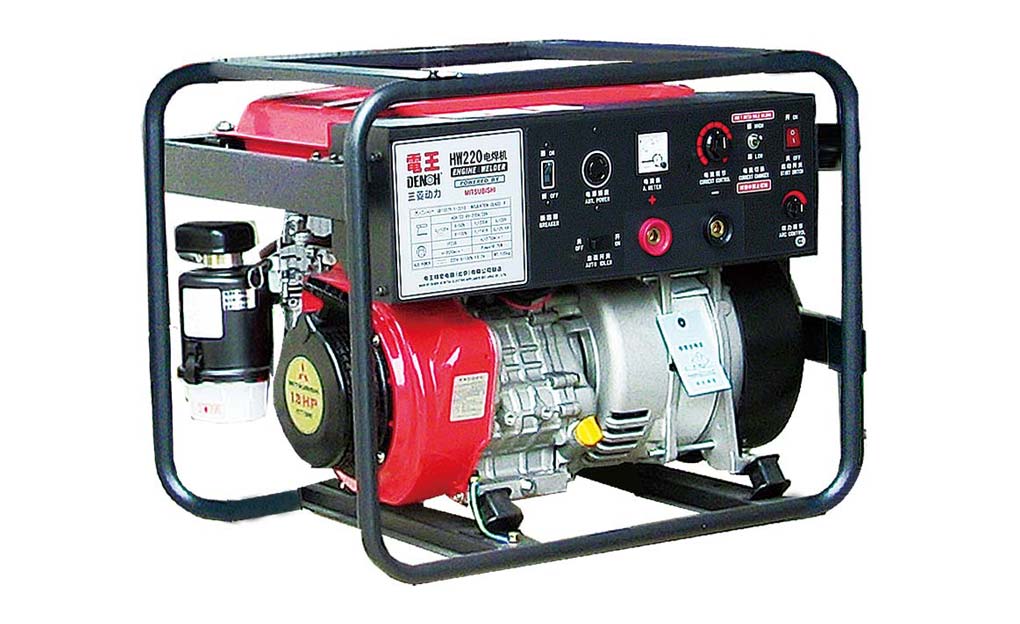
This is the constraint that catches contractors on floating sites. A cage walkway section or a small feed pontoon has a structural weight limit per panel, and the welder is one of the heaviest items on it after the operator. Gasoline sets in the HW series run from roughly 90 kg (HW190, HW200) through 115 kg (HW220) to 165 kg (HW310) and 185 kg (HW380). Diesel sets start at around 165 kg and reach well over 1400 kg at the top of the range. Putting a 600 A diesel set on a walkway rated for personnel and hand tools is not a conservative choice; it is a structural decision that nobody signed off.
| Platform | Realistic weight budget for a welder | Practical machine | Notes |
|---|---|---|---|
| Cage walkway / handrail repair | Up to about 120 kg, plus one operator | HW220 (about 115 kg) or HW190/HW200 (about 90 kg) | Two-person lift; lash the set to the frame before striking an arc |
| Floating pontoon deck | 200–400 kg concentrated load | HW310 (about 165 kg) or HW380 (about 185 kg) | Spread the load on a plate; keep fuel cans off the deck edge |
| Feed barge main deck | Designed for cargo, effectively unlimited | HW320DS or HW450D diesel | Best location for heavy continuous work; cable run down to the cage |
| Jetty head / quay | Unlimited | HW450DS, HW600DS | Dual-operator work on pile caps and fenders |
| RAS hall floor | Unlimited | HW310 gasoline or HW450D diesel | Diesel if three-phase tools are needed; gasoline if the hall is far from the fuel store |
Sizing current for aquaculture work
Aquaculture welding is thinner than pipeline work and dirtier than structural steel work, which pushes the current range down and the arc stability requirement up. The table below converts typical fish farm joints into current, using the standard covered-electrode relationship.
| Joint / component | Electrode | Current | Process note | Model |
|---|---|---|---|---|
| Handrail and thin tube (2–3 mm) | 2.5 mm | 50–90 A | Low current, short arc, watch for burn-through | HW220, HW310 |
| Walkway grating and support angles | 3.2 mm | 90–140 A | Tack first, weld in balanced sequence to limit distortion | HW310, HW380 |
| Cage frame and net-lifting brackets | 3.2–4.0 mm | 90–200 A | Galvanising removed 25 mm either side of the weld | HW380, HW320DS |
| Pontoon deck and hatch coamings | 4.0–5.0 mm | 140–280 A | Continuous run, high duty cycle, weather window pressure | HW450D, HW450DS |
| Pile caps and fender frames | 5.0–6.0 mm | 200–350 A | Heavy sections over water; long cable runs need headroom | HW600DS, HW800DS |
| RAS stainless pipe (sanitary) | TIG, 1.6–2.4 mm filler | 60–140 A (DC) | Purge and back-purge; do not use a carbon steel brush | Dedicated TIG unit; welder supplies auxiliary power only |
Why dual-operator sets suit net-pen fabrication yards
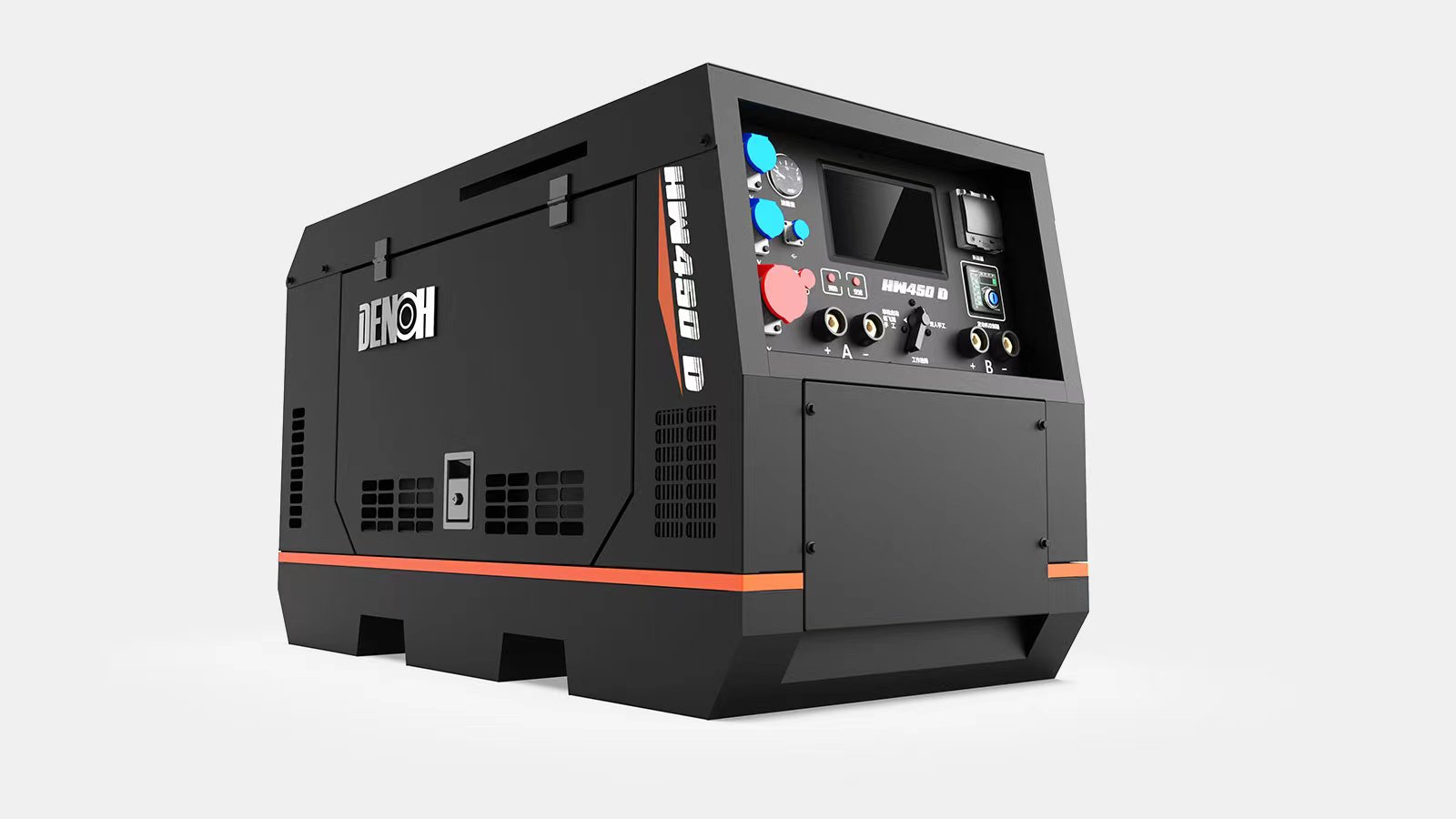
A fabrication yard building cage frames works in jigs: two operators tacking opposite corners, then two operators running fillets on the same frame. A dual-operator diesel set such as the HW320DS (50–320 A, 10 kVA auxiliary) or the HW450DS (50–450 A, 15 kVA auxiliary) matches that workflow exactly. One engine, one fuel drum, one service interval, two arcs. In a yard where the constraint is floor space and fume extraction rather than power, halving the number of engines is a material improvement in air quality as well as in cost.
For on-site cage work the argument reverses. There, portability and deck weight dominate, and a single-operator gasoline set that two people can carry to the repair point is worth more than any productivity gain from a bigger machine.
Power quality matters more than amperage on a modern farm
An aquaculture site is full of electronics: oxygen probes, feed systems, VFD-driven pumps, aeration blowers, camera and sensor networks. A welder running on the same supply as that equipment is a classic source of nuisance faults. Two practices prevent almost all of them: run the welder as an independent source rather than back-feeding the site board, and keep the welding return clamped to the workpiece, never to a structural member that also carries instrument earthing.
Where the welder is also supplying tools, the auxiliary rating becomes the constraint. Gasoline models provide 3 kW DC, which covers a small grinder and task lighting. Diesel models provide 10–30 kVA, usually three-phase, which covers a 230 mm grinder, a magnetic drill or a bevel machine. On a barge where a three-phase tool is needed for a two-hour repair, the diesel set pays for itself in avoided generator hire.
Maintenance in a marine environment
The service interval that works inland will not work on a coastal site. Salt air attacks electrical connectors, corrodes battery terminals and turns a slightly loose fastener into a seized one. The practical routine below is the one that keeps fish farm welders running through a season.
| Interval | Action | Reason |
|---|---|---|
| Every shift | Wash down the enclosure, check air filter, inspect welding leads for chafing | Salt film and abrasive dust destroy filters and insulation |
| Weekly | Clean battery terminals, check earth clamp condition, blow out the alternator | Conductive salt bridging causes phantom electrical faults |
| Monthly | Change engine oil and filter under heavy duty; inspect fuel lines for UV cracking | Marine air accelerates oil degradation and hose ageing |
| Quarterly | Service the fuel system, check AVR and output stability, test auxiliary outlets | Voltage drift damages tools and downstream electronics |
| Seasonally | Full strip inspection, repaint damaged panels, replace all fasteners showing corrosion | Catches structural corrosion before it becomes a failure |
Safety points specific to fish farms
- Carbon monoxide on a barge. Never run a welder in a closed hold, a wheelhouse or an enclosed deck locker. Exhaust must discharge downwind and away from accommodation.
- Wet decks and electrical safety. Use residual-current protection on every auxiliary outlet, keep leads off the deck where possible, and never weld while standing in standing water.
- Tidal and weather windows. Plan the weld so it can be stopped mid-pass; a rising tide does not wait for a cap pass.
- Fuel handling. Fuel drums on a floating structure need bunding and lashing; a drum that goes overboard is an environmental incident, not just a loss.
- Hot work near nets and feed. Netting, feed bags and floatation foam are all combustible. A hot-work permit and a fire watch are not optional on a cage site.
A selection checklist you can send to a supplier
| Question | Why the supplier needs it | Typical fish farm answer |
|---|---|---|
| Onshore, floating or over-water work? | Determines weight, mobility and ingress protection | Mixed: yard fabrication onshore, repairs on floating cages |
| Maximum section thickness and electrode? | Sets the current ceiling | 5.0–6.0 mm on piles; 3.2–4.0 mm on frames |
| One or two operators? | Dual-operator decision | Two in the yard, one on site |
| Three-phase tools required? | Rules gasoline in or out | Yes for the bevel machine and 230 mm grinder |
| Platform load limit? | Prevents an unsafe installation | About 120 kg on walkway sections |
| Salt fog exposure and wash-down routine? | Coating and enclosure specification | Direct spray; wash-down available at the yard only |
| Distance to the nearest service point? | Spares and service strategy | Remote; keep filters, plugs, belts and an AVR on site |
Conclusion
Aquaculture rewards a split fleet rather than a single hero machine. Gasoline sets of 90–185 kg handle handrails, grating and cage frame repairs where the deck cannot carry more. A diesel set of 320–600 A with three-phase auxiliary handles pontoons, pile caps and yard production where the work is heavy and continuous. Around both, the disciplines that decide service life are unglamorous: coating repair on the day of welding, matched fillers, a wash-down routine, and welding returns that never travel through instrumentation earthing. Get those right and an engine driven welder will outlast several cages.
ENGINE WELDER supplies gasoline and diesel engine driven welders from 190 A to 1200 A, including dual-operator and three-phase auxiliary configurations, for coastal fabrication yards, RAS builders and marine contractors. Send us your structures and site conditions and we will propose the configuration.
Contact ENGINE WELDER (Beijing Anjie Weida Technology Co., Ltd.)
Tell us the jobsite, the pipe or section size, the process and the daily joint count, and our engineers will size the machine, the dual-operator configuration and the auxiliary power for you. English-language technical proposals are issued within one working day.
- Tel (landline): 010-86468776
- Phone / WeChat: 13521628344
- Email: sales@denohgroup.com
- Product range: diesel engine driven welders and gasoline engine driven welders
- More field guides: engine welder technical library