A hyperscale data centre is commissioned in months, but the utility substation that feeds it is often energised later than the building. In that gap the site still has to weld: structural steel mezzanines, cooling-water pipework, cable-tray and busway supports, genset exhaust and fuel lines, security fencing and the temporary site infrastructure itself. This is exactly the working condition an engine driven welder was designed for, and on a campus where every week of delay carries a very large commercial cost, the machine choice stops being a purchasing detail and becomes a schedule decision.

Why a data centre site cannot wait for grid power
Data centre construction follows an unusual sequence: the shell and steel go up, the cooling plant and electrical rooms are fitted out, the gensets and switchgear are set, and only then does the utility connection reach full capacity. Even where a temporary supply is available, it is usually sized for construction loads, not for welding. A single 400 A welding set drawing on a shared 250 kVA site transformer will trip protection or dim every temporary light on the campus.
An engine driven welder removes that constraint completely. The machine carries its own generator, so the welding circuit is independent of the site distribution board, the temporary supply contract and the utility energisation date. On a campus with several simultaneous work fronts, that independence is worth more than the machine’s purchase price: it lets the steel crew, the mechanical crew and the electrical contractor work in parallel instead of queueing for a welding outlet.
There is a second, less obvious reason. Data centre halls are built to strict fire and hot-work regimes. A diesel or gasoline welder located outside the building, with the welding cable run in to the work point, keeps the engine, the fuel and the exhaust out of the white space and out of the fire-risk discussion. That is a permitting advantage that site managers value as much as the amperage.
The five welding fronts on a data centre campus
Engine driven welders earn their place on a data centre project because the work is spread across five fronts that rarely share the same power or the same access. The table below maps each front to the process, the typical current and the machine that fits.
| Work front | Typical work | Process and current | Recommended machine |
|---|---|---|---|
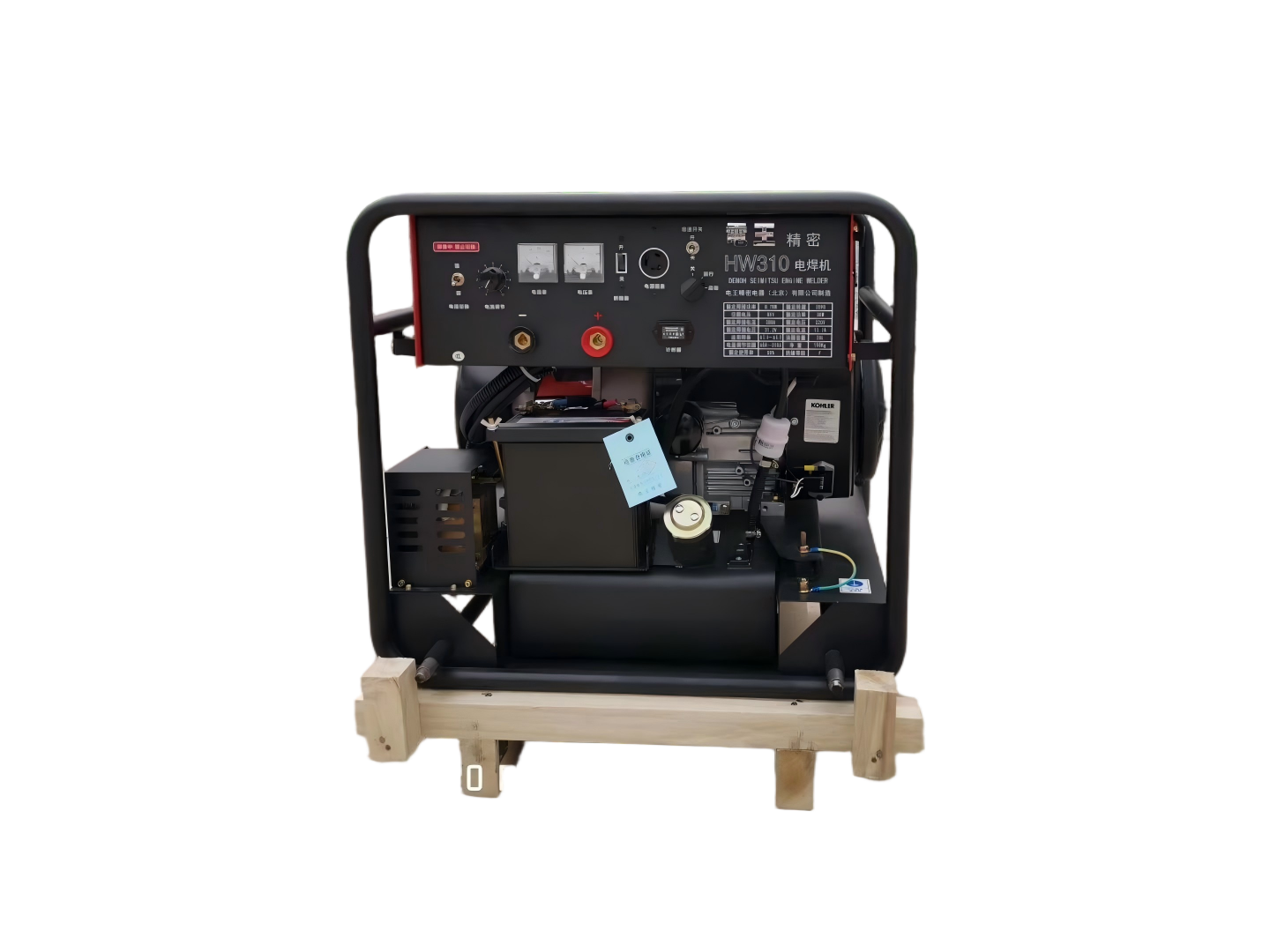
| Structural steel and mezzanine framing | Column splices, bracing gussets, roof steel, equipment platforms | SMAW 3.2–4.0 mm electrode, 90–200 A; occasional 5.0 mm at 200–280 A | HW320DS or HW450D diesel for continuous structural work |
| Cooling water and process pipework | Carbon steel and galvanised pipe spools, supports, hangers, valve stations | SMAW root and fill 90–160 A; TIG root on small bore if specified | HW450DS dual-operator for two pipe crews on one machine |
| Cable tray, busway and containment supports | Unistrut frames, tray brackets, seismic bracing | SMAW 2.5–3.2 mm, 50–140 A, short intermittent arcs | HW310 or HW380 gasoline for light, mobile work inside the building |
| Genset, fuel and exhaust systems | Skid frames, exhaust supports, fuel pipe and day-tank brackets | SMAW 3.2 mm, 90–140 A, plus tack welding | HW450D single operator, 15 kVA auxiliary for grinders |
| Site infrastructure and security | Fencing, gates, temporary walkways, lighting masts, bollards | SMAW 2.5–4.0 mm at 60–180 A, often in wet or muddy ground | HW220 or HW310 gasoline for portability, or HW320DS in monsoon conditions |
Sizing welding current before choosing a model
Most specification errors on a data centre project come from estimating current by habit rather than by electrode. The relationship between electrode diameter and working current is stable for covered electrodes, and it is the fastest way to convert a weld schedule into a machine rating. Add 10–20% headroom for cable length and for operators who run slightly hot, and the model range narrows immediately.
| Electrode diameter | Typical current | Typical joints on a data centre site | Machine class that covers it comfortably |
|---|---|---|---|
| 2.5 mm | 50–90 A | Thin tray brackets, light railing, tack-up | HW190 / HW200 / HW220 gasoline |
| 3.2 mm | 90–140 A | Pipe supports, hangers, general structural fillets | HW310 / HW380 gasoline, HW320DS diesel |
| 4.0 mm | 140–200 A | Column splices, gussets, base plates, pipe fill | HW320DS, HW450D, HW450DS |
| 5.0 mm | 200–280 A | Heavy base plates, thick-wall pipe fill and cap | HW450DS, HW600DS |
| 6.0 mm | 260–350 A | Long structural runs where deposition rate matters | HW600DS, HW800DS |
| 8.0 mm | 350–500 A | Rare on a data centre site, used in heavy fabrication yards | HW800DS, HW1000, HW1200 |
Two rules keep this table honest. First, current at the electrode is not the same as current at the machine: a 50 m welding cable run at 300 A loses enough voltage to make the arc feel cold, so either shorten the run or step up a model. Second, a duty-cycle rating quoted at 60% means the machine can deliver that current for six minutes in ten; if the crew is welding continuously on thick plate, buy for the continuous figure, not the headline figure.
Diesel or gasoline: the decision on a multi-year campus build
A data centre campus is a long programme, often built out in phases over two to four years. That changes the economics of the fuel decision. Gasoline machines are lighter, cheaper and start easily in cold weather, which makes them ideal for the fit-out phase where the crew moves between floors and the machine rides in a service lift or on a pick-up. Diesel machines cost more up front but deliver a 30–35% better fuel efficiency, far longer engine life and the amperage needed for heavy structural work, which is what the steel phase actually requires.
| Criterion | Gasoline engine driven welder | Diesel engine driven welder | What it means on a data centre site |
|---|---|---|---|
| Typical output | 40–380 A (HW190 to HW380) | 50–1200 A (HW320DS to HW1200) | Gasoline covers fit-out and supports; diesel covers steel and heavy pipe |
| Weight | 80–200 kg | 165–1400+ kg | Gasoline can be moved by two people and a pallet truck between floors |
| Auxiliary power | 3 kW DC | 10–30 kVA, three-phase on most models | Diesel runs grinders, lights and heat-shrink tools; gasoline runs hand tools only |
| Fuel economy | Baseline | 30–35% better | On a two-year programme the fuel difference pays for the upgrade |
| Engine life | 2,000–5,000 h | 10,000–15,000+ h | Diesel survives being run all day, every day, for the whole build |
| Noise | 65–75 dB | 70–85 dB, lowered by silent enclosures | Matters at the site boundary and for night work near neighbours |
| Best fit | Fit-out, tray, railing, fencing, small pipe | Structural steel, pipe spools, dual-operator production | Most campuses end up with both types on site |
Where dual-operator output changes the schedule
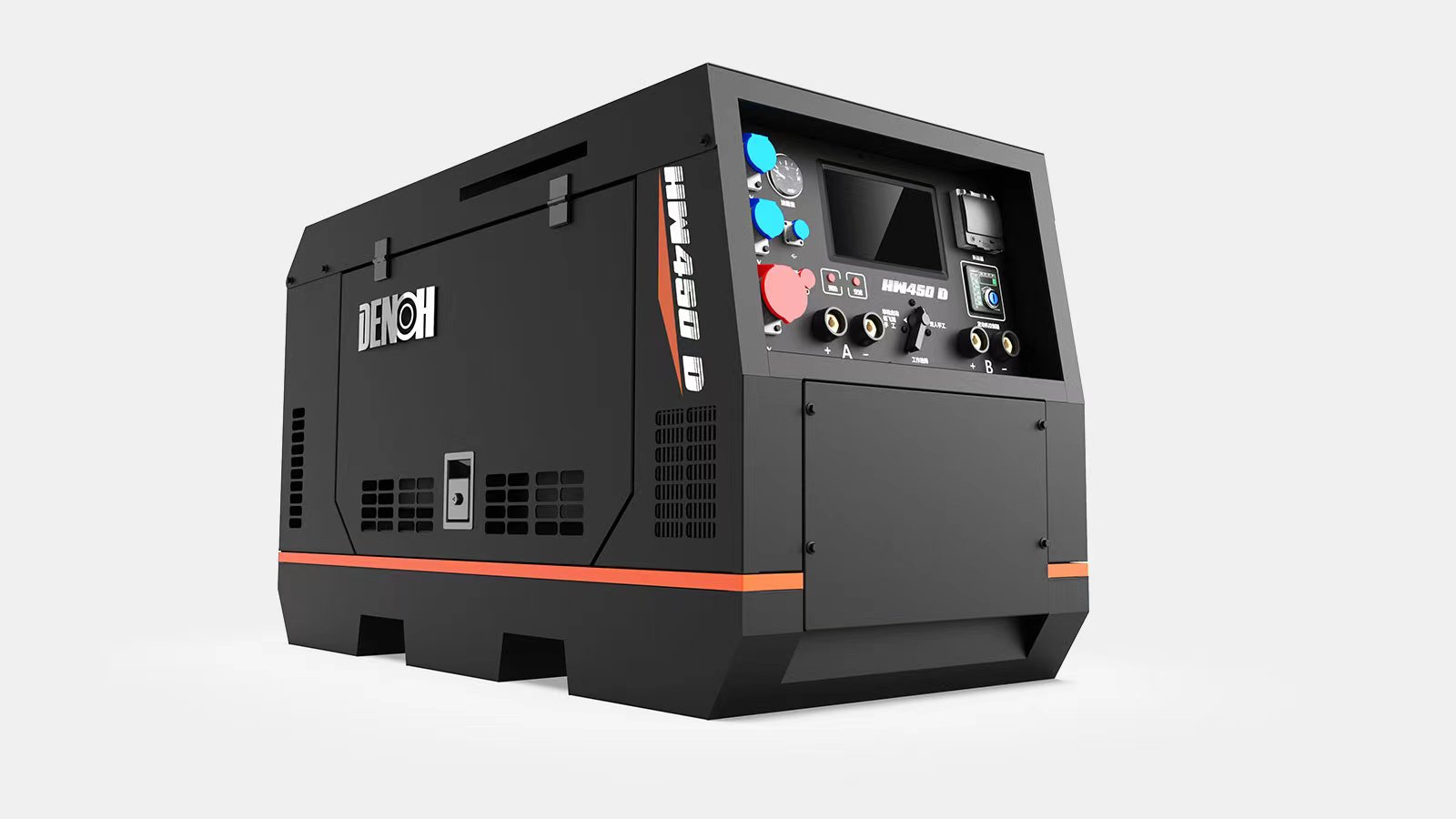
The cooling plant and the process pipework are usually the critical path, because they must be complete before commissioning tests. Two operators welding from one engine cuts the number of machines, the number of fuel trips and the number of hot-work permits in half. Models such as the HW320DS (50–320 A, 10 kVA auxiliary) and the HW450DS (50–450 A, 15 kVA) provide independent outputs so a root pass and a fill pass can run simultaneously without one arc dragging the other down. In practice a two-operator set on pipe supports and spools delivers close to twice the completed joints per shift of a single-operator machine, and it removes the argument about who owns the only welding outlet on the floor.
Auxiliary power is part of the welding package
On a data centre site, the welder is also the power source for the tools around it. Gasoline models in the HW series carry a 3 kW DC auxiliary output, enough for a 100–125 mm grinder, work lights and a small heat gun. Diesel models carry 10–30 kVA, often three-phase, which is enough to run a 230 mm grinder, a magnetic drill, a pipe bevel machine or a bank of task lights, and still weld. The HW450D, for example, pairs a 60–400 A single-operator (40–200 A dual-operator) welding output with a 15 kVA three-phase auxiliary supply on a Yanmar 3TNV88 engine.
Two cautions apply. First, simultaneous welding and full auxiliary load is not free: the engine has a finite output, and the machine’s own literature will state the combined limit. Plan the tool load against that limit rather than discovering it when a breaker trips mid-pass. Second, keep the auxiliary circuit separate from any inverter-fed equipment in the hall. VFDs on cooling pumps and AHU fans are sensitive to voltage distortion, and a welder sharing a temporary board with them is a common source of nuisance trips.
Working inside the building versus outside it
The single most common safety finding on a data centre project is a welder running inside an enclosed space. Carbon monoxide from a gasoline or diesel engine is odourless and accumulates quickly in a plant room, a service corridor or a partially enclosed steel frame. The correct arrangement is always the same: engine outside, welding cable in, work point ventilated, and a gas monitor at the operator’s position if the space is confined.
When the machine must be inside, for example in a basement electrical room, the practical options are limited and should be chosen deliberately: a battery or energy-storage welder for the small work, a cable run from the surface for the rest, or a forced-ventilation plan signed off by the site EHS team. A 3 kW gasoline set in a closed room is not an acceptable third option, however short the job.
Deployment patterns that work on a campus site
| Site condition | Constraint | Practical arrangement |
|---|---|---|
| Steel erection, open frame | Long cable runs, wind, vibration | Diesel set at grade, cable routed on hangers, machine bonded to the steel being welded |
| Plant room fit-out | Confined space, CO risk, fire load | Engine outside the room or on a mezzanine with exhaust ducted out; gas monitor at the arc |
| Cooling pipe spool yard | Two or three crews, one power source | Dual-operator diesel set, spools pre-positioned, welding returns run as short as possible |
| Upper-floor fit-out | No crane access, floor loading limits | Gasoline HW310 (about 165 kg) or HW220 (about 115 kg) on a pallet truck |
| Perimeter and security works | Mud, rain, long distances | Gasoline or diesel set on a trailer, weatherproof canopy, GFCI protection on tools |
| Commissioning phase | Clean hall, no hot work permitted | Weld repairs completed before white-space handover; keep a small set available for off-hall work |
Site power and grounding rules that are often missed
- Bond the workpiece. Structural steel is a good conductor but a poor return path through bolted connections; clamp the return directly to the member being welded.
- Keep welding returns off building earthing and off cable trays. A welding current that travels through a tray system can damage cable insulation and instrumentation.
- Do not back-feed the site board. Engine driven welders should run as independent sources unless the changeover arrangement has been designed and approved.
- Protect the auxiliary outlets. On wet decks and in unfinished buildings, use residual-current protection on every tool fed from the welder.
- Control fuel storage. A day tank plus a bunded store, kept away from hot work and from the temporary electrical rooms.
Selection checklist for the procurement package
| Question | Why it matters | Typical answer on a data centre build |
|---|---|---|
| What is the maximum electrode and the thickest section? | Sets the current ceiling | 4.0–5.0 mm, 140–280 A, with occasional 6.0 mm |
| How many operators weld at once? | Drives the dual-operator decision | One per crew; two crews on the cooling-water package |
| Is the auxiliary load three-phase? | Rules out gasoline models | Yes on diesel fronts: grinders, magnetic drill, bevel machine |
| How far is the work point from the machine? | Cable sizing and voltage drop | 20–50 m, sometimes 80 m in a large hall |
| What is the ambient and altitude envelope? | Derating and cooling | Standard at grade; higher altitude sites need derating |
| Who maintains it, and where are the parts? | Uptime over a multi-year programme | Site mechanic with dealer support; keep filters, plugs and belts on site |
| Is night work expected? | Noise limits and lighting | Yes in fit-out; silent enclosure and directional lighting |
Conclusion
On a data centre campus the engine driven welder is not a support item, it is the reason the steel, the pipework and the supports can be built before the utility arrives. Choose diesel for the structural and pipe fronts where continuous heavy current and long engine life matter; choose gasoline for the fit-out, the supports and the work that has to travel between floors. Where the cooling-water package is on the critical path, a dual-operator diesel set will return more schedule than any other single purchase on the welding side. The rest is discipline: current sized from the electrode, returns clamped to the work, engines kept outside enclosed spaces, and fuel and hot-work controls that survive an audit.
ENGINE WELDER builds both families for exactly this duty, from the 190 A gasoline sets to the 1200 A diesel sets, with dual-operator and three-phase auxiliary configurations for sites that need them. Send us your work fronts and weld schedule and we will size the package.
Contact ENGINE WELDER (Beijing Anjie Weida Technology Co., Ltd.)
Tell us the jobsite, the pipe or section size, the process and the daily joint count, and our engineers will size the machine, the dual-operator configuration and the auxiliary power for you. English-language technical proposals are issued within one working day.
- Tel (landline): 010-86468776
- Phone / WeChat: 13521628344
- Email: sales@denohgroup.com
- Product range: diesel engine driven welders and gasoline engine driven welders
- More field guides: engine welder technical library