Why One Machine, Two Arcs Changes the Math on Remote Job Sites
Field welding lives and dies by a simple constraint: how many qualified joints you can close before the light goes or the weather turns. A single-operator engine driven welder keeps one arc burning at a time. When a crew needs throughput, the traditional answer has been to haul two separate machines, double the fuel, double the weight, and double the maintenance surface. The dual-operator diesel engine driven welder removes that trade-off by running two independent arcs from one engine and one fuel tank.
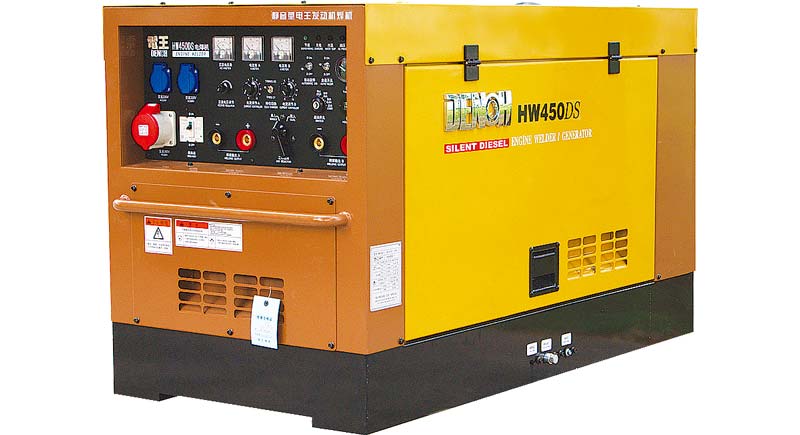
The ENGINE WELDER HW450DS is built around exactly this idea. It is a 400A class diesel generator-welder that lets two welders work side by side on the same piece of steel, on the same machine, without the arcs interfering with each other. For structural steel erection, fabrication yards, and pipeline tie-in work, that capability translates directly into schedule gains.
How Independent Dual-ArC Control Works
On the HW450DS, the two welding outputs are electrically separated. In double-operator mode each side is adjustable from 30 to 200 DCA, and each operator controls their own current without affecting the other’s arc. In single-operator mode the full 60 to 400 DCA range is available for heavy root passes or large electrodes. The decoupling means a fitter running a 90A tack-up on one side does not drag down a welder laying a 160A fill pass on the other.
- Two isolated welding circuits share one Kubota diesel engine and one 37-litre fuel tank.
- Single mode: 60–400 DCA for demanding root and fill work.
- Double mode: 30–200 DCA on each side, independently adjustable.
- Welding and 380V auxiliary output can run at the same time within engine capacity.
The Powertrain Behind the HW450DS
At the core is a Kubota D1105, a four-stroke, three-cylinder liquid-cooled diesel rated at 29.5 HP at 3000 rpm. Liquid cooling keeps exhaust temperatures and component stress manageable during long duty cycles, which matters when the machine runs a full shift in summer heat. Direct coupling between engine and generator removes belt losses and reduces the number of wearing parts. The alternator is brushless, which cuts routine servicing and improves reliability in dusty field conditions.
An energy-saving device provides automatic start and stop of the welding function when the arc is not active, reducing idle fuel burn and noise on the site. Brushless excitation and an F-class insulation system with IP23 protection are specified for outdoor use.
Auxiliary Power: More Than Just Welding
Beyond the welding arcs, the HW450DS delivers 15.0 KW of three-phase 380V auxiliary power at 80 percent duty cycle. That output can run grinders, lights, small pumps, or a magnetic drill while welding continues. On a remote tie-in or a fabrication pad without grid access, a single machine becomes the site’s power hub as well as its welding source.
| Parameter | HW450DS specification |
|---|---|
| Rated welding power | 12.38 KW |
| Rated welding current | 360 DCA |
| Rated welding voltage | 34.4 DCV |
| Open-circuit voltage | 80 DCV |
| Duty cycle (welding) | 50% |
| Current range – single | 60–400 DCA |
| Current range – double | (30–200) × 2 DCA |
| Auxiliary power | 15.0 KW / 380V / 21.7A / 80% |
| Engine | Kubota D1105, 4-stroke 3-cyl |
| Displacement | 1123 CC |
| Rated engine output | 29.5 HP @ 3000 rpm |
| Starting / fuel / cooling | Electric / Diesel / Water-cooled |
| Fuel tank | 37 L |
| Dimensions (L×W×H) | 1530 × 710 × 865 mm |
| Net weight | 510 Kg |
| Battery | 12V – 48AH |
| Protection / insulation | IP23 / Class F |
Where the Dual Operator Pays Off
Consider a structural steel repair where two joints sit a few metres apart. With one single-operator machine, the second joint waits. With the HW450DS, both joints are welded in parallel. On a pipeline tie-in, one operator can root while the second caps, compressing the hold-and-inspect window. In a fabrication yard, the machine can weld on one bench and power a band saw on another.
- Structural steel erection and field repairs where two welders are on the same assembly.
- Pipeline tie-ins and valve sets where root-and-cap sequencing speeds handover.
- Fabrication yards needing welding plus shop power from one source.
- Remote infrastructure where transporting two machines is costly.
Field Operating Notes
- Size the electrode to the current band: double mode favours 2.5–3.2 mm electrodes per side.
- Keep the 37 L tank topped on long shifts; auxiliary loads shorten runtime when both arcs and tools run.
- Use the automatic start/stop feature during fit-up gaps to save fuel and cut noise.
- Schedule coolant and oil checks per the engine hour meter, not the calendar.
Talk to the Technical Team
For datasheets, a written quotation, or an on-site demonstration of the HW450DS dual-operator diesel engine driven welder, reach out through the channels below.
- Phone / landline: 010-86468776
- Email: denoh@126.com
- Website: https://www.denohgroup.com/contact/