Field welding has always lived or died by one factor: a dependable source of power. On a pipeline right-of-way, a remote substation, or a storm-damaged distribution network, the nearest utility socket can be kilometers away. Running long extension cords or towing a separate generator plus a conventional welder is slow, fuel-hungry, and hard to manage. The ENGINE WELDER concept collapses three pieces of equipment – engine, alternator, and welding power source – into a single wheeled unit. This article examines the gasoline branch of that family, using the HW310 300A gasoline engine-driven welder as a concrete reference, and explains why a self-contained gasoline platform stays a practical choice for utility crews, rental fleets, and emergency-response teams.
1. The Integrated Machine Concept
The defining idea behind an engine-driven welder is integration. A four-stroke gasoline engine is directly coupled to a brushless inductor-type alternator. The alternator produces a stable three-phase supply that is conditioned into a DC welding output and, in parallel, an AC auxiliary outlet. There is no belt, no clutch, and no separate trailer to tow. Because excitation is brushless and inductor-based, the unit avoids the wear and sparking associated with carbon brushes – a meaningful advantage when a machine must run a full shift in dust, humidity, or light rain.
Direct coupling also removes a common failure point. Power flows straight from crankshaft to rotor, so efficiency stays high and maintenance stays simple. For a crew that cannot afford a breakdown fifty kilometers from the depot, that mechanical simplicity is part of the value proposition.
2. Welding Performance You Can Plan Around
The HW310 sits in the 300-ampere class. Its descending (CC) characteristic covers a welding current range of roughly 60–310 A, with a rated welding current of 280 A at 31.2 V DC and a 50% duty cycle. Built-in arc-force (arc blow) adjustment keeps the arc stable and limits spatter across electrode types. The machine handles cellulose electrodes for downhill pipe welding, low-hydrogen electrodes, and scratch-start TIG, and it sustains long runs of cellulosic downhill welding without the arc fading.
A high/low current selector switch lets the operator change range without stopping the engine or swapping quick-connect plugs – a small detail that saves real minutes on a tie-in. The 85 V open-circuit voltage is enough to re-strike the arc reliably while staying within a sensible envelope for field safety.
3. Auxiliary Power That Keeps the Crew Working
Beyond the weld, the HW310 delivers a 3 kW / 220 V auxiliary circuit at 100% duty cycle. That outlet powers grinders, floodlights, drills, and pumps while the weld is in progress, so a two-person crew can prep, weld, and clean up without a second machine. On a remote job the auxiliary circuit often does as much work as the weld itself – running the site lighting and the angle grinder is what turns a welding task into a finished joint.
4. Portability and Field Readiness
Compact dimensions of about 730 × 620 × 718 mm and a dry weight near 165 kg put the HW310 in the “one operator can load it” category next to heavier diesel siblings. A standard wheel kit and electric start (Kohler CH20S, 20 HP, 624 cc, air-cooled) mean a single technician can deploy it from a service van, top it up with unleaded gasoline from a jerry can, and be welding within minutes. The 20 L tank supports a full working day of intermittent use, and the air-cooled layout removes the radiator, coolant, and freeze-risk that diesel water-cooling brings to cold climates.
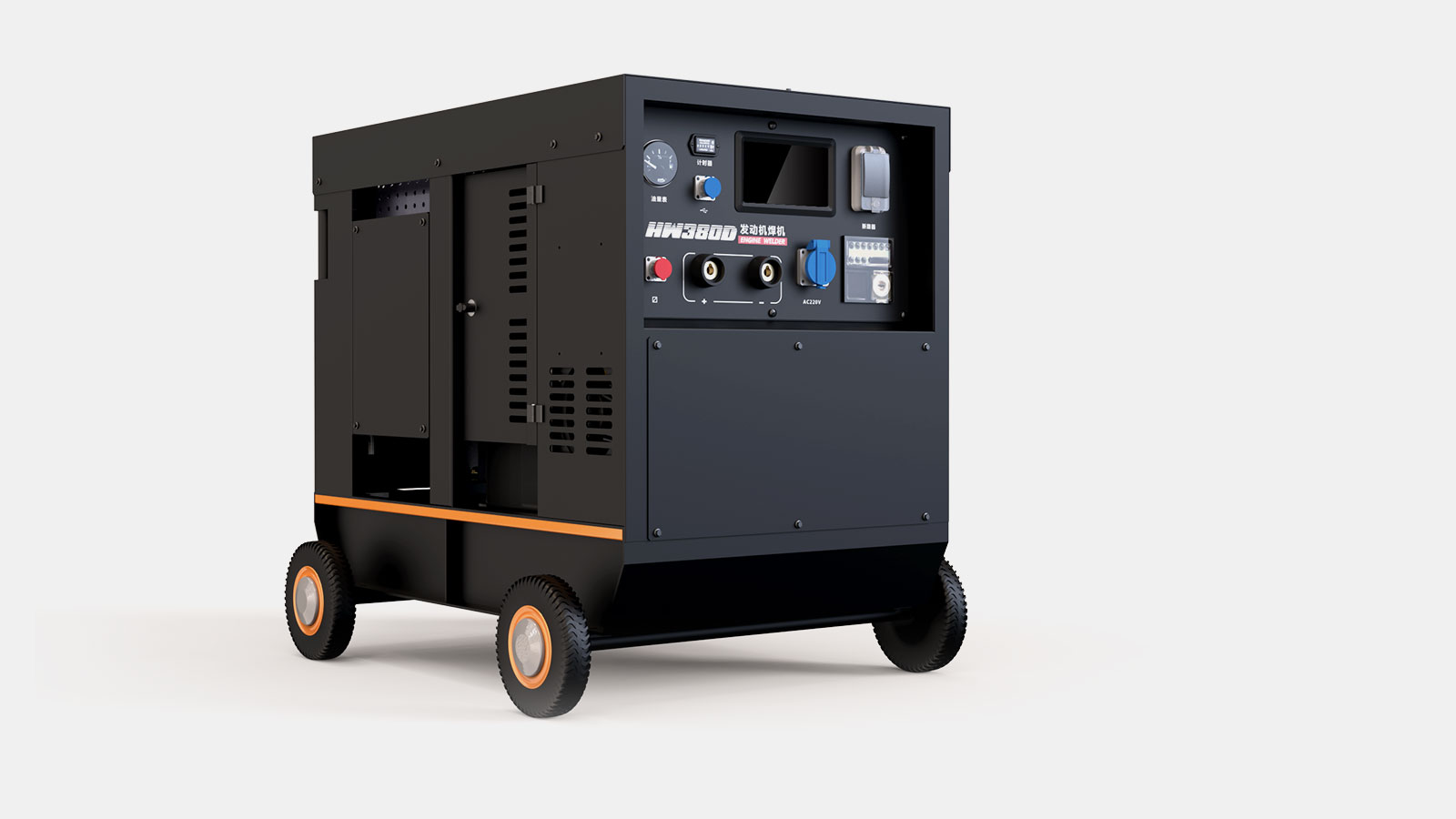
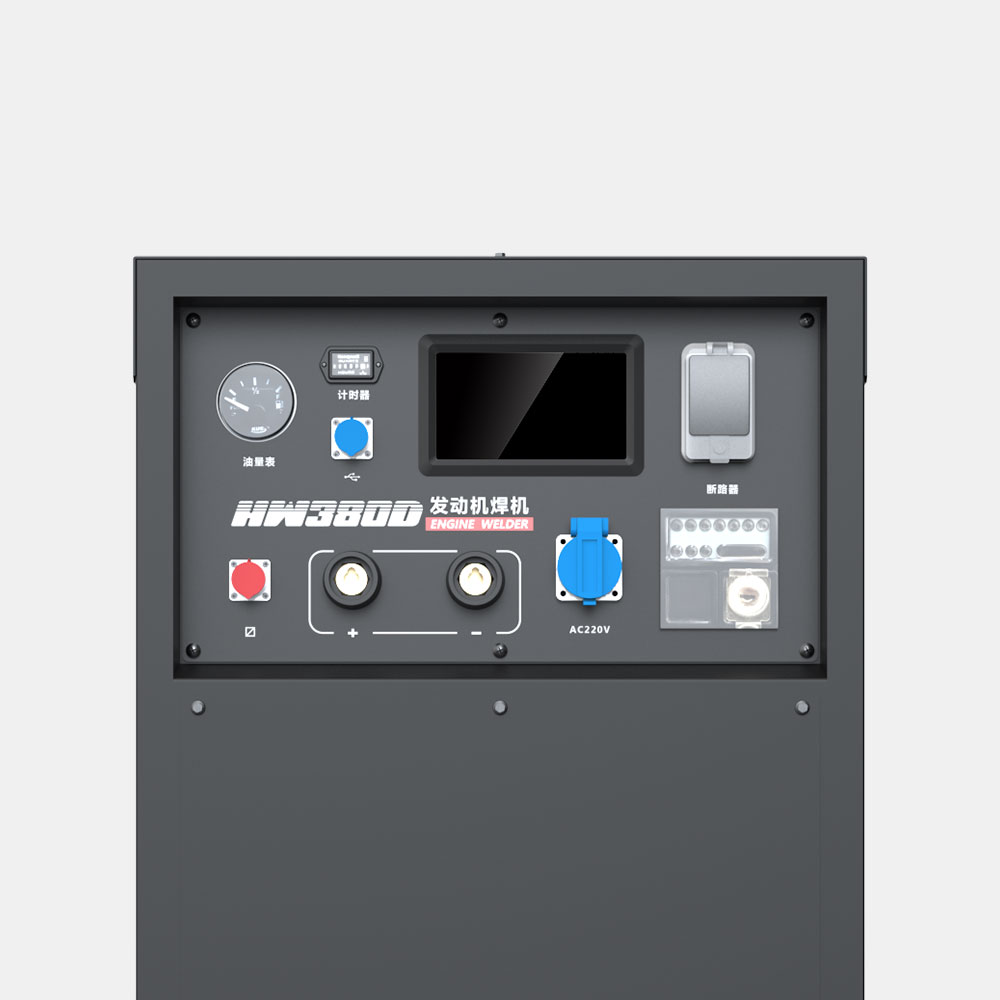
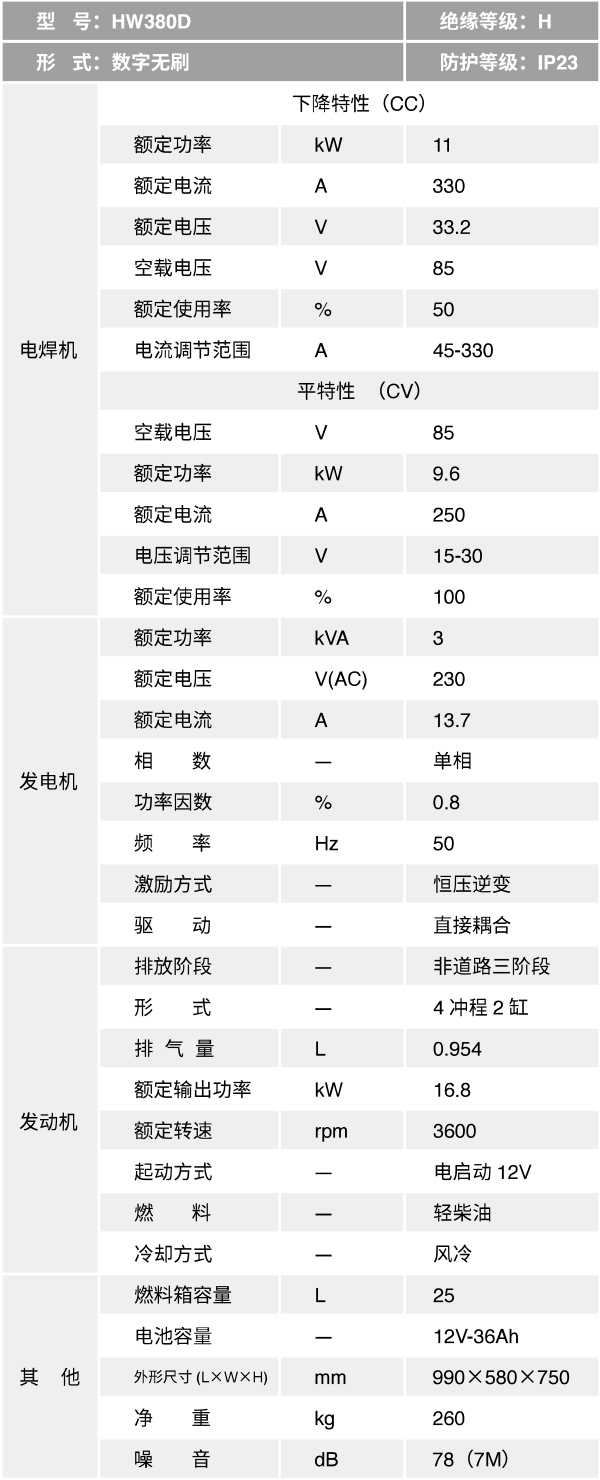
The gasoline line also includes higher-current variants such as the HW380 (350 A class), shown in the photos above as a representative of the same portable platform. For crews that need more deposition without leaving the gasoline format, those models extend the family upward.
5. Where the Gasoline Platform Earns Its Keep
Consider a municipal crew repairing a broken service line at 2 a.m. The nearest building power is disconnected for safety. A gasoline engine-driven welder rolls out of the truck, starts on the first try, and supplies both the root-pass weld and the floodlight from the same fuel. Or a rural co-op restoring a downed pole: the same unit welds the bracket, runs the cut-off wheel, and charges the crew’s battery tools. For rental houses, the familiarity of gasoline – common fuel, lighter weight, simpler emissions profile in some regions – keeps utilization high and training short.
- Emergency repair of distribution and service lines
- Pipeline tie-ins and valve stations away from grid power
- Rural grid restoration after weather events
- Telecom tower and utility-pole steel fabrication
- Rental-fleet general SMAW and light FCAW work
6. Key Specifications – HW310EW
| Item | Specification |
|---|---|
| Welding current range | 60–310 A (DCA) |
| Rated current / voltage | 280 A / 31.2 V DC |
| Open-circuit voltage | 85 V DC |
| Rated welding power | 8.7 kW |
| Duty cycle (welding) | 50% |
| Auxiliary power | 3.0 kW / 220 V, 100% duty cycle |
| Excitation | Brushless, inductor-type |
| Drive | Direct coupling |
| Protection class | IP21 |
| Engine | KOHLER CH20S, 4-stroke, 2-cylinder |
| Displacement / power | 624 cc / 20 HP |
| Speed | 3580 rpm |
| Start / fuel | Electric / Unleaded gasoline |
| Cooling | Air-cooled |
| Fuel tank | 20 L |
| Dimensions (L×W×H) | 730 × 620 × 718 mm |
| Weight | 165 kg |
| Wheel kit | Standard |
Contact & Consultation
For specifications, quotation, and delivery lead time of the ENGINE WELDER engine-driven welder range, please reach the technical team directly:
- Telephone: 010-86468776
- Email: sales@denohgroup.com
- Contact page: https://www.denohgroup.com/contact/
Our application engineers help you match welder model, current class, and auxiliary power to your jobsite.