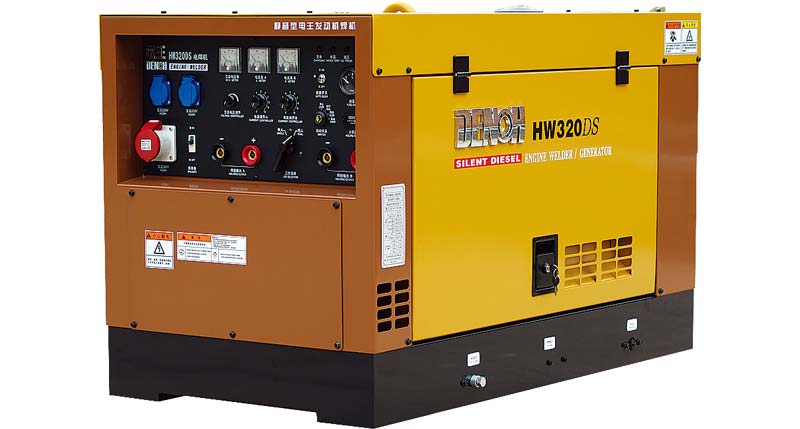
Field pipeline construction is unforgiving. Crews work hundreds of kilometres from the nearest stable power supply, weather windows are short, and every stalled joint delays the whole stringing operation. The HW320DS diesel engine driven welder from ENGINE WELDER was engineered for exactly this reality: a self-contained welding and power unit that travels with the crew, starts in remote sites, and delivers stable DC arc performance without any dependency on grid electricity. This article examines the design, the field behaviour, and the practical reasons contractor teams keep choosing this class of machine for spread-length pipeline work.
1. Core Specifications at a Glance
The HW320DS pairs a brushless welding generator with a Kubota D905 three-cylinder diesel engine. It provides a rated welding current of 280 A (DC) with an adjustable range from 45 to 300 A, which covers the large majority of field joints on small- and mid-diameter pipelines, as well as structural steel and repair work.
| Welding rated power | 8.7 kW |
| Rated welding current | 280 A (DC) |
| Rated welding voltage | 31.2 V (DC) |
| Open-circuit voltage | 75 V (DC) |
| Duty cycle | 50% |
| Current range | 45-300 A (DC) |
| Auxiliary power | 10.0 kW / 380 V (DC) |
| Auxiliary duty cycle | 80% |
| Engine | Kubota D905, 3-cyl, 898 cc, 19 HP |
| Fuel tank | 37 L |
| Dimensions (LxWxH) | 1300 x 710 x 803 mm |
| Net weight | 410 kg |
| Battery | 12 V – 36 AH |
2. Dual Output: Weld and Power at the Same Time
One of the practical advantages of the HW320DS is that welding and auxiliary power are available together. While the operator welds, the 10 kW auxiliary outlet can run angle grinders, work lights, magnetic drills or small pumps. On a pipeline right-of-way this removes the need for a separate generator, which in turn cuts trailer load, fuel consumption and the number of machines to maintain.
The unit can supply 50 Hz 10 kVA three-phase power together with 3.3 kW x 2 single-phase auxiliary outlets, covering most hand tools used at a weld station. Because the auxiliary circuit is rated to an 80% duty cycle, it is dependable for sustained tool use rather than only brief peaks.
3. Engine and Arc Stability
The Kubota D905 is a liquid-cooled, three-cylinder industrial diesel. Its 19 HP output at 3000 rpm is matched to the welder load so the engine holds speed under arc fluctuation. Direct coupling between engine and generator removes belt wear and slip, while the brushless design reduces the maintenance points that normally fail first in dusty, damp field conditions. The result is a predictable DC arc from 45 A root passes up to 300 A fill and cap passes.
4. Built for Harsh Field Conditions
- Brushless excitation and direct coupling reduce maintenance points in dusty, damp environments.
- IP23 protection and class F insulation support outdoor operation.
- Electric start with a 12 V battery gives reliable cold-weather starting.
- A 37 L fuel tank gives extended running time between refills on long spreads.
- Compact 410 kg footprint allows transport by a small service truck between stringing areas.
5. A Practical Field Case
On a municipal water pipeline rehabilitation project, a two-person crew used the HW320DS for socket and fillet welds on steel mains. With the auxiliary outlet powering an angle grinder and a work light, the crew completed joint preparation and welding without a second machine. The stable 45-300 A range handled both root and fill passes with cellulosic electrodes, and the compact footprint let the unit move easily between stringing areas. Compared with running a dedicated generator alongside a grid-dependent welder, the crew reported fewer setup moves and simpler refuelling logistics.
6. Maintenance That Keeps You Working
Field reliability comes from disciplined, low-complexity maintenance. Recommended practice for the HW320DS includes daily checks of coolant and fuel levels, periodic replacement of fuel and air filters, and keeping the battery charged between jobs. Because the machine is brushless and directly coupled, there are no commutator or belt items to service. A simple pre-start checklist is usually enough to avoid the failures that cause costly downtime on a spread.
7. Selection Notes and Comparison
Choose the HW320DS when your work is mid-current field welding (up to roughly 300 A) and you want one machine to also cover site power. The table below places it against two siblings in the same series so you can see where each fits.
| Model | Max welding current | Aux power | Dual operator | Weight |
| HW320DS | 300 A | 10 kW | No | 410 kg |
| HW450DS | 400 A | 15 kW | Yes | 510 kg |
| HW600DS | 600 A | 20 kW | Yes | 900 kg |
8. Frequently Asked Questions
- Can it weld and run tools at the same time? Yes. Welding and the 10 kW auxiliary outlet operate simultaneously.
- What electrodes suit it? Cellulosic and basic electrodes within the 45-300 A range are typical for pipeline root and fill passes.
- How is it moved on site? At 410 kg it is transported by service truck or skid; no crane is needed for routine repositioning.
- Is it certified? The design follows compulsory product certification (CCC) requirements for the domestic market.
9. Productivity and Operating Cost
Beyond the specification sheet, what matters to a contractor is cost per completed joint. The HW320DS is positioned for spread-length work where one machine must cover both welding and site power. Compared with running a separate engine-driven welder plus a towed generator, the combined unit reduces fuel burn because a single diesel engine serves both loads. With a 37 L tank and a roughly 19 HP engine, typical field duty gives a full working shift between refuels for moderate welding plus tool use. Crews also recover the trailer space and avoid the second machine’s maintenance. When estimating total cost of ownership, factor fuel, filter service and the avoided cost of a second generator rather than only the purchase price.
10. Compliance, Emissions and Jobsite Safety
The HW320DS follows compulsory product certification (CCC) requirements for the domestic market, and the IP23 enclosure with class F insulation supports outdoor deployment. Operators should still respect basic field safety: keep the unit on stable, level ground; maintain clearance around the radiator for cooling air; and never refuel a hot engine. DC welding carries the usual electric-shock precautions, so dry gloves, insulated leads and a properly bonded work clamp remain mandatory. Because the machine is diesel and water-cooled, it presents less spark risk than petrol units in hazardous areas, but site hot-work permit rules still apply.
11. Pre-Purchase Checklist for Contractors
Before specifying the HW320DS, confirm three points: the maximum root-and-fill current your procedure needs (stay within the 45-300 A envelope); the auxiliary load profile of your weld station (the 10 kW outlet covers most hand tools but not large compressors); and how the unit will be transported and lifted on site (410 kg moves on a service truck, no crane for routine moves). Also check spare-parts availability for the Kubota D905 in your region and agree a preventive-maintenance interval with your supplier.
12. More Frequently Asked Questions
- Does it need a separate generator for tools? No. The 10 kW auxiliary outlet runs typical hand tools such as grinders and drills.
- How does it start in cold weather? The 12 V electric start and water-cooled diesel start reliably in cold climates when winter-grade coolant and correct oil are used.
- Is special training required? Standard DC stick procedure applies; no certification beyond normal welding qualifications is needed.
- Can the auxiliary outlet run a compressor? Only small units; size larger compressors against the 10 kW limit.
13. Field Troubleshooting: What to Check First
When arc problems appear on a spread, work from the simplest causes outward. First confirm the work clamp is clean and tightly bonded to the pipe – a poor ground is the most common cause of unstable arcs and porosity. Next check the electrode and lead connections, then the engine speed under load; a sagging governor shows up as a weak arc at higher current. If the auxiliary outlet drops voltage under load, verify the total tool draw stays within the 10 kW limit. Most stoppages are resolved without parts, which is why a short pre-shift checklist pays for itself in uptime.
14. Why Crews Standardize on One Engine-Welder Platform
Larger contractors often standardize on a single engine-welder family so operators, spares and service procedures carry across jobs. The HW320DS fits the lower-current end of that family; when a project steps up to dual-operator or higher current, the same brand’s HW450DS or HW600DS covers it without retraining the crew on a different control layout. Standardization reduces training, spare-parts variety and the learning curve on each new spread, which quietly improves both safety and throughput over a season.
15. Welding Procedure and Quality Records
Pipeline specifications increasingly demand repeatable parameters. The stable 45-300 A envelope of the HW320DS lets you lock root and fill settings for cellulosic and basic electrodes, which simplifies the quality procedure and lowers the risk of rejected welds at acceptance. Documenting the setting per joint becomes straightforward when the equipment holds the values without mid-weld trimming, and that consistency is what inspectors look for on a records review.
Contact Us
For technical consultation, quotation and field demo of the ENGINE WELDER engine driven welder series, please reach out to our team:
- Phone: 010-86468776
- Email: sales@denohgroup.com
- Website: https://www.denohgroup.com/contact/