Introduction
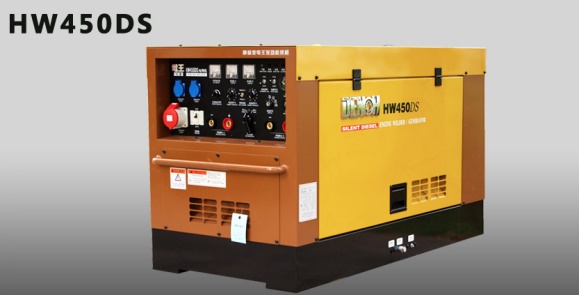
In the field of pipeline construction, dual-operator diesel welding generators must simultaneously deliver high current output, stable auxiliary AC power, and precise digital current regulation. The ENGINE WELDER HW450D addresses these demands through its proprietary IGBT digital Buck chopping topology combined with a dual closed-loop patented control system ( Invention Patent No. ZL 2019 1 0681162.9). This article provides an in-depth technical analysis of how these systems function and why they matter for field welding operations.
1. What Is Buck Topology and Why It Matters for Welding
Buck (step-down) topology is a DC-DC converter topology that efficiently reduces input voltage while delivering controlled output current. In welding applications, the HW450D’s main circuit uses Buck topology as its core power conversion platform, managed by IGBT switching elements operating at precise duty cycles.
Compared to traditional SCR-phase-controlled welders, Buck+IGBT offers three critical advantages:
- Faster dynamic response: IGBT switching frequencies allow the controller to adjust arc current within milliseconds, compensating for changes in arc length caused by operator movement or electrode consumption.
- Higher efficiency: IGBT losses at the switching stage are significantly lower than SCR phase-control, reducing fuel consumption during extended field operations.
- Wider current range: The HW450D achieves a single-operator welding current range of 60–400 A DCA and dual-operator range of (40–200) × 2 A DCA from the same hardware platform.
2. Dual Closed-Loop Patented Control System
The HW450D’s dual closed-loop system continuously monitors two key variables simultaneously: arc voltage and welding current. The outer loop maintains the target current set by the operator, while the inner loop adjusts IGBT switching parameters to compensate for engine speed fluctuations and load transients.
When the engine rpm dips under heavy auxiliary load (e.g., simultaneous use of an external power tool), the inner loop anticipates the voltage sag before it affects arc stability — preventing the arc from going out during critical weld passes. This is particularly important for cellulose electrode down-hand welding, where arc interruption creates weld defects that are costly to repair in the field.
3. DFJ Low-Splash Waveform Control Technology
The HW450D incorporates DFJ (Low Splash) waveform control technology, which shapes the short-circuit transfer and spray transfer phases of the welding arc. DFJ reduces spatter by approximately 30–40% compared to conventional waveforms, resulting in:
- Less post-weld cleaning and slag removal time
- Reduced filler wire consumption
- Improved weld bead appearance, especially on out-of-position welds
DFJ also supports semi-automatic flux-cored wire self-shielded (FCAW-S) welding, making the HW450D adaptable to a broader range of field welding codes and procedures.
4. Dual-Operator Simultaneous Welding: Technical Design
One of the most technically challenging aspects of dual-operator welding machines is ensuring that two separate arcs do not interfere with each other. The HW450D solves this through isolated current regulation paths for each holder circuit:
- Each operator independently selects a current setting (30–200 A) via the front panel
- Digital closed-loop circuits for each path are decoupled to prevent cross-talk
- Both operators can weld simultaneously at full rated current without the engine stalling, thanks to the 22/26.8 kW engine power reserve
The 75 L fuel tank provides extended run time for long pipeline sections between refueling stops.
5. Technical Specifications Overview
| Parameter | Single Operator | Dual Operator |
| Welding Current Range | 60–400 A DCA | (40–200) × 2 A DCA |
| Rated Power | 12.4 kW | — |
| Rated Voltage | 34.4 V DC | 28 V DC |
| No-Load Voltage | 85 V DC | — |
| Rated Duty Cycle | 50% | 50% |
| Auxiliary AC Output | 15.0 kVA / 400 V / 50 Hz / 80% duty | |
| Engine | 4-cylinder, water-cooled diesel / 1.372–1.642 L / 22–26.8 kW @ 3000 rpm | |
| Fuel Tank | 75 L | |
| Weight | 550 kg | |
| Protection / Insulation | IP23 / Class H | |
6. Field Applications and Use Cases
The HW450D’s combination of digital control and high auxiliary power output makes it suitable for:
- Long-distance oil & gas pipelines: Dual-operator configuration doubles weld joint production rate on field joints and tie-in welds.
- Urban pipeline construction: The 400 V auxiliary output powers electric rebar benders and concrete vibrators, eliminating the need for a separate generator.
- Bridge and structural welding: The H-class insulation rating and IP23 protection allow operation in outdoor environments with rain and dust.
- Disaster relief and emergency repair: Fast startup via electric start (12 V) and high fuel efficiency reduce logistical burden in remote areas.
Conclusion
The ENGINE WELDER HW450D represents a significant step forward in dual-operator diesel welding technology. Its IGBT Buck topology, dual closed-loop patented control, and DFJ waveform technology combine to deliver stable, efficient, and adaptable welding performance across the most demanding field environments.
For technical inquiries, specifications, or project consultation, contact our team:
Phone: 010-86468776
Email: denoh@126.com
Website: https://www.denohgroup.com/contact/