

When the winter freeze line moves across a pipeline region, welding spreads stop, demobilize and leave their machines parked for weeks or months. The projects that restart fastest in spring are not the ones with the newest machines — they are the ones whose fleet was mothballed properly in November. A pipeline automatic welding fleet degrades in storage differently than it wears in production: batteries self-discharge silently, seals dry out, condensation attacks electronics, and the first weld of the new season pays for every skipped preservation step. This guide turns seasonal shutdown and reactivation into an engineering discipline for the four machine classes of the DENVO / ENGINE WELDER pipeline automatic welding line: the single-torch external welder (DW-EW-I), the dual-torch external welder (DW-EW-II), the battery-powered internal welding machine (DW-EH48/56), the flexible internal welding machine (DW48/56-8H-D), and the automatic TIG orbital welding machine.
Why the Shutdown Season Decides Next Season’s Welding
Between spreads and between seasons, machines sit. An idle machine does not accumulate weld meters, but it does accumulate damage: lithium cells discharge below safe thresholds, rack teeth corrode where grease has migrated away, rubber seals take a permanent set, and electronics absorb moisture through unheated containers. None of this shows on the daily inspection sheet — it shows at first arc in spring, as drift, faults or scrap joints. The economic argument is simple: preservation costs hours per machine per year; a failed restart costs days of production and one bad reputation with the client’s QA team.
What Actually Degrades While a Machine Sits
Before writing a shutdown plan, know the failure modes. The map below lists the dominant idle-degradation mechanisms and where they surface on restart:
| Degradation mechanism | Machines most exposed | What happens while idle | First symptom at restart |
|---|---|---|---|
| Battery self-discharge | DW-EH48/56 (lithium), DW48/56-8H-D (230AH×3 groups), wireless remotes | Cell voltage drifts down month by month; deep discharge shortens service life | Machine refuses to power up or shows reduced runtime |
| Corrosion of precision motion | External welder carts and split ring tracks (rack-and-pinion) | Condensation on gear teeth and guides; grease washes off or hardens | Jerky travel, position drift, uneven bead at 6 o’clock |
| Condensation in electronics | All machines — touchscreens, controllers, remote receivers | Cold containers breathe with day-night cycles; moisture condenses on boards | Intermittent faults, display errors, communication drops |
| Seal and hose aging | Internal welder hydraulic clamping systems (5–7MPa) | O-rings and hoses take a set, hydraulic fluid settles | Slow or unequal clamping pressure on first setups |
| Gas system contamination | Battery internal welder (30L onboard cylinder), TIG gas lines | Valves left open leak; residual moisture enters lines | Porosity in first root passes |
| Data and configuration loss | Dual-torch multi-channel parameter library, single-torch touchscreen | Stored sets remain, but backups are not updated; batteries of record-keeping tools die | Parameter sets must be re-entered by hand |
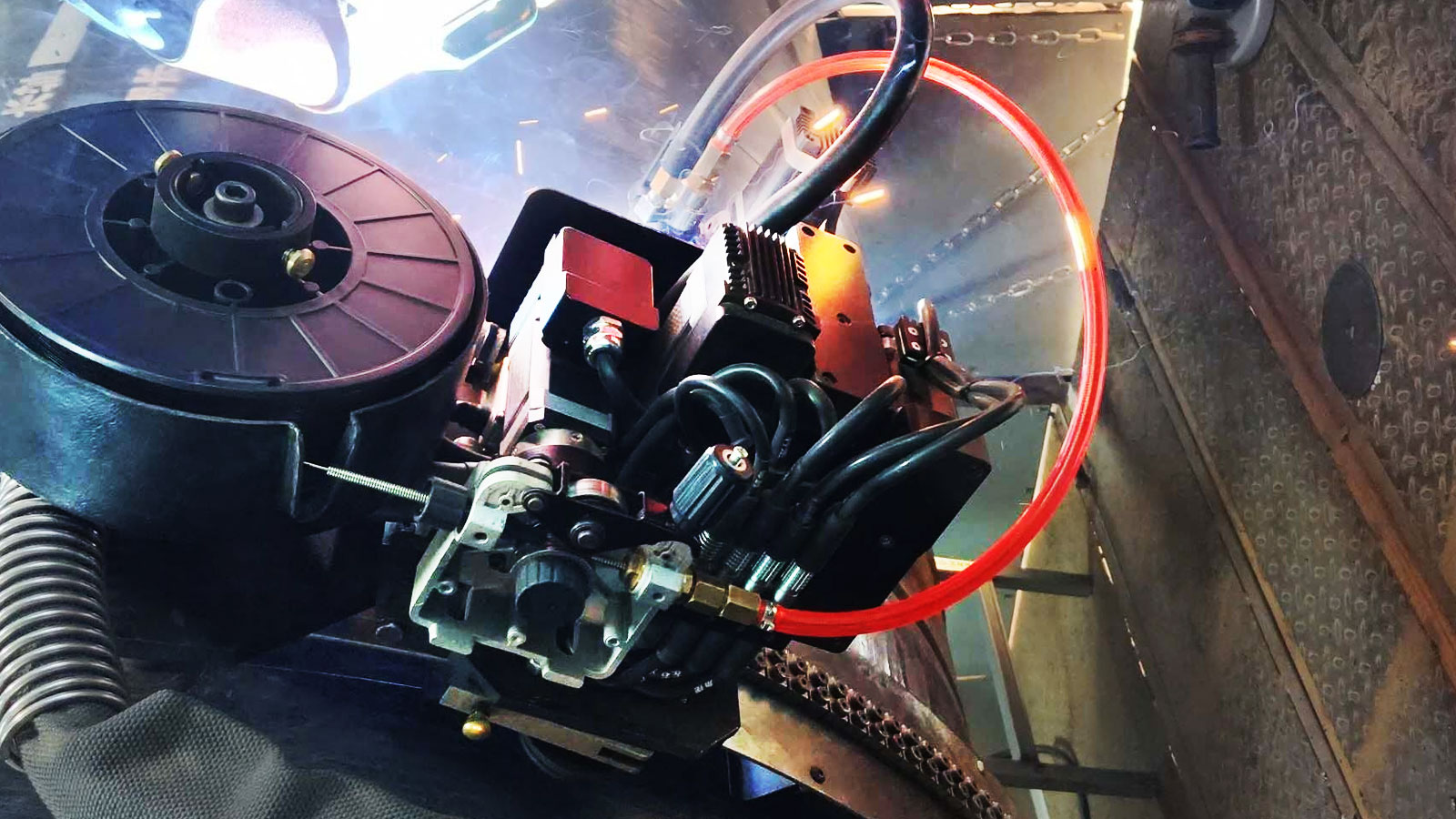
Single-Torch External Welder: Store the Track Like a Precision Tool
Track and rack care
The DW-EW-I rides on a perforated steel track with single-gear rack drive. Its accuracy lives in the gear mesh, so preservation starts there: clean rack teeth, re-grease per the maintenance manual, and store track segments indoors on racks — not on ground or in snow. Split segments are an advantage here: each piece can be inspected, tagged by diameter, and stored on edge where it cannot collect standing water. The split ring design that speeds field assembly also makes off-season inspection fast.
Cart, touchscreen and cables
The lightweight cart is dust-protected by design, but storage adds risks dust alone does not: bag the cart, keep the visualization touchscreen out of direct frost cycles, and coil cables loosely — tight coils in cold weather take memory and crack in spring. Before shutdown, upload the current parameter sets through the touchscreen interface and archive them off the machine; the touchscreen supports data upload and download, and an archived parameter file is cheaper than re-deriving one in February.
Dual-Torch External Welder: Back Up the Parameter Library Before You Power Down
Export the multi-channel data
The DW-EW-II stores process parameters in multiple channels with storage, recall, import and export. The shutdown rule: export every validated parameter set for every diameter and wall thickness the spread ran, verify the export opens on a second computer, and store two copies in two places. In spring, a verified import returns the machine to production without re-qualification — the fastest possible restart is the one that starts from proven parameters instead of a blank screen.
Two torches, one shared consumables kit
Dual-torch machines carry twice the torch hardware, but consumables are standardized across the single- and dual-torch family. Build one shutdown consumables kit: remove contact tips and nozzles, clean and bag them, and inventory spares against next season’s diameter plan. Protect the arc tracking system — its sensor path is the most dust- and moisture-sensitive part of the carriage — and cover it rather than wrapping the whole machine in plastic where condensation can collect.
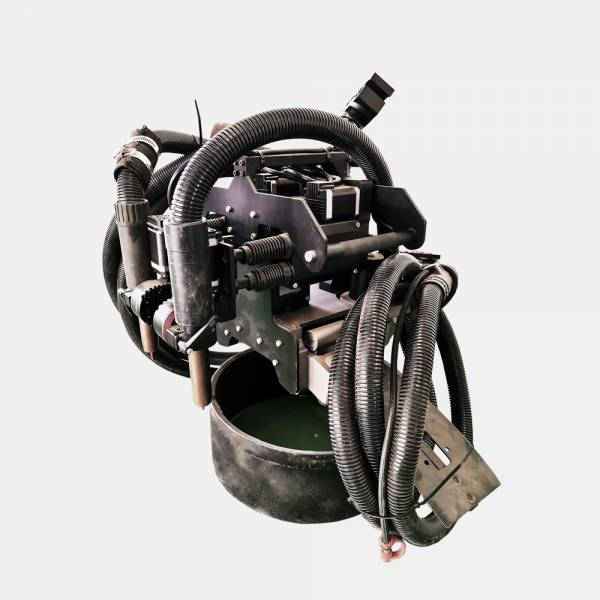
Battery Internal Welder: Lithium Care Is the Whole Shutdown Plan
Charge state, temperature and humidity
For the DW-EH48/56, battery management dominates the preservation plan. General industry practice for long lithium storage is to keep cells at a partial state of charge — commonly around 40–60% — and to top them up on a periodic schedule rather than leaving them full or empty; confirm the exact interval with the manufacturer. The machine is rated to operate from −40°C to 65°C at altitudes to 4000m and humidity up to 90%, but an operating envelope is not a storage endorsement: a dry, ventilated room out of frost cycles is always better than a container in the open. Remove the wireless remote units and store their batteries separately per site practice.
Gas cylinder and hydraulics
The 30L onboard shielding gas cylinder should be valve-closed for storage, and site rules govern whether it stays mounted or moves to a dedicated gas storage area — the safer reading of most site HSE rules is: cylinder off the machine, in the designated cage. Cycle the hydraulic clamping system once before shutdown so seals are lubricated, and record clamping pressure behavior; the 5–7MPa working pressure should return unchanged at restart, and any drift found in spring is traceable to a known baseline.
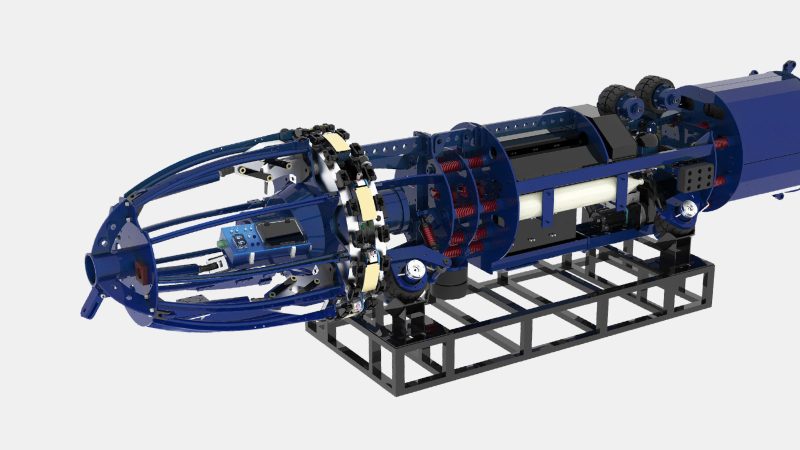
Flexible Internal Welder: Compact Body, Same Battery Discipline
230AH×3 groups and DC24V care
The DW48/56-8H-D carries 230AH×3 battery groups at DC24V and a servo-electric drive. The same partial-charge discipline applies to all three groups — a fleet of battery packs ages unevenly, and one neglected group can hold the whole machine hostage. Its electromagnetic brake and wireless remote units get the same treatment as on any machine: remotes cleared of batteries, brake function tested at reactivation before any grade work. The compact 2400kg body is easy to store well: it fits standard containers and workshops, so there is no excuse for outdoor storage.
Specification snapshot for storage planning
| Parameter | DW48/56-8H-D (flexible) | DW-EH48/56 (battery) |
|---|---|---|
| Pipe diameter | Φ1219–Φ1422mm | Φ1219–Φ1422mm |
| Welding units | 8 | 8 |
| Battery | 230AH×3 groups, DC24V | Lithium battery group, electric + hydraulic |
| Operating temperature | −50°C to 65°C | −40°C to 65°C |
| Operating humidity | Site range per specification | ≤90% |
| Altitude | 0–3500m | ≤4000m |
| Weight / size | 2400kg, 4600×1250×1200mm | 2950kg, 5200×1200×1100mm |
| Clamping pressure | 5–7MPa hydraulic | 5–7MPa hydraulic |
| Gas | External supply per procedure | 30L onboard cylinder |

Automatic TIG Welder: Small Machine, Simple Rules
The automatic TIG orbital welding machine has no separate public data sheet — its shutdown and restart follow the welding procedure specification and general practice. Remove tungsten electrodes, cap gas lines after purging residual moisture, and store the power source in a dry room like any precision electronics package. For root passes on small diameters and tie-ins, the TIG units are the first machines wanted at restart, so give them a marked shelf location instead of burying them under seasonal stock.
Shutdown Gates: From Last Weld to Sealed
A shutdown is a mini-commissioning in reverse. Run it as gates, and sign each one:
| Gate | Action | Evidence recorded |
|---|---|---|
| G1 — Last production weld | Final inspection of last joints; note any drift already visible | Joint reports; known issues list |
| G2 — Cleaning | Weld spatter off torches and carriages; dust off electronics housings; clean tracks | Photos before storage |
| G3 — Battery and power | Set lithium packs to storage charge per practice; remove remote batteries; disconnect external power sources | Battery charge log |
| G4 — Data | Export parameter libraries (dual-torch channels, single-torch touchscreen sets); verify and archive two copies | Archive checksum or copy location |
| G5 — Mechanical | Re-grease racks; cycle hydraulic clamps; inspect seals; cap gas lines; close cylinders | Maintenance sheet |
| G6 — Storage placement | Indoor, dry, ventilated, off ground, machines covered — not wrapped airtight; gas cylinder to cage | Storage location register |
Storage Environment: What the Temperature Ratings Do and Don’t Mean
The internal welders are specified for operation down to −40°C and −50°C respectively. That is an operating envelope with powered systems and controlled conditions — it is not permission to store machines outdoors under snow. The storage rule that matters is the condensation rule: machines in unheated spaces breathe with the weather, and repeated frost-thaw cycles move moisture onto boards, into connectors and onto rack teeth. Store the fleet indoors, dry and ventilated, machines raised off the floor and covered with breathable covers. Where nothing better exists, a container on pallets with desiccant beats a machine on open ground — but treat any such compromise as temporary and inspect monthly.
Reactivation Timeline: From Silence to First Production Weld
| Window | Stage | Content |
|---|---|---|
| T−7 days | Wake-up inspection | Visual check, battery recharge to working state, cable and hose condition, track re-grease check |
| T−5 days | Power-on and dry run | Powered systems test, touchscreen and remote check, carriage travel without arc, dual-torch tracking sensor check |
| T−3 days | Trial welds | Joints on project pipe per WPS; verify clamping pressure, gas flow and bead quality against last-season baselines |
| T−1 day | Sign-off | QA review of trial joints; parameter import verified; readiness documented |
| T+0 | First production weld | First joints under normal supervision frequency; compare against restart baselines |
Ten-Point Mothballing Checklist
- Lithium packs set to storage charge; recharge schedule assigned to a named person
- Wireless remote units cleared of batteries and bagged
- Track segments cleaned, re-greased, stored indoors on racks
- Carriages bagged; touchscreens and controllers out of frost cycles
- Dual-torch parameter channels exported, verified and archived in two places
- Single-torch touchscreen parameter sets uploaded and archived
- Hydraulic clamping cycled once; seal condition recorded
- 30L gas cylinder valve closed and moved to the designated cage per site rules
- TIG units de-electroded, gas lines purged and capped, stored on a marked shelf
- Storage register opened: location, environment, monthly inspection owner
Frequently Asked Questions
Can the internal welders simply stay outside all winter since they are rated to −50°C?
No. The −40°C and −50°C figures are operating envelopes — powered machines under controlled conditions, not storage endorsements. What kills a parked machine is not cold itself but frost-thaw condensation on electronics and rack teeth. Indoor dry storage costs almost nothing and removes the largest restart risk.
How should the lithium batteries be stored over the winter?
General industry practice: partial state of charge (commonly around 40–60%), periodic top-ups on a schedule, dry and temperature-stable storage, batteries removed from remotes and small devices. Confirm the exact interval and charge level with the manufacturer for the DW-EH48/56 and the 230AH×3 groups of the DW48/56-8H-D — the principle is universal, the interval is specific.
What is the fastest safe path to first weld in spring?
Start from data, not memory: import the archived parameter sets, run the dry-run sequence, then trial welds per WPS on project pipe. The reactivation table above fits in a week; the variable is usually not the machine but whether the battery and gas infrastructure at the new site is ready.
What is worth checking on the dual-torch machine beyond the usual items?
Two things. First, the parameter library: export and verify before shutdown, import and re-verify at restart — two arcs with two synchronized channels amplify any re-entry mistake. Second, the arc tracking sensor path: it is the most contamination-sensitive part of the carriage, so clean, cover and re-check it before the first dual-torch joint.
Conclusion: the Fleet That Winters Well, Welds First
Seasonal shutdown is the cheapest quality program a pipeline welding fleet will ever run: hours of preservation versus days of restart losses. Modular external welders live or die by their tracks and parameter archives; dual-torch machines add the parameter library and the tracking sensor; battery internal welders concentrate everything into lithium discipline; the flexible machine rewards compact indoor storage; and the TIG units simply ask for dry shelves. Run the six gates, keep the ten-point checklist honest, and the first weld of the new season looks like the last weld of the old one — which is exactly what your client’s QA team will notice.
Beijing Anjie Weida Technology Co., Ltd. (DENOH Group) — pipeline automatic welding equipment: single- and dual-torch external welders, battery and flexible internal welding machines, automatic TIG systems.
Tel: 010-86468776 | WhatsApp/WeChat: 13521628344 | Email: sales@denohgroup.com | Contact page