
Engine Driven Welder for EV Charging Station Construction: Site Power, Earthing and Steel Installation
Electric vehicle charging sites are built in phases, and the welding work almost always starts long before the utility supply is energised. Canopy frames, cable tray supports, cabinet plinths, bollards, trench covers and earthing networks must be completed while the site is still a construction zone with no reliable mains power. An engine driven welder supplies both the welding arc and auxiliary electricity from one machine, which is why it is a standard piece of kit for electrical contractors and steel fabricators working on EV infrastructure.
This guide looks at the actual weld scopes on an EV charging project, how to match a machine to those scopes, how welding interacts with the earthing and bonding design, and what to check before the site is handed over. It is written for contractors who need a practical selection framework rather than a generic product comparison.
1. Where an Engine Driven Welder Fits in an EV Project
A charging station project usually moves through four overlapping stages. The engine driven welder is useful in each of them, but for different reasons.
- Stage 1 – civic works: trenching, duct banks, manholes and reinforcement steel for transformer plinths. Power is needed at the edge of the site, often before any temporary supply exists.
- Stage 2 – structural steel: parking canopy columns and beams, lighting gantries, signage frames and cable tray brackets. Welds are dispersed across a large area, so moving a generator plus a separate welder to each point wastes time.
- Stage 3 – electrical installation: cabinet bases, earth electrodes, bonding of metallic services, and support steel for cable routes. Here the auxiliary outlet matters as much as the welding output because grinders, drills and temporary lighting run all day.
- Stage 4 – commissioning support: last-minute modifications to brackets, damaged coatings after cable pulling, and emergency repairs during the energisation window.
The common thread is that the work front moves faster than the permanent electrical installation. A self-powered welding package removes the dependency on extension leads and site transformers.
2. Weld Scopes on a Charging Site
Not every weld on an EV site is a pressure weld or a structural weld. Most are small, short and repeated. That pattern favours a machine that starts quickly, holds a stable arc at moderate current and can also run tools.
| Work package | Typical joint | Why mobile power wins | Key acceptance concern |
|---|---|---|---|
| Canopy and gantry steel | Column base plates, beam splices, bracket fillet welds | Work fronts spread across the whole car park | Fit-up, weld size, coating restoration |
| Cabinet and plinth frames | Channel frames, anchor angles, door stiffeners | No mains supply near the equipment row | Flatness and corrosion protection |
| Cable tray and ladder supports | Short fillet welds on wall and rack brackets | Hundreds of small welds at changing locations | Repeatability and fast repositioning |
| Earthing and bonding | Earth electrode connections, bonding straps to steelwork | Continuity must be verified before backfill | Electrical continuity, not weld appearance |
| Bollards and protection frames | Post-to-plate welds, guard rails | Outdoor, remote corners of the site | Impact resistance and coating life |
| Emergency modifications | Cutting, grinding and re-welding during commissioning | One machine covers both arc and tools | Documentation of the change |
The last row is often overlooked. A machine that can weld and then immediately supply a grinder avoids a second mobilisation during the most time-sensitive week of the project.
3. Choosing the Machine Class
DENOH engine driven welder product listings group diesel engine driven machines by welding current and auxiliary output. The figures below are taken from the published product information; confirm the current data sheet before placing an order.
| Class | Welding current (as listed) | Auxiliary output | Where it fits on an EV site |
|---|---|---|---|
| HW320DS | 45-300 A adjustable, 280 A rated point on the standard listing | 10 kVA three-phase plus 3.3 kW single-phase | Small retail sites, canopy brackets, night work in noise-sensitive areas |
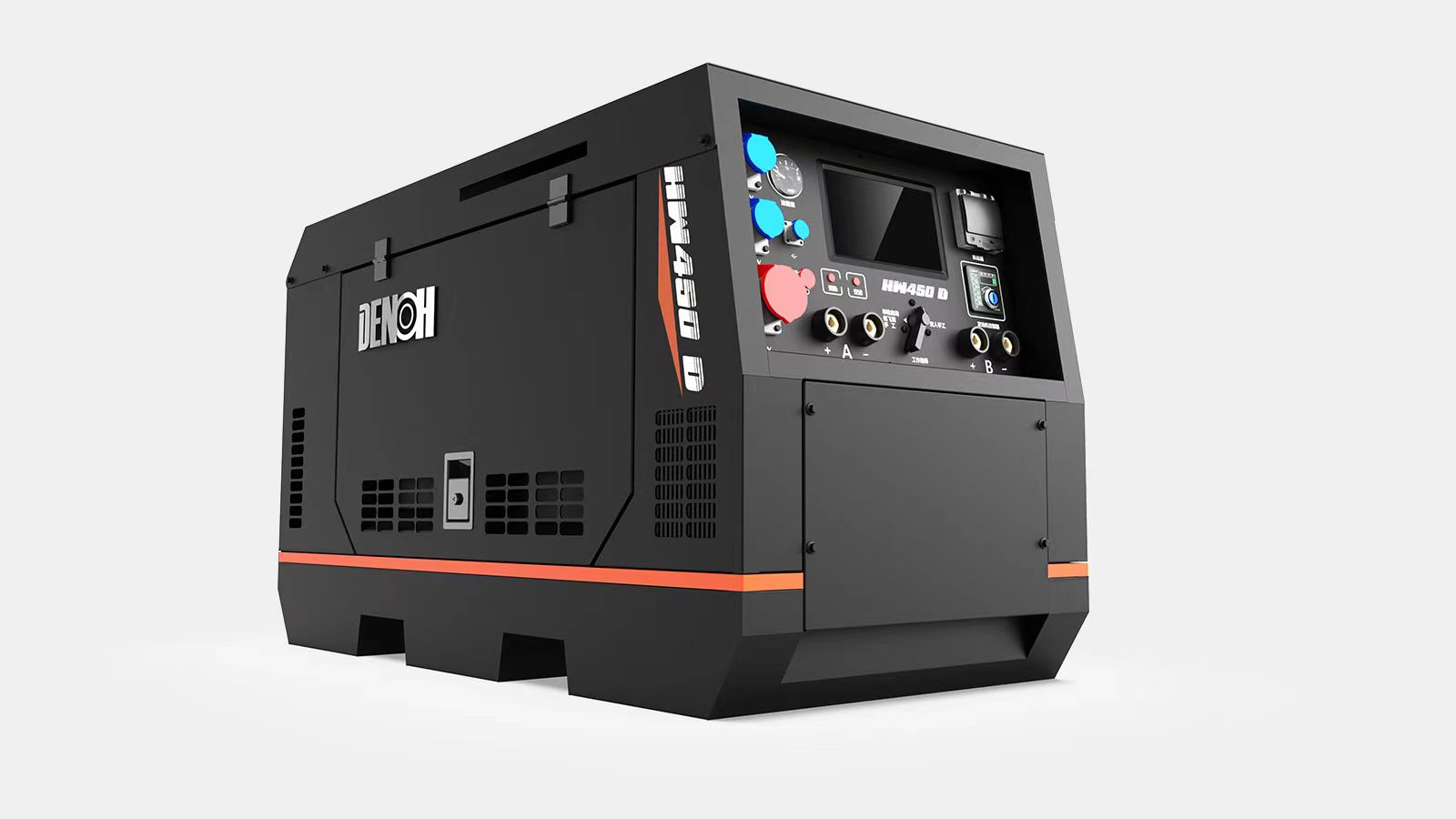
| HW450D | Roughly 60-400 A single-handle class | 15 kVA class | Main canopy steel, plinth frames, multi-trade crews |
| HW600DS / HW800DS | 500-800 A class | 20-30 kVA class | Large depot canopies, heavy steel, simultaneous tool loads |
The HW320DS is a useful reference point because its published sheet combines a Kubota D905 water-cooled diesel, a 40 L tank, at least eight hours of full-load operation, a noise figure around 72 dB(A) at 7 m, and an operating band of -30 C to +50 C. Those are exactly the characteristics a suburban charging site needs when work continues after shop hours. See the HW320DS product page for the full specification.
For larger fleet depots where steel fabrication and site power overlap, the HW450D and HW600DS classes provide the current and auxiliary capacity to keep grinders, pumps and lighting running without a separate generator.
4. Earthing and Bonding: Where Welding Has Consequences
EV charging installations are unusually sensitive to earthing quality. A welded connection may be mechanically sound but electrically unreliable if the mating surfaces are painted, galvanised or coated after welding. Treat the weld and the bonding path as two separate deliverables.
4.1 Practical rules
- Bond metallic cabinet frames, cable tray and structural steel to the site earth system using designated bonding conductors or listed clamps – do not assume a fillet weld is the only bonding path.
- Where a weld is part of the bonding route, clean the surfaces to bright metal before welding and verify continuity with a low-resistance tester afterwards.
- Measure electrode resistance before backfilling. Once the trench is closed, remediation is expensive.
- Keep welding current away from data and communication cables. Route the work lead close to the electrode lead and avoid using steel reinforcement or cable trays as a return path.
- Restore corrosion protection on every weld in the earthing network. A corroded bond fails silently and is rarely caught during visual inspection.
The machine itself must also be integrated correctly into the temporary supply arrangement. An engine driven welder with an auxiliary outlet is a source, not a socket; its frame and neutral-earth arrangement should follow the site temporary-power plan and local regulations.
5. Pre-Start Selection Checklist
- List the largest electrode diameter and the corresponding current range you will actually use.
- Estimate duty cycle from the number and length of welds per shift, not from the machine nameplate alone.
- Add the auxiliary loads that will run at the same time: grinders, drills, lighting, pumps.
- Check the distance from the machine to the work and plan cable runs to limit voltage drop.
- Confirm local noise limits for evening and weekend work; a silent diesel unit may be required.
- Confirm fuel logistics and refuelling intervals for a full shift.
- Check access width and weight limits for the areas the machine must enter.
- Verify that the site has a designated welding permit and fire-watch arrangement.
6. Deployment Patterns
| Site type | Constraint | Recommended approach |
|---|---|---|
| Retail car park retrofit | Live trading hours, noise complaints | Silent HW320DS class, short evening shifts, central cable routing |
| Fleet depot | Large canopy, dispersed steelwork | HW450D class with auxiliary power for tools; two welding positions if needed |
| Motorway service area | No grid point near the works, long runs | HW600DS class with high auxiliary capacity and planned fuel stops |
| Port or logistics yard | Heavy protection frames, dusty environment | HW600DS / HW800DS class, strengthened air filtration and cleaning routine |

7. Quality and Handover Discipline
Charging sites are handed over to electrical commissioning teams, not only to structural inspectors. That changes the documentation burden.
- Use a written welding procedure for structural and canopy work, even when the welds are short.
- Record which welder made which joint, especially on canopy steel and earth connections.
- Visually inspect welds before coating. Repair damaged zinc or paint using a compatible system.
- Keep a separate continuity test record for bonding points; photographs alone are not sufficient.
- Log any modification made during commissioning and update the as-built drawings.
8. Common Mistakes
- Choosing a machine by maximum current alone, then discovering the auxiliary output cannot run the tools.
- Welding galvanised steel without removing coating at the joint and restoring it afterwards.
- Using the steel frame as a welding-current return path near sensitive electronics.
- Sizing the machine for a best-case shift and ignoring high ambient temperature or altitude.
- Leaving the earth bond connection for the last day, when the trench is already closed.
9. Frequently Asked Questions
Can one engine driven welder run tools at the same time as welding?
Yes, provided the combined load stays within the machine’s rated welding and auxiliary outputs. Check both ratings separately; they are not interchangeable.
Is a gasoline unit enough for a small charging site?
For light bracket work and short shifts, a compact gasoline welder can be sufficient. For canopy steel, long shifts or continuous auxiliary loads, a diesel unit is usually the better fit.
How noisy is a silent diesel welding unit?
The HW320DS listing gives a figure around 72 dB(A) at 7 m. Always confirm the exact configuration and local night-time limits before scheduling evening work.
Can a welded joint replace a bonding conductor?
Not by default. Bonding must be designed, installed and tested as an electrical system. A weld may contribute to continuity, but it should not be the only documented path.
Do I need a separate generator on site?
Often no. A machine with 10-15 kVA of auxiliary output can run most construction tools and lighting, provided the loads are planned and started in sequence.
10. Conclusion
An engine driven welder is not just a backup power source on an EV charging project. It is the tool that lets structural, electrical and commissioning crews work before the grid arrives and continue when the site layout changes. Match the machine class to the weld scope, plan the auxiliary load, and treat earthing as a tested system rather than a by-product of welding.
DENOH Group supplies engine driven welders from compact silent units to high-current diesel machines for field construction. To discuss a charging-site configuration, contact the team below.
Beijing Anjie Weida Technology Co., Ltd. (DENOH Group)
Tel (landline): 010-86468776
Phone / WeChat: 13521628344
Email: sales@denohgroup.com
Website: https://www.denohgroup.com/
More field welding guides: Engine Welder Category