
Engine Driven Welder for Geothermal Wellhead Sites: Remote Power, Heat and Dust Duty
Geothermal work combines three conditions that are hard on welding equipment: the site is far from a stable grid, the ambient environment can be hot and dusty, and the work is often performed around live wellhead equipment where hot-work discipline is strict. A conventional inverter plus a hired generator can be made to work, but it adds two machines to transport, fuel and maintain. An engine driven welder keeps the arc and the site power on one chassis.
This guide explains the typical weld scopes around a geothermal wellhead, how to choose a machine class for remote duty, and how heat, silica dust and corrosive brine change the way equipment is set up and maintained. The aim is to help field teams reduce unplanned downtime without compromising safety.
1. What Makes a Geothermal Site Different
A geothermal well pad is not a normal fabrication shop. Conditions change through the day and often rule out equipment that performs well on a paved construction site.
- No permanent power: exploration and early development pads may be tens of kilometres from a grid connection.
- High ambient heat: radiator clearance, fuel temperature and duty cycle become limiting factors.
- Silica and volcanic dust: fine dust enters air intakes, connectors and control enclosures.
- Corrosive media: brine, steam and associated gases attack exposed steel and electrical contacts.
- Confined access: wellhead cellars and skid-mounted plant leave little room for a generator and a separate welder.
- Live equipment: hot work near a well requires permits, gas checks and an isolation plan.
These constraints favour a machine with a protected control system, a water-cooled engine, adequate auxiliary output and a fuel tank sized for a full remote shift.
2. Weld Scopes Around the Wellhead
Most geothermal welding is pragmatic: support steel, platforms, clamps and repair work rather than high-volume pressure welding. The table below summarises the recurring scopes.
| Scope | Material / joint | Recommended machine class | Main risk |
|---|---|---|---|
| Wellhead support frames | Carbon steel plate and sections, fillet welds | HW450D class | Alignment under load, coating damage |
| Cellar covers and platform steel | Checker plate, framing, handrails | HW320DS / HW450D | Corrosion at welds, slip hazards |
| Brine line supports and tie-ins | Pipe saddles, clamps, local spool replacement | HW450D / HW600DS | Residual pressure, corrosive environment |
| Equipment skids and pipe racks | Heavy sections, long continuous welds | HW600DS / HW800DS | Heat build-up, duty cycle |
| Drilling equipment repair | Build-up, cracks, worn brackets | HW600DS class | Unknown base metal, contamination |
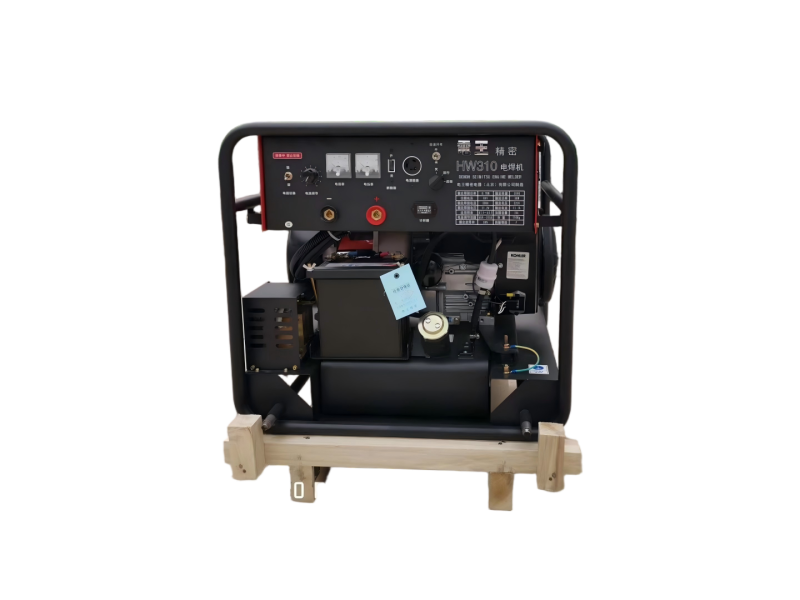
| Temporary camp and lighting steel | Light frames, posts, fixtures | HW220 / HW310 gasoline class | Fuel logistics for scattered tasks |
3. Machine Selection for Remote Duty
The published DENOH diesel welder range runs from 320 A to 1200 A with auxiliary outputs from 10 kVA to 30 kVA and engines from Kohler, Kubota, Yanmar, Deutz and Cummins. The following classes are the ones most often relevant to geothermal pads.
| Class | Welding range (as listed) | Auxiliary output | Remote-site advantage |
|---|---|---|---|
| HW320DS | 45-300 A adjustable, 280 A rated point | 10 kVA / 380 V plus 3.3 kW / 220 V | 40 L tank, at least 8 h full-load operation, silent operation around 72 dB(A) at 7 m |
| HW450D | Around 60-400 A single-handle class | 15 kVA class | Balance of welding power and site tools; Yanmar power plant |
| HW600DS | 50-600 A | 20 kVA | Long continuous runs and heavier structural work |
| HW800DS | 50-800 A | 30 kVA | Heavy fabrication where the machine is also the site power source |
Product listings state that the range is verified for -40 C to +55 C conditions and 4,500 m altitude, but a geothermal pad should still be assessed on its own heat and dust load. The diesel engine-driven welder range gives the current model-by-model data.

4. Heat Management at the Pad
High ambient temperature does not immediately stop a diesel welder, but it reduces margin. Set the machine up as part of the work plan rather than as an afterthought.
4.1 Setup rules
- Place the radiator intake away from exhaust recirculation and away from steam vents.
- Keep the clearance around the machine specified by the manufacturer; do not park it against a skid or a stack of pipe.
- Use a shade structure that does not restrict airflow, and keep the fuel tank out of direct sun where possible.
- Monitor coolant temperature during the first hour of a high-duty shift, not only when a warning appears.
- Schedule heavy welding for the cooler part of the day and use the auxiliary outlet for lighter work at midday.
An engine driven welder rated for a high ambient band is useful, but rating assumes clean airflow and correct maintenance. Dust control is therefore part of thermal management.
5. Silica Dust and Air Filtration
Geothermal dust is fine and abrasive. It blocks radiators, contaminates filters and wears moving parts. A simple daily routine prevents most failures.
- Inspect the air filter every shift during drilling or excavation support; clean or replace according to the site dust level.
- Blow out the radiator fins from the inside outwards at the end of the shift, using low pressure to avoid bending fins.
- Keep connector caps on auxiliary sockets when they are not in use.
- Store electrode and wire consumables in sealed containers; dust on a joint is a defect source.
- Do not place the machine downwind of grinding or blasting operations.
Note the ingress protection rating on the selected model. The HW320DS listing specifies IP23; that is suitable for outdoor site use but not for pressure washing or direct water jets.
6. Corrosion and Material Discipline
Brine and steam accelerate corrosion around welds. The welding procedure should address the environment as well as the joint.
- Identify the base material before welding. Clad or stainless components require a matching consumable and a controlled heat input.
- Use low-hydrogen consumables for critical clips and supports, and store them according to the consumable manufacturer’s instructions.
- Remove mill scale, rust and brine residue from the joint area before striking an arc.
- Restore coating immediately after inspection. A weld left bare for one shift in a brine atmosphere can already show corrosion.
- Keep a record of which consumable lot was used on each repair; this matters when investigating premature failures.
7. Hot-Work Safety Near the Wellhead
A welding machine is only one part of the permit-to-work system. Before any arc is struck around a wellhead, confirm the following:
- Hot-work permit issued and the work area gas-tested for flammable and toxic gases.
- H2S monitoring active, with escape routes and respiratory protection available.
- Pressure isolation verified for any line being modified; assume residual pressure until proven otherwise.
- Fire watch in place and extinguishers positioned downwind of the work.
- Welding return lead attached close to the work, not through pipework or structural steel that carries instrumentation.
- Machine earthed according to the temporary power plan and parked clear of traffic routes.
If conditions change – a gas alarm, a steam leak or a shift in wind direction – stop work and re-assess. No production target justifies bypassing the isolation check.
8. Mobilisation Checklist
- Confirm the maximum current and duty cycle needed for the planned welds.
- Add auxiliary loads for lighting, pumps, grinders and instrumentation charging.
- Check fuel quantity against the full shift plus a contingency for access delays.
- Inspect filters, coolant, tyres and lifting points before transport.
- Bring spare filters, fuses and contactor parts for remote sites.
- Verify delivery access to the pad and the turning radius of the transport vehicle.
- Arrange a fire watch, gas monitoring and a communication link to the control room.
9. Frequently Asked Questions
Can an engine driven welder also power site instruments?
Yes, within its auxiliary rating. Use a separate distribution board with appropriate protection, and start large motors sequentially to avoid voltage dips.
How does high heat affect welding current?
Duty cycle is the first thing to suffer. Plan shorter welding blocks and keep the engine cooling system clean rather than increasing current settings.
Is a dual-operator machine useful on a well pad?
It can be, when two welders work on separate frames or spools. Confirm that the combined load and duty cycle are acceptable for the specific model.
What maintenance interval is realistic in silica dust?
Inspection should be every shift; filter replacement depends on measured restriction, not a fixed calendar date. Dusty pads often need far shorter intervals than the standard schedule.
Can the machine be left running unattended overnight?
Only if the site procedure allows it and shutdown protection is verified. Otherwise use the automatic idle or stop feature where equipped, and restart at the beginning of the shift.
10. Conclusion
Geothermal sites reward equipment that is simple to move, easy to clean and generous in auxiliary power. Choosing the right engine driven welder class, protecting it from heat and dust, and respecting hot-work discipline will do more for productivity than chasing a higher nameplate current. For remote pad work, reliability is the real specification.
DENOH Group supplies diesel engine driven welders for field construction, pipeline work and remote energy projects. Share your current range, auxiliary load and site conditions with our engineering team for a configuration proposal.
Beijing Anjie Weida Technology Co., Ltd. (DENOH Group)
Tel (landline): 010-86468776
Phone / WeChat: 13521628344
Email: sales@denohgroup.com
Website: https://www.denohgroup.com/
More field welding guides: Engine Welder Category