
A pipeline spread does not buy welding machines. It buys joints per day, for a defined number of seasons, on a defined class of line pipe. Once that reframing is made, the equipment decision stops being a technical comparison of torches and carriages and becomes what it always was financially: an asset decision. The machine that looks cheapest on a quotation can be the most expensive asset on the spread if it idles between mobilisations, if its consumables are not common with the rest of the fleet, or if it cannot move between a mountain section and an urban section without a new set of lifting and tracking equipment.
This guide sets out how to structure that decision for the pipeline automatic welding range — the single-torch external welder, the dual-torch external welder, the lithium and flexible internal welders, and automatic TIG root welding — covering ownership versus rental, fleet sizing against cycle time, whole-life cost structure, utilisation break-even, residual value, and the contract terms actually worth negotiating.
Why the Asset Decision Now Decides the Project Margin
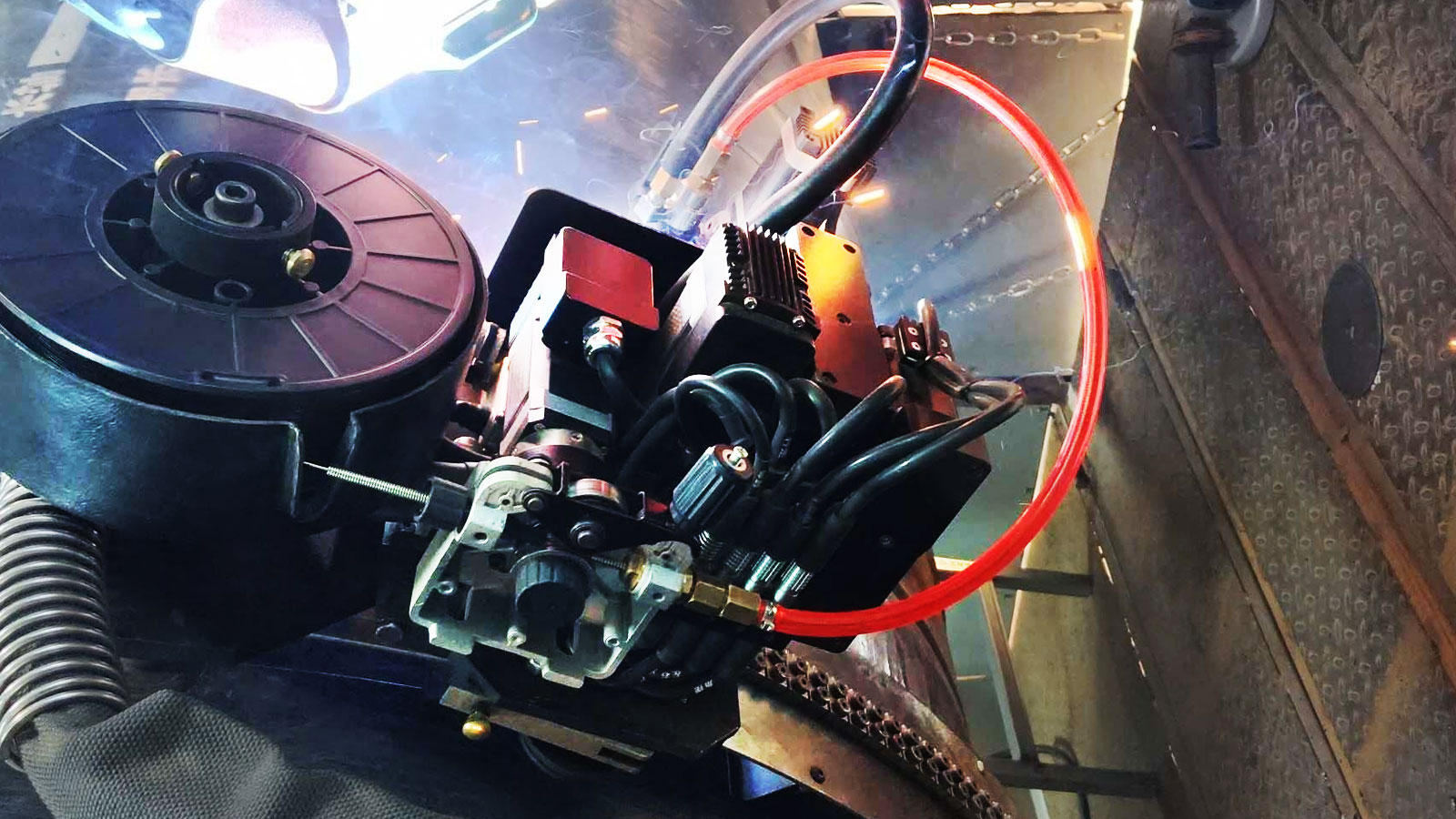
Automatic welding has moved from a productivity option to an entry condition. On high-grade long-distance work, tender pre-qualification increasingly asks for mechanised or automatic welding capability, and the equipment package is examined alongside the welding procedure. Once a contract is awarded, the equipment fleet is effectively locked: there is no management technique that compensates for a machine that cannot weld the line pipe in front of it, and no schedule recovery that repays a fleet sized for the wrong cycle time. The decision window is before the tender, not after mobilisation.
Four variables sit inside that window, and they are interdependent rather than sequential:
- Machine mix — which of the four machine families the spread needs, and in what proportion.
- Ownership route — outright purchase, finance lease, short-term rental or subcontracted welding.
- Fleet size — the number of units per family, sized against the joint cycle rather than the budget.
- Whole-life cost — everything the asset consumes between commissioning and disposal, not the purchase price alone.
These four together set the cost per joint and therefore the room available in the bid. Getting them wrong is not recoverable on site; getting them right is a competitive advantage that shows up in every kilometre of the line.
The Four-Machine Capital Map: What Each Machine Is Bought For
The four machine families are not alternatives to one another. They divide a pipeline joint into stages: an internal welder produces the root pass from inside the pipe, one or two external welders complete fill and cap from outside, and automatic TIG is used where a fully positional, high-integrity root is specified or where wall thickness makes a controlled root the priority. Each family therefore has its own asset role, its own return mechanism, and its own case for ownership or rental.
| Machine family | Model | Asset role in the welding line | Published specification | Where it earns its money |
|---|---|---|---|---|
| Single-torch external welder | DW-EW-I | Fill and cap on moderate-diameter lines and in prefabrication; the general-purpose external workhorse | Toothed-hole steel track with a lightweight carriage, single rack-and-pinion drive, multi-axis adjustable torch, position-dependent parameter control, visual touch screen with parameter upload and download, split round track covering Φ219–Φ1422 mm | Prefabrication and field work on the same machine; the lowest-cost route to external automation |
| Dual-torch external welder | DW-EW-II | High-productivity fill and cap on high-grade long-distance lines | Two torches with straight and angular oscillation modes, automatic arc tracking, integrated digital control, on-board HMI adjustment, multi-channel process-data storage, recall, import and export, common consumables, Φ219–Φ1422 mm | Projects where cycle time is contractual; common consumables cut running cost across the fleet |
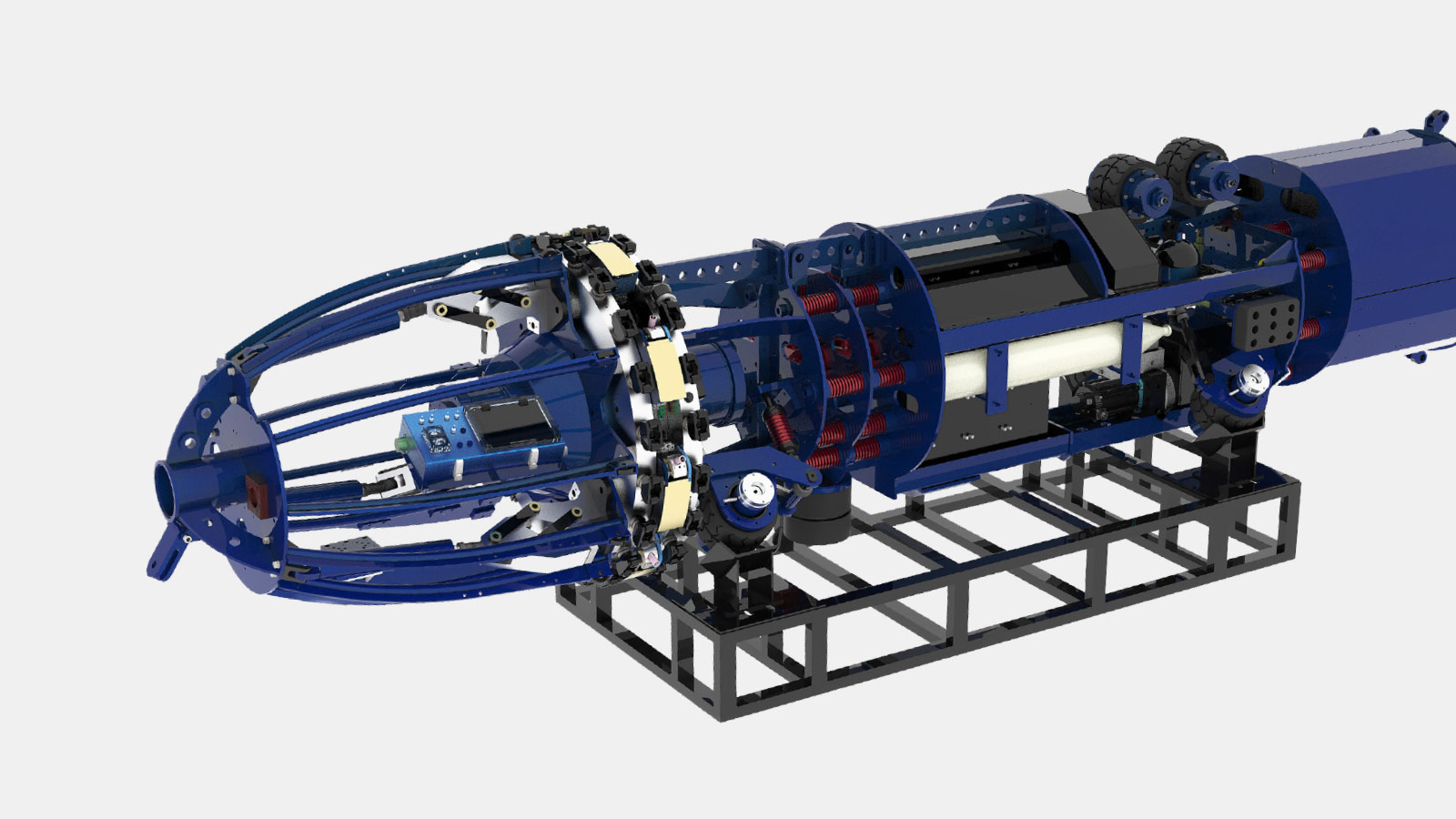
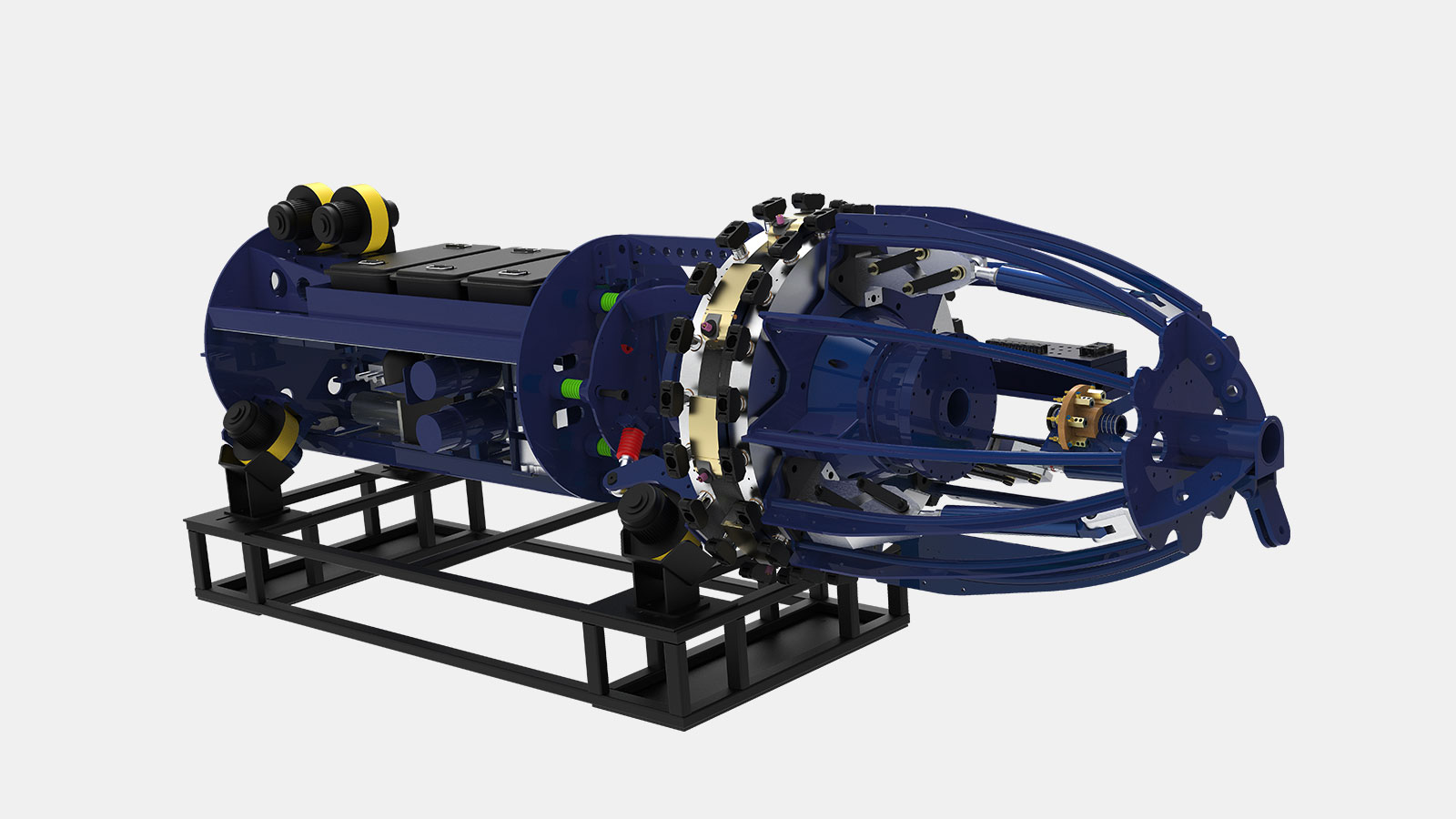
| Lithium battery internal welder | DW-EH48/56 | Root pass on large-diameter line with no grid connection and no cable dependency | 8 welding units, Φ1219–Φ1422 mm, internal pass ≤90 s, travel 0–40 m/min, 5–7 MPa hydraulic expansion, 2950 kg, 30 L shielding-gas bottle, −40 to 65 °C, altitude ≤4000 m, humidity ≤90 %, 5D lateral 90° and 30° longitudinal bends, slope ≤30° | Remote and off-grid sections; avoids the cable, generator and fuel investment a cabled machine would need |
| Flexible internal welder | DW48/56-8H-D | Root pass where terrain and access, not diameter, are the binding constraint | Large-torque servo drive, 8 welding units, Φ1219–Φ1422 mm, internal pass ≤120 s, travel 0–60 m/min, 230 AH × 3 battery packs, 2400 kg, slope ≤30°, 5/6 D bends, −50 to 65 °C, altitude 0–3500 m, fit-up and root pass in roughly 5 minutes | Mountain, hill and utility-corridor work; the compact body cuts transport and lifting cost per move |
Automatic TIG root welding sits alongside these four as a process rather than a packaged product page: it is specified when the root quality requirement, the material or the wall thickness rules out a conventional internal root, and it is budgeted as a capability rather than a fleet item.
Own, Finance, Rent or Subcontract: The Ownership Decision
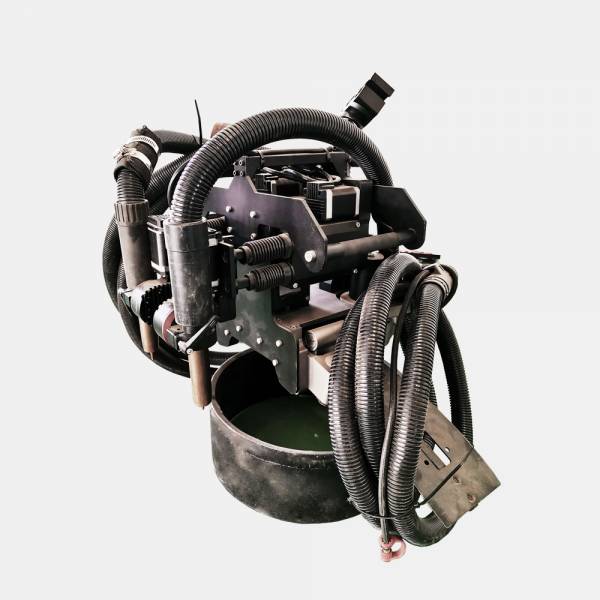
The four acquisition routes are not financial preferences. They allocate risk, and the risk being allocated is idle time, technical obsolescence and unplanned downtime. A machine that runs 250 days a year belongs on the balance sheet; a machine that runs 60 days a year does not.
| Consideration | Direct purchase | Finance lease / instalments | Short-term rental | Subcontract the service |
|---|---|---|---|---|
| Cash flow | Full cost up front or on delivery milestones | Spread across the depreciation life | Pay per mobilisation or per month | Pay per joint or per kilometre |
| Ownership at end of term | Yours | Yours, or transfer at a stated option price | None | None |
| Best when | Continuous multi-season pipeline workload | Firm multi-year order book, but tight capital | Peak demand, single project, first entry into automatic welding | Non-core machine families or a one-off specification |
| Idle risk | Carried entirely by you | Shared with the financier | Carried by the lessor | Carried by the subcontractor |
| Mobilisation speed | Depends on lead time and shipping | Same as purchase once financing is agreed | Fastest, if local units exist | Immediate, if a qualified contractor is in the region |
| Residual value | Retained by you | Partly retained, subject to contract terms | Not applicable | Not applicable |
| Process and QA data | Fully under your control | Fully under your control | Depends on the lessor allowing parameter export | Data resides with the subcontractor; fix the format in the contract |
A practical pattern for most contractors is a hybrid: own the bottleneck machine that sets the line rate, finance the second fill-and-cap unit, and rent or subcontract the machine family that appears on only one project in three. The point of the matrix is not to pick a column but to make the allocation explicit in the bid, because every unallocated risk becomes a claim later.
Fleet Sizing: How Many Machines One Spread Actually Needs
Fleet size follows the joint cycle, and the joint cycle is set by the slowest stage. The internal welder usually establishes the floor: an internal pass takes up to about 90 seconds on the lithium machine and up to about 120 seconds on the flexible machine, with fit-up and root pass together completing in roughly five minutes. Fill and cap capacity must then be matched to that rate, not purchased independently of it, otherwise the spread simply relocates the queue from the welding line to the waiting area.
The arithmetic itself is short: effective welding hours per day divided by the joint cycle gives joints per day; joints per day multiplied by working days gives the annual output the fleet has to be paid for from. What makes it difficult is that the joint cycle is a WPS property, not a machine property — it changes with pass count, wall thickness and the pipe-handling chain around the welding station.
- Fix the joint cycle from the welding procedure: root, hot pass, fill and cap, at the actual wall thickness.
- Measure the real effective welding window on site, including weather, daylight, pipe delivery and trench conditions, rather than using nominal shift hours.
- Match fill-and-cap capacity to root capacity. If root takes five minutes and fill and cap need twelve, the external machines, not the internal machine, set the line rate.
- Add redundancy only at the bottleneck. Uniform spare capacity across all four families raises the capital charge without raising output.
- Carry one spare carriage and one spare internal unit for any multi-season spread: an internal unit that stops work stops the entire line.
- Re-run the calculation at every line-pipe change. A diameter or wall thickness change resets the cycle and can invalidate the fleet ratio the project was priced on.
Whole-Life Cost: The Cost Lines That Decide the Outcome
The purchase price is the first cost line, and on a multi-season spread it is rarely the largest. The following lines, taken together, decide whether the asset is cheap or expensive, and most of them are influenced at specification stage rather than at negotiation stage.
| Cost line | What drives it | How the specification reduces it |
|---|---|---|
| Acquisition and commissioning | Number of torches, control platform, tracking system, on-site commissioning | A shared track platform across single-torch and dual-torch machines; commissioning bundled into the order |
| Track and carriage inventory | Number of track sets needed to cover the diameter range | Split round track and toothed-hole steel track that adapt Φ219–Φ1422 mm without extra sets |
| Consumables | Contact tips, nozzles, liners, wire, gas, per joint | Common-consumable design on the dual-torch machine, so one stock serves the fleet |
| Shielding gas | Flow rate, pass count, number of joints | Position-dependent parameter control; 30 L bottle on the internal unit |
| Power and site electrification | Cable runs, distribution, generators, fuel, maintenance | Lithium battery internal welding removes cable and generator dependency on remote sections |
| Lifting, transport and access | Machine mass, footprint and turning envelope | 2400 kg flexible machine, 5/6 D bend passage and ≤30° slope capability reduce per-move cost |
| Maintenance and spares | Preventive schedule, wear parts, lead times | Documented routine maintenance; A/B/C classified spare-parts list agreed at purchase |
| Training and retention | Number of distinct control platforms the crews must master | Consistent touch-screen and HMI logic; stored process parameters speed up new operator ramp-up |
| Idle and mobilisation | Utilisation between projects, seasonality | Rent or subcontract the low-utilisation machine family instead of owning peak capacity |
| Quality non-conformance | Repair rate, cut-outs, re-testing | Automatic arc tracking and 5–7 MPa hydraulic expansion that corrects fit-up before the root is welded |
| Process knowledge | Re-establishing parameters for every new project | Multi-channel process-data storage, recall, import and export, and parameter upload and download |
| Residual value | Accumulated hours, condition, documentation | Service records, parameter archives and upgradeability rather than undocumented modifications |
Utilisation Is the Variable That Really Moves the Payback
Two spreads can buy identical machines and obtain completely different economics, because the capital charge per joint is divided by the number of joints the machine actually produces before the depreciation period ends. That figure is driven far more by utilisation than by purchase price. Moving availability from 35 % to 70 % halves the absorbed cost per joint without any change to the machine.
The relationship is straightforward: absorption per joint equals investment divided by annual joints multiplied by depreciation years, where annual joints equals working days times availability times joints per effective day. The table below illustrates the arithmetic only. No price is quoted and no machine output is claimed; substitute your own quoted figures and your own measured cycle times.
| Parameter | Symbol | Illustrative value | Note |
|---|---|---|---|
| Machine investment | C | 1.00 relative unit | Substitute your own quoted figure |
| Depreciation life | L | 5 years | Depends on contract term and technical life |
| Working days per year | D | 250 days | Exclude mobilisation and seasonal shutdown |
| Availability (utilisation) | U | 70 % / 35 % | Two cases compared below |
| Joints per effective day | N | 12 | Derived from the WPS joint cycle |
| Joints per year | J = D × U × N | 2 100 / 1 050 | 70 % case / 35 % case |
| Absorption per joint | C ÷ (J × L) | 0.095 / 0.190 relative unit | Halved purely by utilisation, same machine |
The same logic explains why the specification details matter commercially. A machine that shares its track system with the rest of the fleet can be redeployed onto a different diameter without new track purchases. A machine with common consumables does not create a second stock line. A machine with stored parameter libraries returns to production faster after a shutdown. None of these appear in a purchase order comparison, and all of them appear in the cost per joint.
- Combine prefabrication and field work on the same machine to raise annual utilisation without a second asset.
- Standardise on a shared track platform so any external machine can be moved to the bottleneck diameter.
- Use rental for peak demand instead of buying capacity that will sit idle in the low season.
- Schedule mobilisations to eliminate idle quarters, and quote the mobilisation plan as part of the bid.
- Keep the machine productive between pipelines on prefabrication, spooling or training work.
- Track utilisation per machine as a management KPI, exactly as you track weld repair rate.
Specification Features That Pay for Themselves
Every published specification point on these machines has a financial consequence. Read as an investment case rather than a feature list, the differences that matter are the ones that reduce labour content, inventory, defect rate or per-move cost.
| Specification feature | Financial effect | Where it appears |
|---|---|---|
| Position-dependent parameter control | Removes manual resetting around the circumference, so position-related defects and the rework they cause fall | Single-torch external welder DW-EW-I |
| Automatic arc tracking | Continuous correction of the weld path holds the defect rate down and reduces cut-outs | Dual-torch external welder DW-EW-II |
| Common consumables | One consumable stock for the fleet rather than one per machine family; lower inventory and better unit pricing | Dual-torch external welder DW-EW-II |
| Shared external track system | A single track platform serving single-torch and dual-torch machines reduces track inventory per diameter | DW-EW-I and DW-EW-II |
| Lithium battery power, no cables | Removes cable, distribution and generator capital cost on remote sections, and removes cable handling labour | Lithium internal welder DW-EH48/56 |
| 2400 kg body with 5/6 D bend passage and ≤30° slope | Fewer lifts, easier transport, and no additional access works on mountain and corridor sections | Flexible internal welder DW48/56-8H-D |
| 5–7 MPa hydraulic expansion | Corrects high-low at fit-up before the root is welded, so repair rate and cut-out cost fall | DW-EH48/56 and DW48/56-8H-D |
| Multi-channel process-data storage, import and export | Parameters replicated across machines and projects, faster ramp-up, and an auditable record for the client | DW-EW-II; parameter upload and download on DW-EW-I |
| Wireless remote control | The operator stands clear of the joint, reducing incident exposure and repositioning time | Internal welders DW-EH48/56 and DW48/56-8H-D |
Residual Value, Technical Life and the Exit
Residual value is decided years before the sale. Machines that leave a project with service records, documented parameter libraries and reversible configurations retain employability; machines that were modified for one narrow purpose, repaired without records and run without preventive maintenance do not. For a leased machine, the same factors decide the return settlement.
| Value factor | What preserves residual value | What destroys it |
|---|---|---|
| Accumulated hours and cycles | Service records against a preventive maintenance calendar | Unlogged repairs and seized drives |
| Diameter coverage | A machine that spans Φ219–Φ1422 mm stays employable across projects | Irreversible modifications for one diameter or one client |
| Control platform | Documented parameter libraries and an updatable HMI | Undocumented parameter edits and obsolete data storage |
| Consumable supply | Consumables common with the rest of the fleet | Discontinued special parts unique to one machine |
| Documentation and crew capability | A complete handover file and trained operators | Missing data packs and untrained crews, which reduce the buyer pool |
Contract and Financing Levers Worth Negotiating
Most of the whole-life cost is negotiable at the point of order and not afterwards. These are the terms worth putting in the technical and commercial annex rather than leaving to the quotation.
- Bundle commissioning and on-site process support into the purchase, with a defined number of days.
- Require parameter libraries for your actual pipe grades and wall thicknesses as a contractual deliverable.
- Fix consumable pricing and availability for the depreciation life, with a stated lead time.
- Specify a shared track platform across the machine mix so any unit can cover the bottleneck diameter.
- Ask for a spare-parts list classified A/B/C, with lead times and a recommended on-site holding quantity.
- Negotiate training places sized for seasonal crews, not for a single permanent team.
- Define acceptance testing on your own pipe and your own welding procedure, not on the supplier sample.
- Fix the process-data export format so records survive a change of platform or supplier.
- Ask about upgrade paths for tracking, control software and data storage before signing.
- If the machine is leased, agree the return condition and settlement basis at the outset.
Ten-Point Investment Checklist
- Confirm the process window for the target projects: diameter, wall thickness, steel grade and pipe-end condition.
- Select the machine mix across internal root, external fill and cap, and TIG root where the specification demands it.
- Size the fleet against the joint cycle from the welding procedure, not against the available budget.
- Identify the bottleneck machine and plan redundancy there only.
- Model whole-life cost across all twelve cost lines rather than comparing purchase prices.
- Stress-test the payback at 35 % and 70 % utilisation before committing capital.
- Compare purchase, finance lease, rental and subcontract for the first year of the order book.
- Verify consumable commonality and priced supply for the full depreciation life.
- Agree acceptance testing on your own pipe and a complete process-data handover.
- Write the residual-value assumption into the business case, not into an appendix nobody reads.
Frequently Asked Questions
Is it cheaper to rent automatic pipeline welding machines than to buy them?
It depends entirely on utilisation. Below roughly 100 working days a year, rental or subcontracted welding is usually cheaper once depreciation, storage, maintenance and idle labour are counted. Above roughly 200 days a year, ownership almost always wins, and the finance route becomes a cash-flow decision rather than a cost decision. The break-even point should be calculated per machine family, because the internal welder usually has the higher utilisation of the two.
How many internal welders does one spread need?
Normally one in continuous service, plus one spare for a multi-season spread, because the internal welder sets the line rate: an internal pass of up to about 90 seconds on the lithium machine and up to about 120 seconds on the flexible machine determines how quickly everything downstream can work. If root pass and fill and cap are separated into a two-station flow, a second internal unit can be justified, but the decision belongs to the cycle-time calculation, not to the equipment list.
What payback period is realistic for a dual-torch external welder?
Payback follows utilisation and repair rate far more than purchase price. A dual-torch machine that is kept on a firm order book, shares its track system, uses common consumables and holds the defect rate down will absorb far less capital per joint than an identical machine used intermittently. Model it with your own quoted figure, your own measured joint cycle and two utilisation cases, as in the table above, rather than relying on a vendor payback claim.
Which machine should be owned outright and which should be rented?
Own the machine that sets the line rate and appears on every project. Finance or rent the machines whose demand is project-specific. In most automatic welding fleets this means an internal welder and one external machine are owned, while a second external machine, automatic TIG root capability and any non-standard diameter configuration are financed, rented or subcontracted to match the order book.
Conclusion
Automatic pipeline welding equipment is a capital asset deployed against a cycle time, and it should be justified the way any capital asset is justified: by output, utilisation and whole-life cost rather than by purchase price. Establish the process window first, size the fleet against the joint cycle, standardise on a shared track and consumable platform, stress-test the payback at realistic availability, and write the residual-value assumption into the plan. Contractors who do that buy capacity; those who do not buy machines.
- Establish the process window before choosing the machine mix.
- Size the fleet from the joint cycle, and place redundancy only at the bottleneck.
- Standardise the track and consumable platform across the machine families.
- Test the business case at two utilisation levels, never one.
Beijing Engine Welder Technology Co., Ltd. (DENOH Group)
Tel: 010-86468776 | WhatsApp/WeChat: 13521628344 | Email: sales@denohgroup.com
Site: www.denohgroup.com | Contacts: /contact/