A pipeline spread is a factory that moves. Once the right-of-way is organized as a line of welding stations – preparation and fit-up, root, fill, cap – the fleet of automatic welding machines stops being a pile of equipment and becomes a paced production system. This guide explains how to organize a multi-machine pipeline assembly line around a single-torch external welder (DW-EW-I), a dual-torch external welder (DW-EW-II), an internal root welding machine (DW-EH48/56 lithium or DW48/56-8H-D flexible), and automatic TIG – with station maps, beat-balance logic, buffer rules and quality gates between stations.
From Joint-by-Joint Work to a Moving Production Line
Traditional crews complete one joint from fit-up to cap before moving on. The assembly-line model separates the operations: while station A welds roots on joint 120, station B is filling joint 118, and the prep crew is beveling joint 122. Each station does one class of work all day, so setups repeat, parameters stay tuned, and learning accumulates. The principle is takt time: the line advances only as fast as its slowest station, so equipment selection and crew planning are really beat-balancing problems.
| Station | Machine | Task on the line |
|---|---|---|
| S0 – Line-up & fit-up | Internal clamp / line-up tools | Gap, hi-lo and alignment; the input quality every later station depends on |
| S1 – Root | DW-EH48/56 lithium or DW48/56-8H-D flexible internal welder | Root pass welded from inside; all 8 units fire simultaneously |
| S1a – Root (special lines) | Automatic TIG (orbital GTAW) | Low-heat-input root and tack welding where the WPS demands it |
| S2 – Hot pass / first fill | DW-EW-I single-torch external welder | Fast, position-compensated fill on a moving carriage |
| S3 – Fill & cap | DW-EW-II dual-torch external welder | Two torches per pass halve the number of stations needed for fill+cap |
The Root Station: Inside-Out Welding Sets the Pace
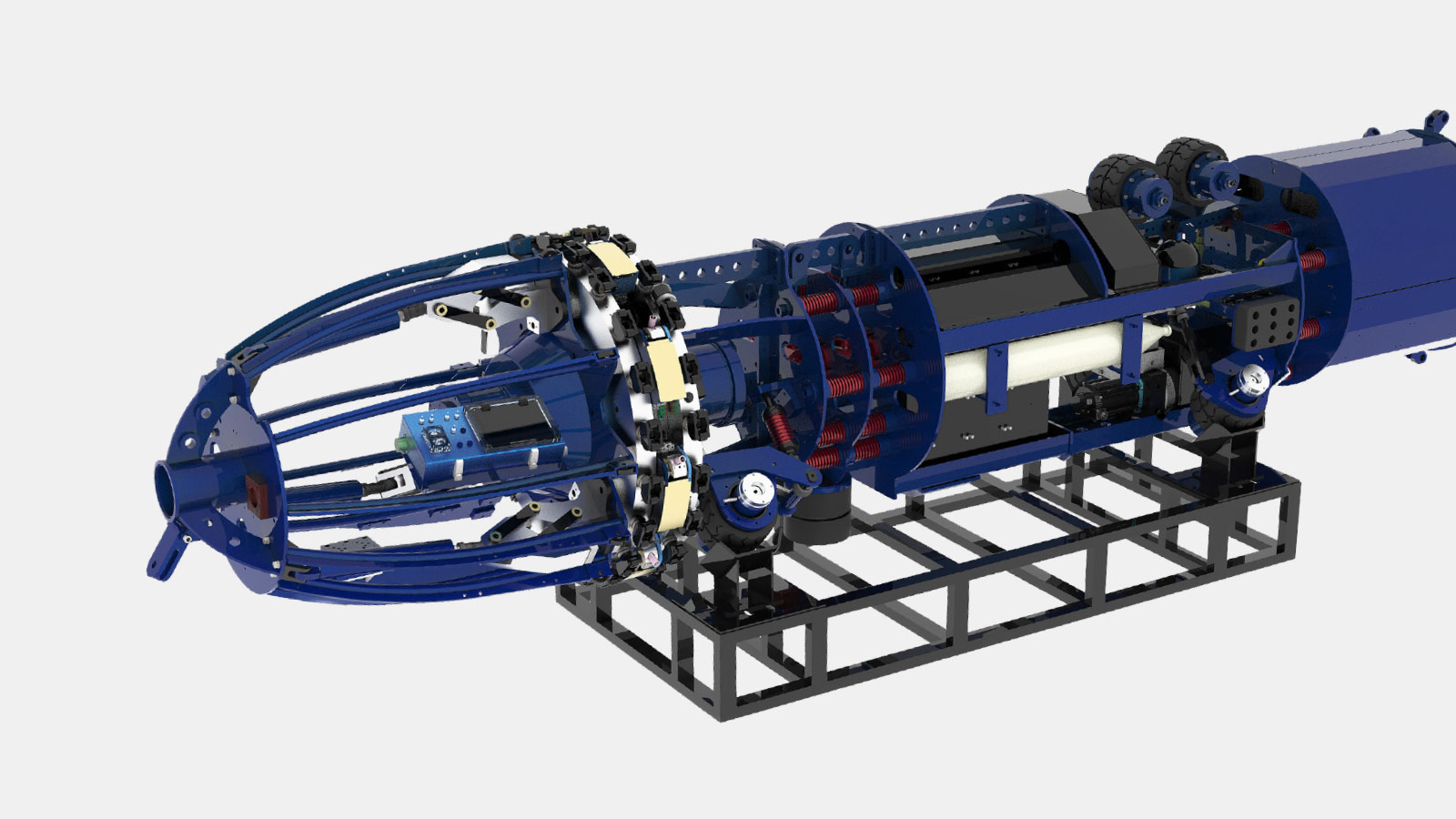
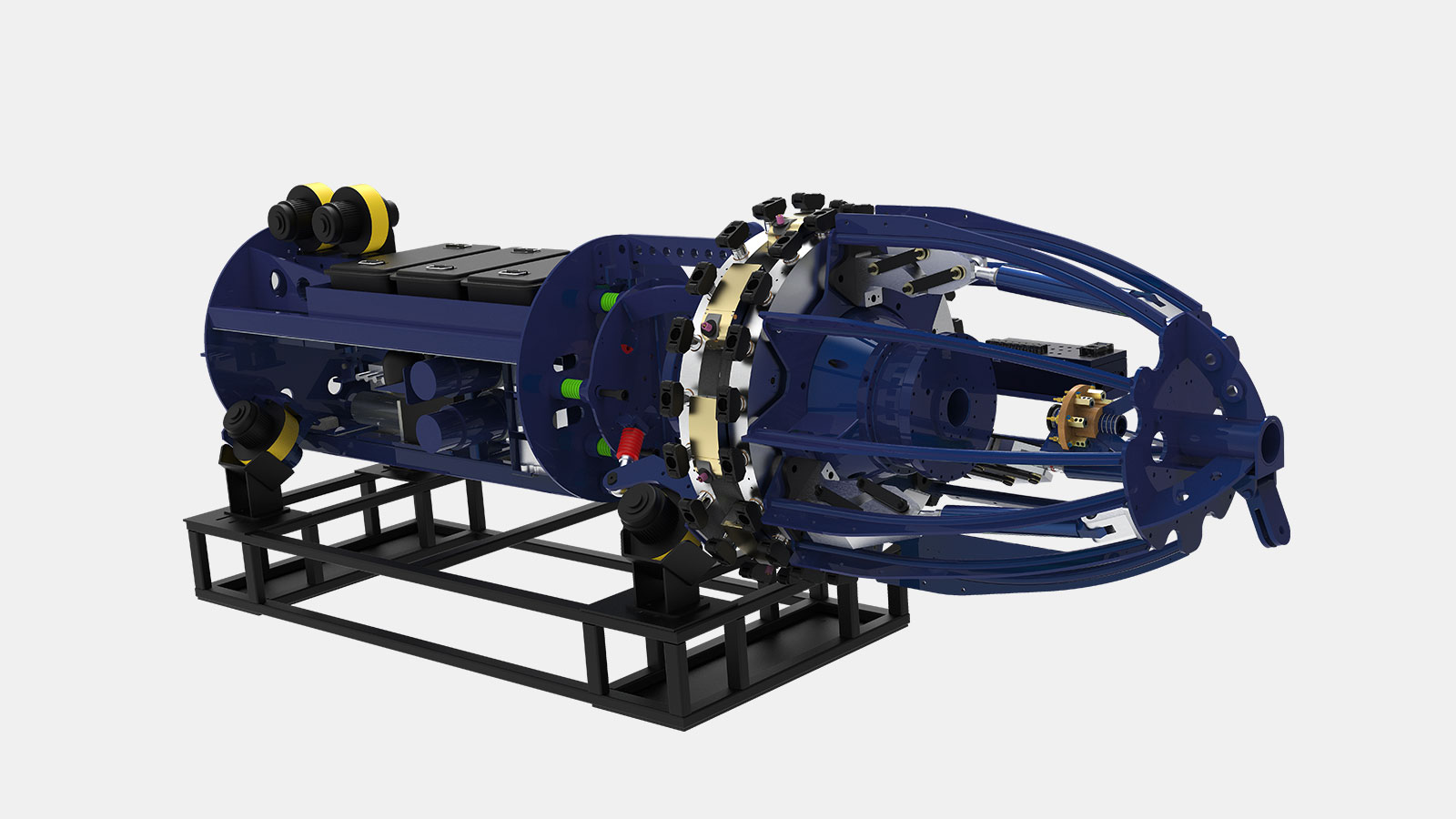
The root station is the backbone of the line. The DW-EH48/56 lithium machine clamps internally (hydraulic expansion 5-7 MPa) and welds all eight units at once, so a root is completed without a crew walking inside the pipe. The flexible DW48/56-8H-D combines positioning and root welding in roughly five minutes, travels to the joint at up to 60 m/min, and handles slopes up to 30 degrees and 5-6D bends – useful when the line crawls through terrain the production line must follow. Both are built for wall thicknesses of 10-35 mm, so one root station can serve many downstream fill stations.
Beat rule for the root station
Count the cycle of the internal machine (positioning, clamping, welding, release – about 120 s positioning for the flexible model plus welding time) and add travel to the next joint. If downstream stations cannot consume roots that fast, the root station becomes the natural pacesetter of the spread – or you split it: one internal machine per welding front.
Fill and Cap Stations: One Torch or Two?
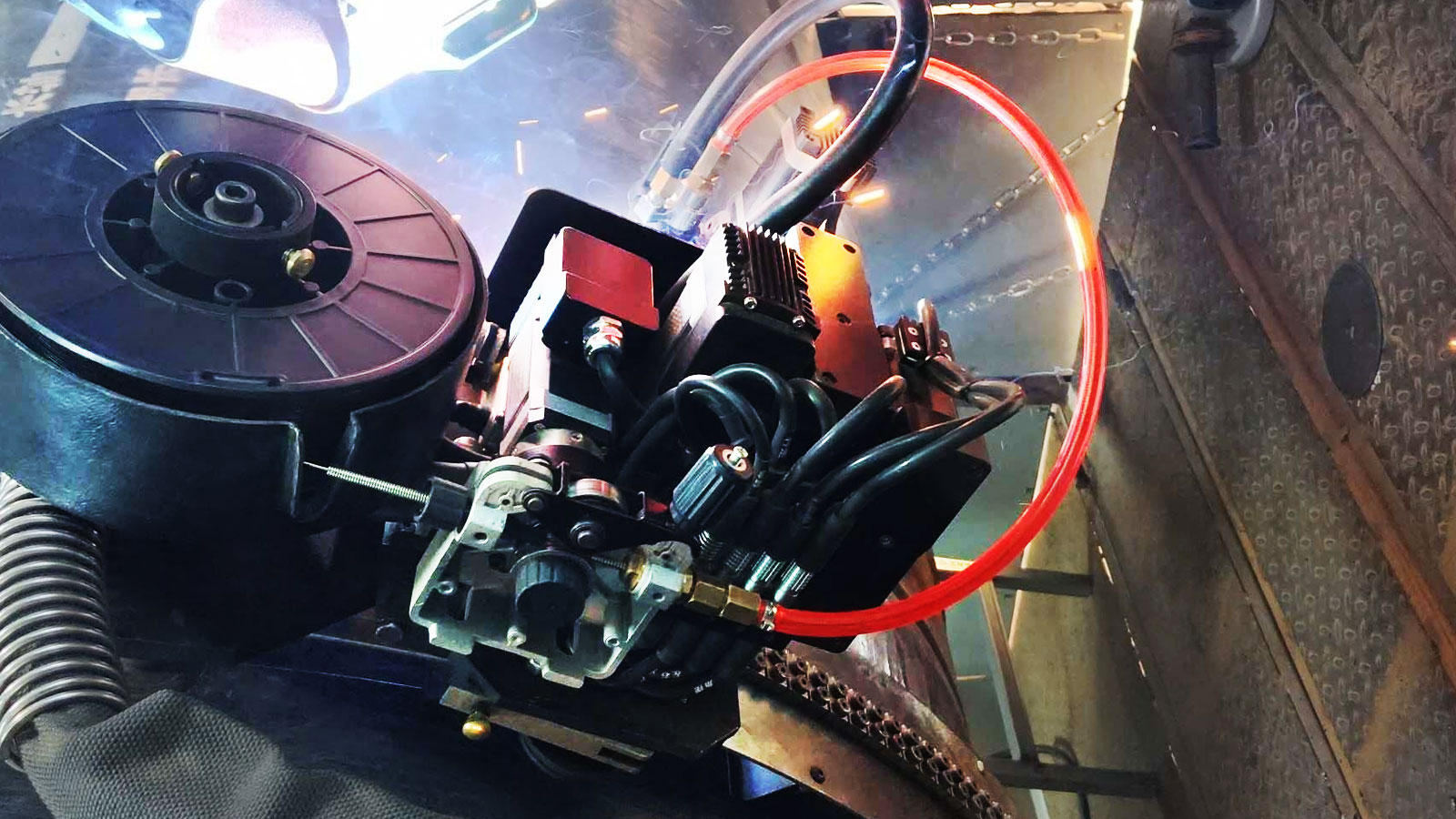
Downstream of the root, the question is how many external stations the fill+cap work needs. The DW-EW-I single-torch welder rides a toothed steel track with rack drive, and its parameters change automatically with clock position, so a single operator produces even beads in every quadrant of the 5G joint. The DW-EW-II dual-torch welder deposits with two torches using straight and angular oscillation and automatic arc tracking – roughly doubling deposition per pass and cutting the number of fill passes per joint. The two machines share consumables, which simplifies spares across all external stations of the line.
| Decision driver | Single-torch stations (DW-EW-I) | Dual-torch station (DW-EW-II) |
|---|---|---|
| Stations per spread | More stations, lower cost each | Fewer stations, higher cost each |
| Fill passes per joint | More passes, simpler per-pass setup | Fewer passes, two arcs to tune |
| Best fit | Long, uniform mainline spreads | Beat-critical spreads and thick-wall fill |
| Data & control | Touch-screen parameter upload/download | Multi-channel process data recording |
Where Automatic TIG Fits in the Line
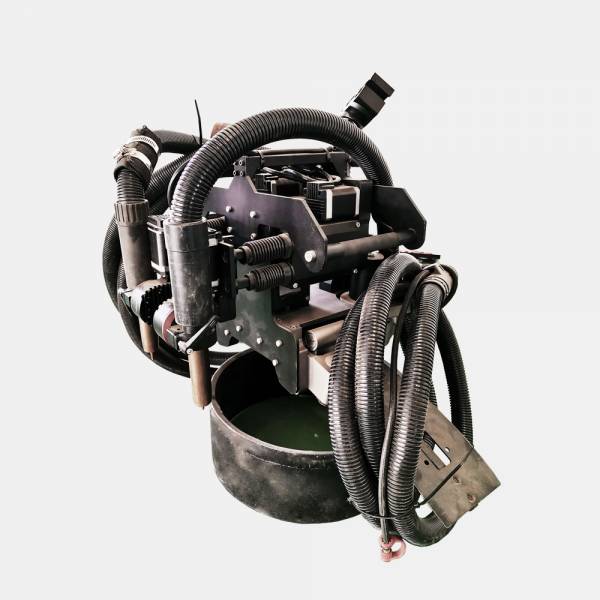
On thin-wall, stainless, duplex or otherwise heat-input-sensitive lines, the root station becomes an automatic TIG (orbital GTAW) station: it tacks and roots with precisely limited energy while the internal machines and external welders handle the mass of the fill downstream. Note: automatic TIG is not published as a standalone product datasheet on this site; plan its cycle time from the WPS and qualify it during procedure trials.
Buffers, Logistics and Front-Back Coordination
A moving production line lives or dies on buffers. Between fit-up and root there is nothing to buffer – alignment must be fresh – so the internal clamp crew and the root machine must work as one unit. Between root and fill, a small buffer of rooted joints absorbs external-station hiccups; between fill and cap, keep one to two joints so the cap never chases a filling station. Upstream, the pipe feed (stringing, beveling, cleaning) must deliver at or above the takt rate; downstream, NDT and repair crews lag the line at a fixed distance with their own two-track queue – normal joints straight to AUT, suspect joints to the repair track.
- Keep the root station within one pipe length of the fit-up crew; alignment errors must be caught before internal clamping closes the joint.
- Let rooted joints accumulate as the main buffer: they are stable, inspectable and reworkable.
- Move stations in leapfrog when terrain or right-of-way constraints break the line into segments.
- Charge lithium batteries (230 Ah x 3 on the flexible internal welder) and refill the 30 L shielding gas bottle at shift change, not mid-beat.
- Fix station boundaries in the daily plan; do not let a fill station creep back to redo roots.
Daily Production Arithmetic (Relative Units, Not a Quote)
Daily output of the spread is not the sum of machine capacities – it is takt x working time of the slowest station. Use the symbolic chain below as planning arithmetic (example only, not a quotation; substitute your own cycles and shift model):
- Root takt = internal-machine cycle + travel time between joints.
- Fill+cap takt = passes per joint / torches per station x cycle per pass (two torches roughly halve station count, not physics).
- Spread output per shift = shift time x utilization / max(root takt, fill+cap takt, feed takt).
- Utilization absorbs weather, moves, battery and gas changes; plan it explicitly instead of assuming 100%.
Quality Gates Between Stations
| Gate | Checked by | What passes / what returns |
|---|---|---|
| Fit-up to root | Fit-up crew + internal machine clamp | Gap, hi-lo, cleanliness within WPS; out-of-tolerance joints go back before clamping |
| Root to fill | Visual + first NDT sampling | Sound root bead profile; concavity or burns-through return to the repair track |
| Fill to cap | Bead spacing and profile check | Even fill height; low fill returns to the fill station, not to the cap torch |
| Cap to NDT | NDT lagging station | Capped joints queue for AUT/RT per the ITP; repairs follow the two-track rule |
Ten-Point Checklist for Building the Line
- Define takt from the contract schedule, then size the fleet to the takt – not the other way round.
- Choose internal root machine type by terrain: lithium DW-EH48/56 for altitude up to 4000 m and -40 to +65 C, flexible DW48/56-8H-D for slopes to 30 degrees, -50 to +65 C and ranges up to 3500 m.
- Verify wall-thickness window (10-35 mm) against the pipe schedule before freezing station design.
- Standardize consumables across external stations (DW-EW-I / DW-EW-II share them; wire 0.9-1.2 mm on the flexible internal machine).
- Set buffer sizes: rooted-joint buffer as the main reservoir, one-to-two-joint buffer before cap.
- Fix the NDT lag distance and the two-track repair queue in the daily plan.
- Schedule battery charging and gas bottle exchange into shift changes.
- Store qualified parameter sets per station on the touch screens; upload/download per crew.
- Track per-station cycle times for the first 100 joints and rebalance the beat on data, not opinions.
- Keep the fit-up standard strict: an assembly line amplifies whatever the first station feeds it.
Frequently Asked Questions
How many external welders do I need per internal root machine?
Derive it from cycles, not habit: compare the internal machine root cycle (including positioning and travel) with the fill+cap cycle per external station. If one root is produced faster than one external station consumes fill work, add external stations; if roots are the bottleneck, split the root station or add a second internal machine per front.
Does the dual-torch welder really halve the fill time?
It roughly halves the number of fill passes per joint because two torches deposit per pass; total heat and bead spacing still obey the WPS. In line terms, it usually means fewer external stations for the same spread output, which also simplifies consumables and data management.
Where should the TIG station sit – always at the root?
Normally yes, because its value is precise, low-heat-input root and tack work. On some special lines it also serves qualification and repair stations, but it should never sit downstream of mass fill – the economics of the line would invert.
What is the most common assembly-line mistake?
Sizing the fleet from peak machine capacity and then letting fit-up or pipe feed starve the line. The spread output equals the slowest station; plan feed, fit-up and NDT with the same rigor as welding itself.
Conclusion
Organizing a pipeline spread as a moving assembly line turns four machine types into one paced system: the DW-EH48/56 lithium or DW48/56-8H-D flexible internal welder owns the root station, the DW-EW-I and DW-EW-II external welders own fill and cap, and automatic TIG guards heat-input-critical roots. Balance the beats, protect the buffers, enforce the quality gates – and daily output becomes a planning result instead of a daily surprise.
Beijing Engine Welder Technology Co., Ltd. (DENOH Group)
Tel: 010-86468776 | Email: sales@denohgroup.com
WhatsApp/WeChat: 13521628344 | Visit /contact/ for a line-organization review of your next spread.