

A pipeline spread is a fixed daily cost — crews, camp, plant hire, permits — and everything hinges on how many of those days the machines are actually welding. The hours are rarely lost to a failed welding power source. They are lost to a worn contact tip, a slack track clamp, a flat remote-control battery, or a service that was planned for next week on a site with no next week to spare. The four machines in the ENGINE WELDER / DENVO pipeline automatic welding range — single-torch and dual-torch external welders, the lithium and flexible internal welders, and the automatic TIG set — wear out in completely different places, yet they can be managed with one method: classify the parts, calendar the checks, and measure availability. This guide sets out that method in the form a spread can actually run.
Why the Consumable Box Decides the Daily Joint Count
Automatic welding removes the welder’s variability, not the consumable’s. A machine repeats exactly what it has been told, so a drifting contact tip or a loose carriage does not average out across a shift — it prints the same small defect on every joint until somebody stops the spread. Two consequences follow. First, consumable management is a production function, not a store-room chore; it belongs on the same board as the daily joint target. Second, the parts that matter most are usually the cheap ones nobody watches: tips, nozzles, drive rolls, track jaws, batteries. On most spreads the parts worth under one per cent of the machine price cause the majority of unplanned stops.
The arithmetic is simple enough to put on one line. A spread welding 120 joints a month at 92% equipment availability loses roughly nine or ten working days to stoppages over the campaign; at 97% that falls to about three. Almost all of that recovery comes from routine parts and routine checks, not from capital spending — which is why the maintenance calendar deserves the same respect as the welding procedure.
The Consumable and Wear-Part Map of Four Machines
Before stocking anything, separate the four machine families, because each wears out in its own place. External welders wear at the wire path and the track; internal welders wear at the expansion system and the power pack; automatic TIG wears at the tungsten and the ceramics.
| Machine | Routine consumables | Wear parts to inspect | Critical spares to hold |
|---|---|---|---|
| External welder — single torch (DW-EW-I) | Contact tips, nozzles, welding wire, drive rolls | Perforated steel track, gear-rack segments, travelling carriage, clamp jaws | Torch body, drive assembly, control cable |
| External welder — dual torch (DW-EW-II) | Same consumable family — the dual-torch design is specified with commonised consumables across the range | Two torches, two wire paths, arc-tracking sensor | Second torch body, tracking sensor, HMI control board |
| Internal welder — lithium (DW-EH48/56) | Wire and tips for 8 welding units, shielding gas (30 L cylinder) | Hydraulic expansion shoes, seals, DC24 V power pack, remote control | Battery pack, hydraulic seal kit, welding unit |
| Internal welder — flexible (DW48/56-8H-D) | Wire Φ0.9–1.2 mm, tips for 8 welding units | 230 AH×3 battery group, servo drive train, electromagnetic brake, expansion shoes | Battery group, servo drive, brake module |
| Automatic TIG (root-pass set) | Tungsten electrodes, ceramic cups, gas lens, wire guide tips, filler wire | Torch head, gas valve, cables | Torch head assembly, ceramic kit, wire feeder |
External welders: the wire path and the track
Both external machines run on the same principle of a perforated steel track with a rack-and-pinion carriage, which is stiff and light and quick to fit — and which is where the wear accumulates. The parts to watch are the gear-rack segments, the carriage rollers and the clamp jaws, because slack there shows up in the weld as undercut or a wandering bead rather than as an obvious breakdown. The torch itself is adjustable vertically and horizontally so the bead can be centred on the pool, and that alignment should be re-checked on a test joint after any track work. Parameters change automatically with welding position around the circumference, and the touch screen stores, displays and exports the parameter sets — which makes a weekly backup of the programme simply another maintenance action, not an IT project.
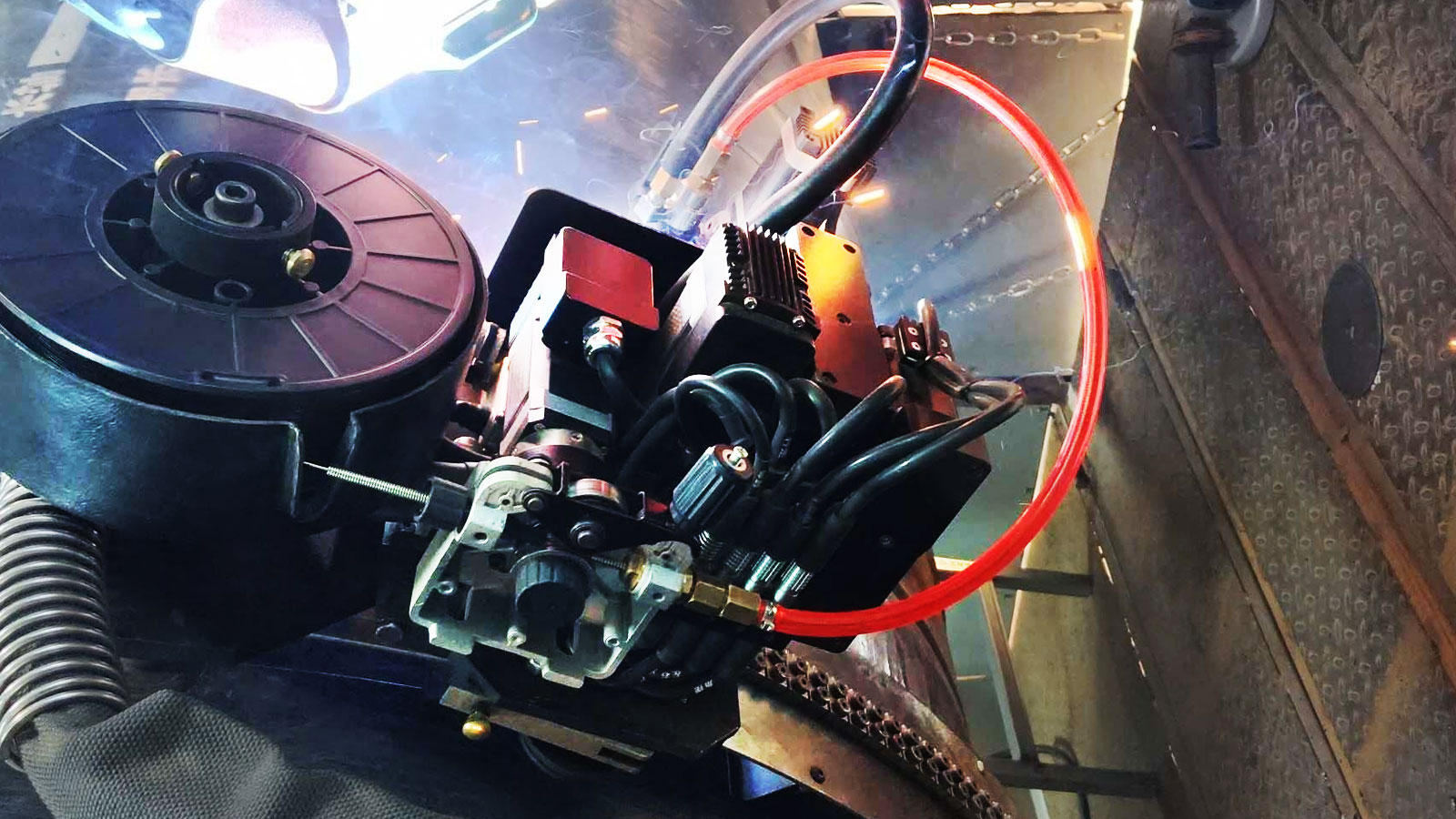
Dual torch: one consumable box for two torches
The dual-torch machine matters to spare-parts planning for an unusual reason: its consumables are specified as commonised across the range, so the same tips, nozzles and wire serve both the single and the dual machine. That is a genuine stock-keeping advantage, but it should not be mistaken for lower consumption. Two torches welding simultaneously consume wire, tips and nozzles at roughly twice the rate, and an arc-tracking sensor that keeps the bead uniform and flat is itself a service item. Plan the consumption rate per machine, then keep one common box.
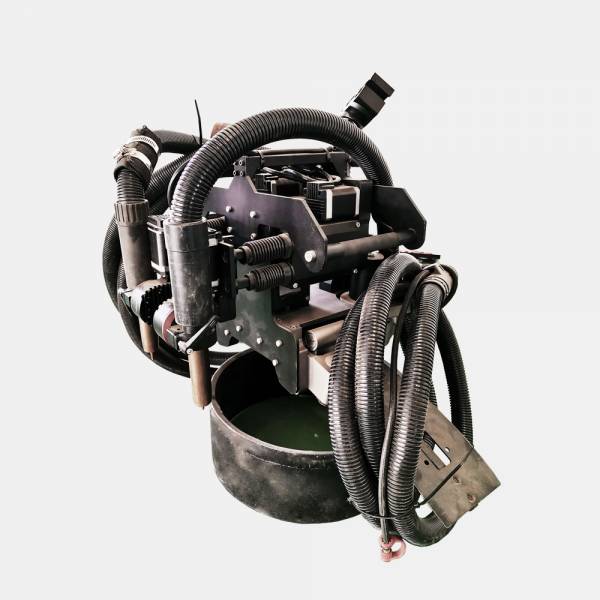
Internal welders: eight welding units and one power pack
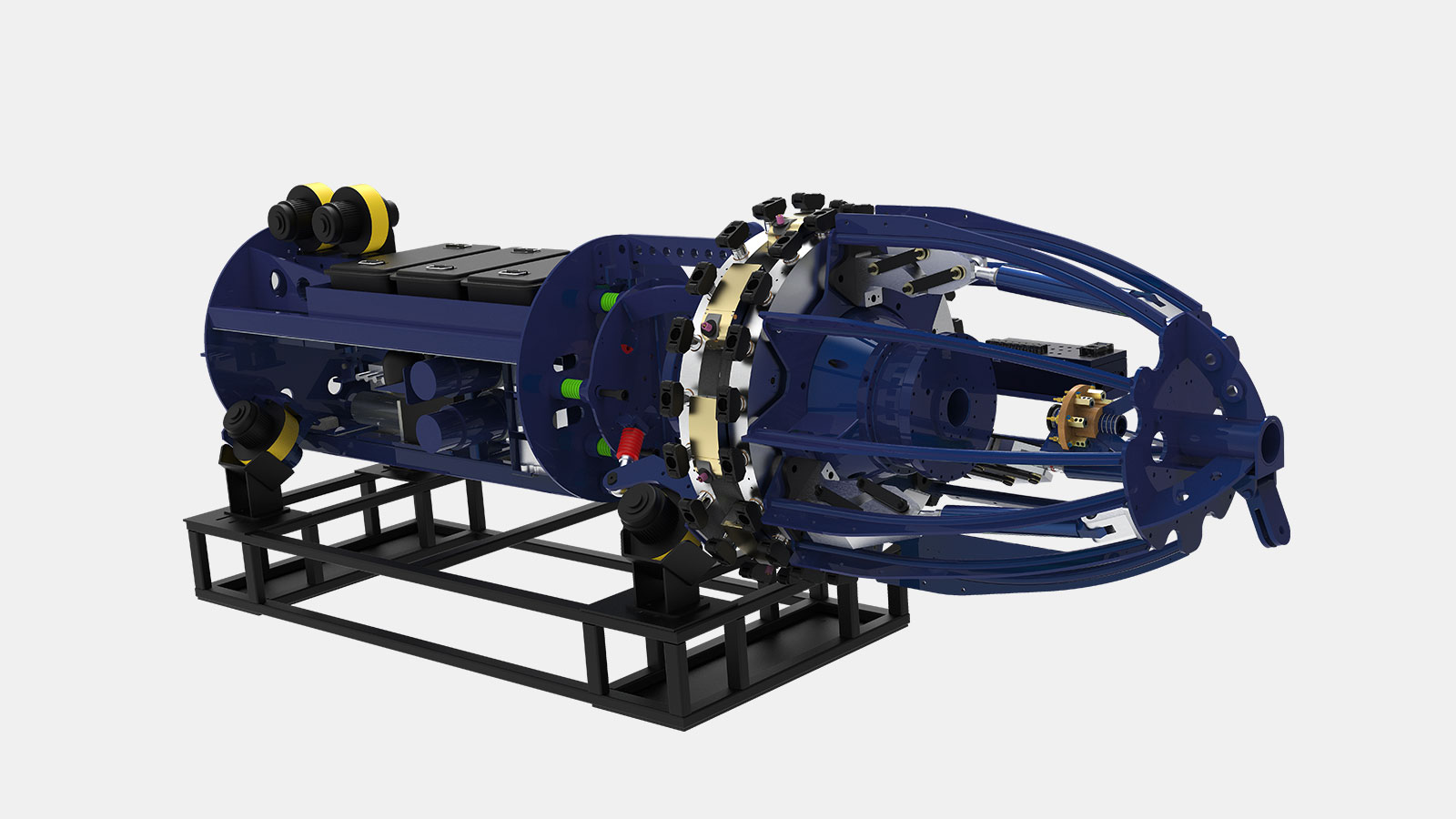
An internal welder is the first machine on a joint, which means it cannot be quietly substituted by hand when it stops. Both internal machines carry eight welding units, so every operator change is potentially eight sets of small consumables — and the single most expensive wearing item is the power pack. The lithium machine (DW-EH48/56) runs on a 2,950 kg body rated −40 °C to 65 °C, altitude ≤4,000 m, humidity ≤90% and wall thickness 10–35 mm, with a 30 L shielding-gas cylinder on board; the flexible machine (DW48/56-8H-D) uses a 230 AH×3 battery group at DC24 V, weighs 2,400 kg and covers −50 °C to 65 °C and 0–3,500 m over 5/6D bends. The hydraulic expansion system that centres the pipe and corrects hi-lo operates at a rated 5–7 MPa and is the second service item: when it drifts, the root gap tells you before the gauge does.
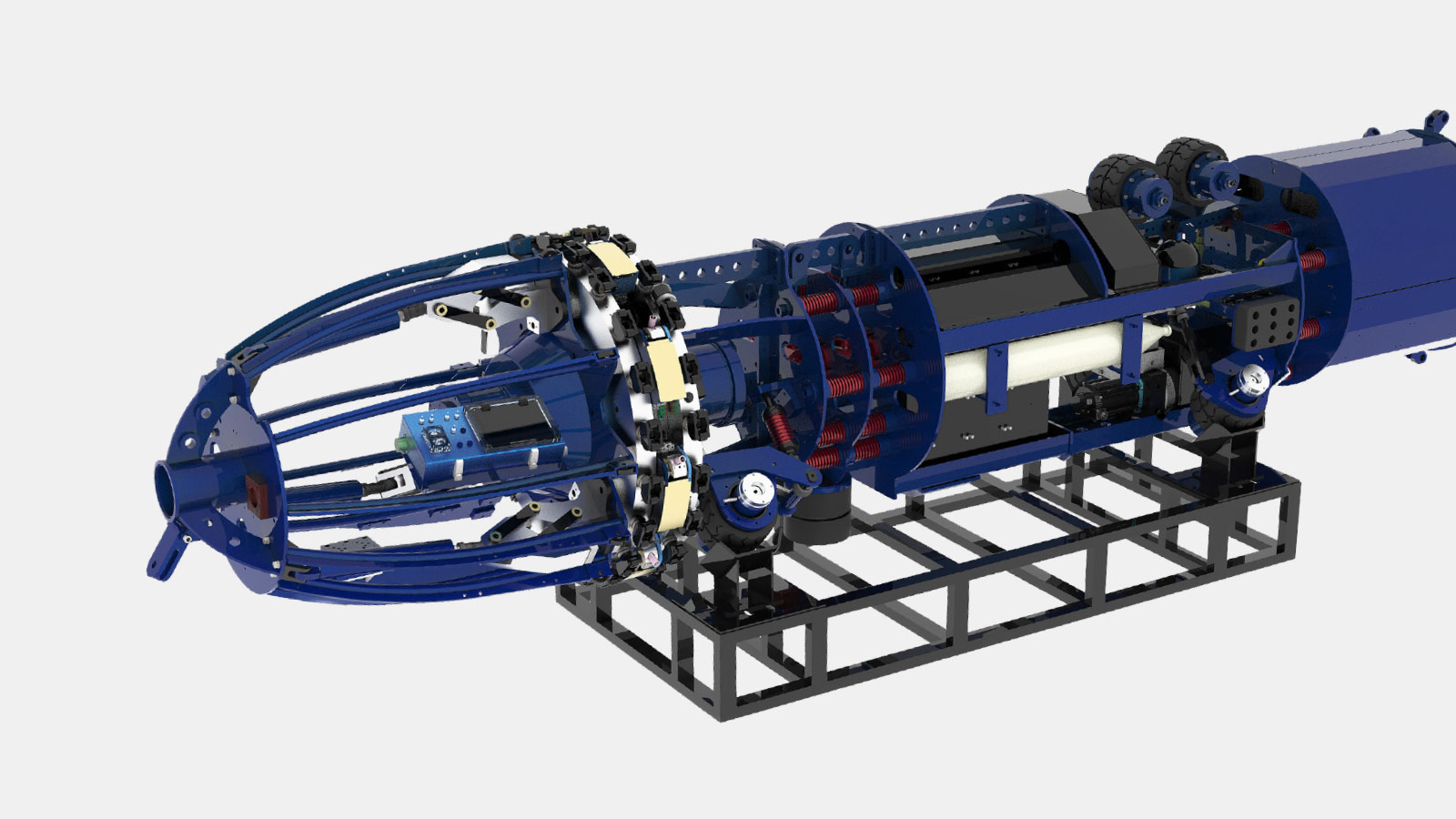
Automatic TIG: cheap parts, frequent changes
The automatic TIG set is the cheapest to keep in parts and the least forgiving in practice. Tungsten electrodes must be ground to a consistent angle and kept concentric, ceramic cups and gas lens control the gas shield that the whole root pass depends on, and wire guide tips wear quickly against hard filler wire. Nothing here is expensive; the discipline is in replacing on schedule rather than on failure, because a contaminated tungsten will not show up as a stop — it shows up as a root defect.
An A/B/C Classification for the Spare-Parts Box
Spares fail to arrive for one of two reasons: too many part numbers and no system, or a system nobody follows. Three classes are enough. The rule that makes it work is that the reorder trigger is written down against the part, not decided by whoever is at the store.
| Class | What belongs here | Stock rule | Reorder trigger |
|---|---|---|---|
| A — per-shift wear | Contact tips, nozzles, drive rolls, tungsten electrodes, ceramic cups, gas lens, welding wire | 3–5 working days of measured consumption, per machine, in the tool container | Reorder at 50% of the container |
| B — machine-specific wear | Gear-rack segments, carriage rollers, clamp jaws, hydraulic seals, remote-control batteries, control and welding cables | One set per machine plus 20%, held at the camp store | Reorder as soon as a spare leaves the store |
| C — long-lead critical | Battery packs, servo drives, brake modules, torch bodies, control boards, welding power modules | Ordered for each machine at mobilisation, lead time 4–8 weeks | Order on issue, never on failure |
A Preventive-Maintenance Calendar That Fits a Shift Pattern
A maintenance plan that depends on a free afternoon will not happen. The calendar has to use the slots that already exist: start of shift, end of shift, the weekend, and the planned stand-down. Everything below is executable by the crew that is already on site, with the tools already in the container.
| When | What is done | Booked as |
|---|---|---|
| Start of shift (5 minutes) | Inspect and replace contact tip and nozzle; check the wire spool and drive-roll pressure; confirm gas flow and look for leaks; confirm track clamp torque; check the remote-control charge | Shift log: parts changed, machine number |
| End of shift | Clear spatter from torch and track; wipe the carriage; check cable sheaths for cuts; recharge or rotate power packs; park the machine dry | Shift log: defects found |
| Weekly | Lubricate the gear-rack and track; measure carriage roller wear; re-check torch vertical and horizontal alignment on a test joint; export the parameter set from the touch screen as a backup | Weekly maintenance sheet |
| Monthly | Clean and insulation-check the control cabinet; verify hydraulic expansion pressure against 5–7 MPa; re-zero arc tracking; torque-check terminals | Signed maintenance sheet |
| Quarterly | Capacity-test the battery group; inspect the servo drive train and the electromagnetic brake; check track straightness and joint wear | Battery test report |
| Annual / major service | Replace hydraulic seals and gas lines; calibrate current and voltage sensing; full electrical inspection; archive the year’s parameter sets | Service report |
Power-Pack Care on Off-Grid Spreads
Where the internal welder carries its own energy, the battery group becomes the machine’s critical spare and its maintenance calendar has to reflect that. Four rules cover most of the risk, and all four are specification-backed rather than folklore: charge above freezing, because the machines are rated to work at −40 °C or −50 °C but charging cold cells damages them; do not store packs full or empty, but at a mid charge; capacity-test the group on the quarterly cycle so a falling runtime is caught as data rather than as a mid-shift surprise; and keep the packs dry, since the working envelope of these machines extends to 90% humidity and rain is the practical enemy of connectors. On a wireless-remote machine, the handheld is also a single point of failure — a second charged handheld in the tool box buys back a shift for the price of a battery.
Reading Wear as a Quality Signal
On an automatic spread the defects that trigger rework are usually the first evidence of a worn part, not a welding procedure problem. Reading the symptom correctly turns an investigation into a consumable change.
| Symptom on the joint | Most likely wear source | Action |
|---|---|---|
| Rising porosity and spatter, unstable arc | Worn contact tip; spatter build-up inside the nozzle | Replace the tip, ream the nozzle, re-check gas flow |
| Undercut or bead wandering at one position | Slack track clamp; worn gear-rack segment | Re-clamp and torque; replace the affected rack segment |
| Uneven travel, loss of repeatability | Worn carriage rollers; gear-rack backlash | Adjust or replace rollers; re-tension the rack |
| Root-gap variation inside the pipe | Worn expansion shoes; hydraulic pressure below range | Verify 5–7 MPa; replace seals or shoes |
| Frequent arc-tracking correction | Dirty or drifted tracking sensor | Clean and re-zero; re-calibrate on a test joint |
| Shorter runtime between battery swaps | Ageing cells in the 230 AH×3 group | Capacity-test; replace the group |
| Remote control dropping out | Flat handheld battery | Keep a second charged handheld in the container |
Five Numbers Worth Putting on the Board
- Equipment availability — planned welding hours minus unplanned stoppage, as a percentage; ≥95% is a reasonable target for an external welding spread.
- MTBF by machine family — the figure that tells you which of the four machines actually needs the spare in the store.
- MTTR — aimed below 30 minutes for class-A parts; if it is not, the part is in the wrong box.
- Consumable cost per 100 joints, by machine — not by camp. A single pooled number hides the machine that is silently wearing everything twice as fast.
- Unplanned stops per week with cause — part, procedure or operator. Only the first is a spares problem, and treating all three as spares is how a store grows without availability improving.
Seven Pitfalls That Cost Joints
- Stocking wire by the pallet and contact tips by the handful — the cheap part stops the spread.
- No inventory for tracks and carriage rollers, which cause most external-welder stoppages and carry a lead time.
- Storing battery packs full or deeply discharged; capacity disappears quietly over a season.
- Never exporting the parameter sets, even though both external machines can store and export them, until a control board fails and the proven programmes go with it.
- Treating hydraulic pressure as ‘looks fine’ instead of reading it against the 5–7 MPa band on a gauge.
- Leaving maintenance to whoever is free, instead of naming an owner per shift.
- Booking consumable changes as repair events rather than as scheduled operations with a time slot in the shift.
None of this is new engineering; it is the difference between owning four automatic welding machines and running a welding spread. Set the three classes, print the calendar, put the five numbers on the board, and the same machines that today produce 120 joints a month at 92% will produce them at 97%. Explore the full ENGINE WELDER / DENVO pipeline automatic welding range and build the consumable and spares package around the machines you actually deploy.
Beijing Engine Welder Technology Co., Ltd. (DENOH Group)
Tel: 010-86468776
WhatsApp / WeChat: 13521628344
Email: sales@denohgroup.com
Website: www.denohgroup.com/contact/