On a long-distance pipeline, welding is rarely limited by how fast a crew can strike an arc. It is limited by how many joints come back from non-destructive testing with a defect. Every rejected joint means cutting out metal, re-bevelling, re-welding and re-inspecting in the most expensive place possible — on the spread, in the weather, against the schedule. Automatic welding does not remove the need for quality control, but it moves control away from the welder’s reflexes and into the parameter program. This article maps the defects that actually cost money on a pipeline and shows how single-torch external welders, dual-torch external welders, internal welding machines and automatic TIG machines each take ownership of a specific pass, using the ENGINE WELDER / DENVO range for configuration examples.
Why Quality Control, Not Speed, Is the Real Bottleneck
A manual welder makes dozens of undocumented decisions per pass. An automatic machine makes them once, stores them, and repeats them identically at every clock position of every joint. The economic difference is not only labour cost: an automatic station that eliminates one class of recurring defect also eliminates the cut-out, the re-weld, the second inspection and the schedule slip that defect caused. That is why quality planning — not travel speed on paper — decides the true cost per joint.
Pass-by-Pass Defect Map for Girth Welds
Field pipeline girth welds are welded in three functional stages, and each stage has a characteristic family of defects. Assigning the right machine to the right stage is the first quality decision.
| Weld stage | Characteristic defects | Root cause | Machine that owns the control |
|---|---|---|---|
| Root pass | Lack of penetration, burn-through, high-low / misalignment, incomplete fusion at the root | Joint fit-up and misalignment, arc energy and travel stability at the 6 o’clock position | Internal welding machine (hydraulic expansion centering) or automatic TIG |
| Hot / fill passes | Lack of fusion, porosity, trapped slag, excessive reinforcement | Deviation from the joint, wrong weave mode, unstable carriage travel | Single- or dual-torch external welder with arc tracking |
| Cap pass | Undercut, overlap, irregular bead profile, arc marks | Constant parameters around the circumference, poor pool symmetry | Dual-torch external welder with clock-position parameter change and oscillation |
Stage 1 — Root Pass: Fixing the Highest-Risk Defect Source
More rejectable defects originate in the root pass than in any other stage, because the root is where fit-up error and welding energy meet. Internal welding machines attack the problem from inside the pipe and from the fit-up side at the same time.
DW48/56-8H-D flexible internal welding machine
This is the model built specifically for uneven terrain and for close control of joint quality. Its hydraulic expansion system performs rapid centring and actively corrects pipe misalignment before the root is welded — the direct countermeasure to high-low defects. Large-torque servo electric drive keeps travel smooth under continuous heavy duty, and a fast-response electromagnetic brake gives reliable positioning, so the arc stops and starts where the program says rather than where the carriage drifted.
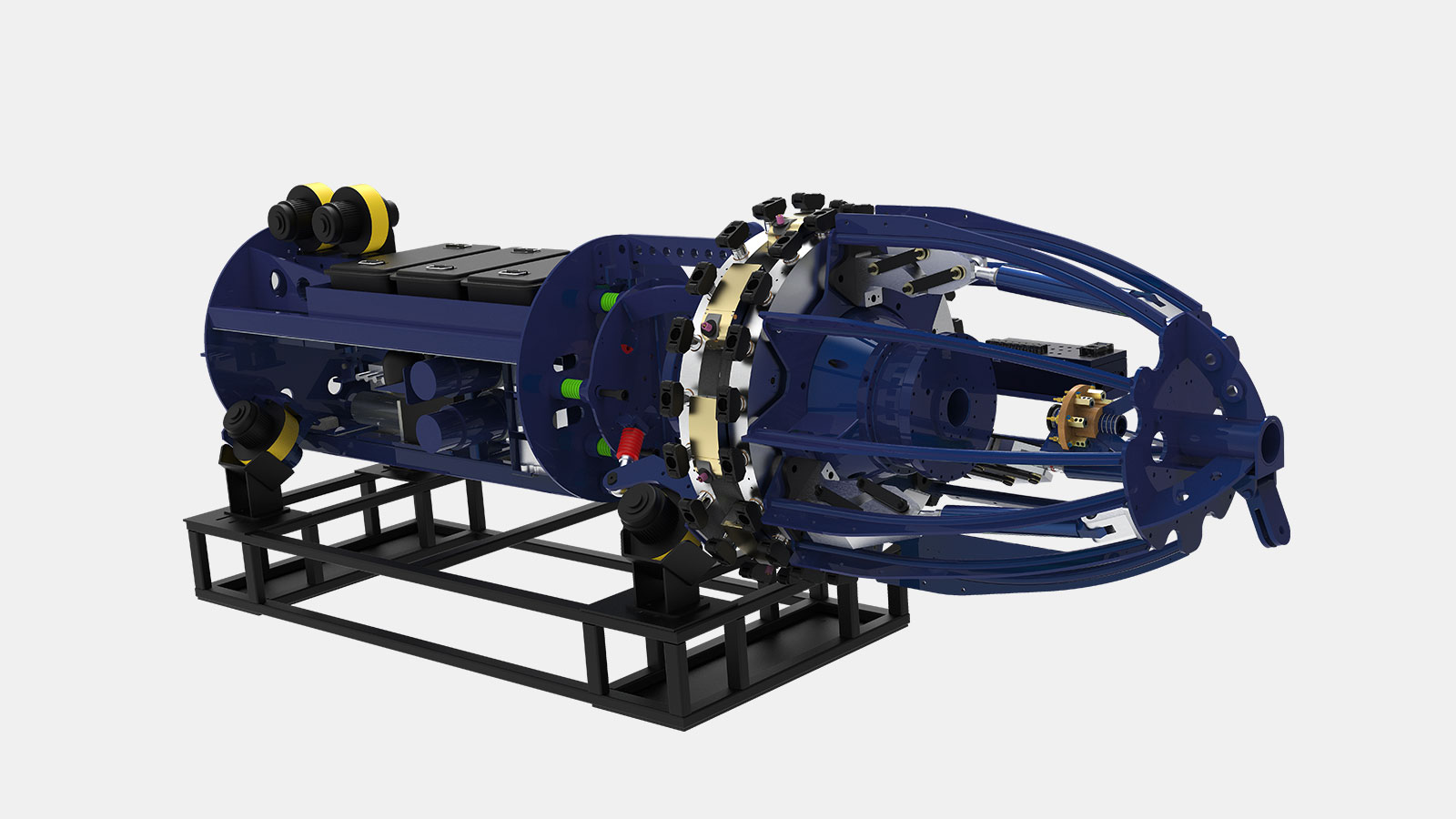
- Pipe range Φ1219–Φ1422mm with 8 welding units; single-pass weld time ≤120 s; travel 0–60 m/min.
- Fitting plus root welding in approximately 5 minutes per joint — quality gains without a schedule penalty.
- Compact 2400 kg body and 5/6 D bend capability, so it reaches complex sections where rigid machines cannot.
- Battery pack of 230 AH × 3 groups, DC 24 V rated voltage, 5–7 MPa working pressure.
- Wire diameter Φ0.9–Φ1.2mm; working temperature −50°C to 65°C; altitude 0–3500 m.
- Wireless remote control keeps the operator clear of the weld zone.
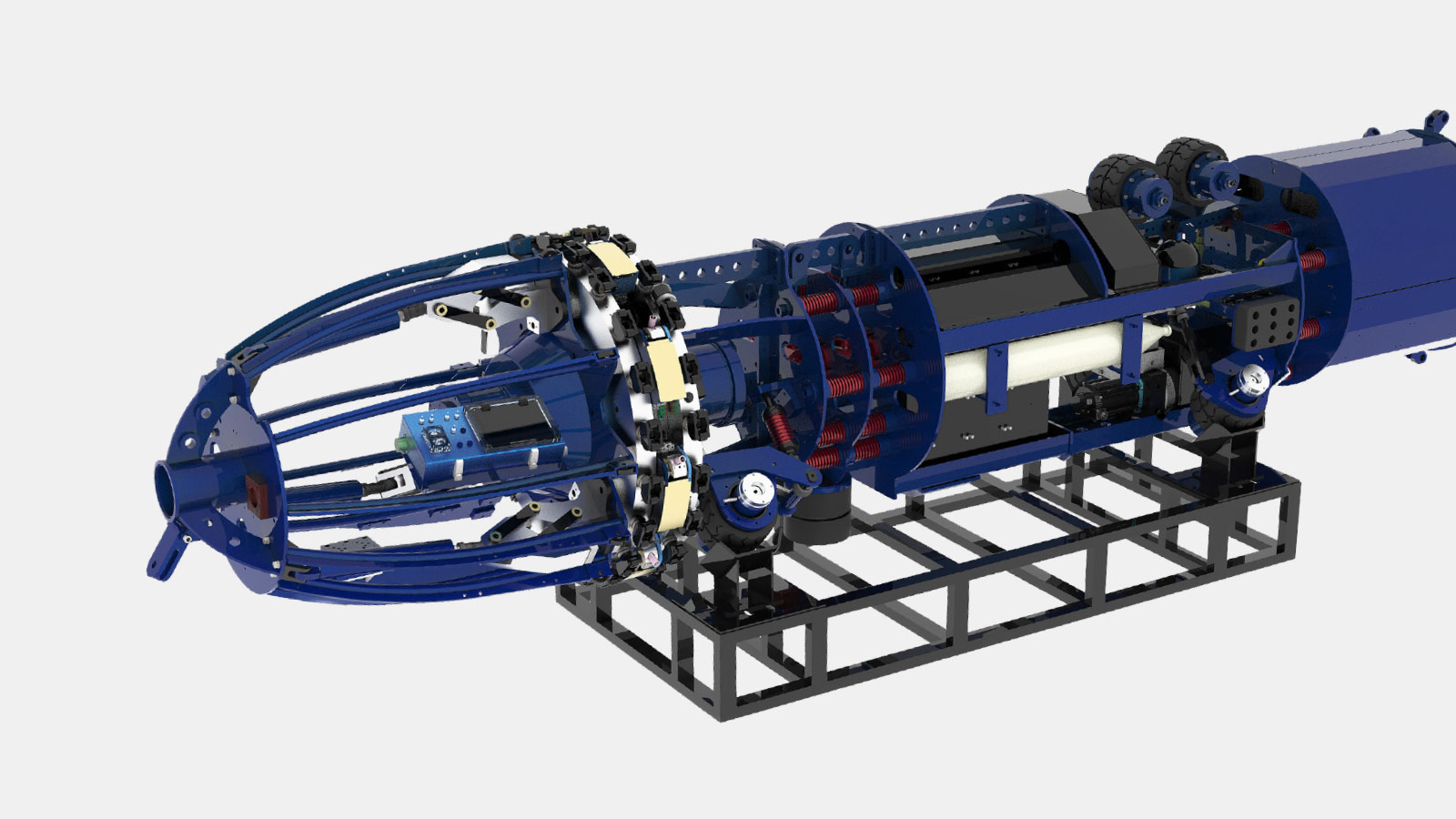
DW-EH48/56 lithium-battery internal welding machine
Where there is no grid and no generator cable, quality traditionally suffers because crews improvise. The DW-EH48/56 removes that compromise: lithium battery power with electric-plus-hydraulic drive delivers smooth output and stable joint alignment, so the internal root pass is welded to specification even on remote spreads. Eight welding units and a ≤90 s single-pass time keep the root cycle the fastest stage of the joint rather than the slowest.
| Parameter | DW-EH48/56 | DW48/56-8H-D |
|---|---|---|
| Pipe diameter | Φ1219–Φ1422mm | Φ1219–Φ1422mm |
| Welding units | 8 | 8 |
| Travel speed | 0–40 m/min | 0–60 m/min |
| Single-pass weld time | ≤90 s | ≤120 s |
| Wall thickness range | 10–35 mm | — |
| Curb weight | 2950 kg | 2400 kg |
| Working temperature | −40°C to 65°C | −50°C to 65°C |
| Altitude limit | ≤4000 m | 0–3500 m |
| Quality-relevant strength | Wireless remote operation, no external cable, stable arc on remote spreads | Hydraulic expansion centring that corrects joint misalignment; about 5 min fitting + root |
Stage 2 — Fill Passes: Where Arc Tracking Converts Skill into a Program
Fill passes occupy the largest share of welding time, so a small defect rate here produces the largest number of rejections. Two mechanisms matter: the carriage must travel without slip, and the arc must stay on the joint even when the pipe is not perfectly round.
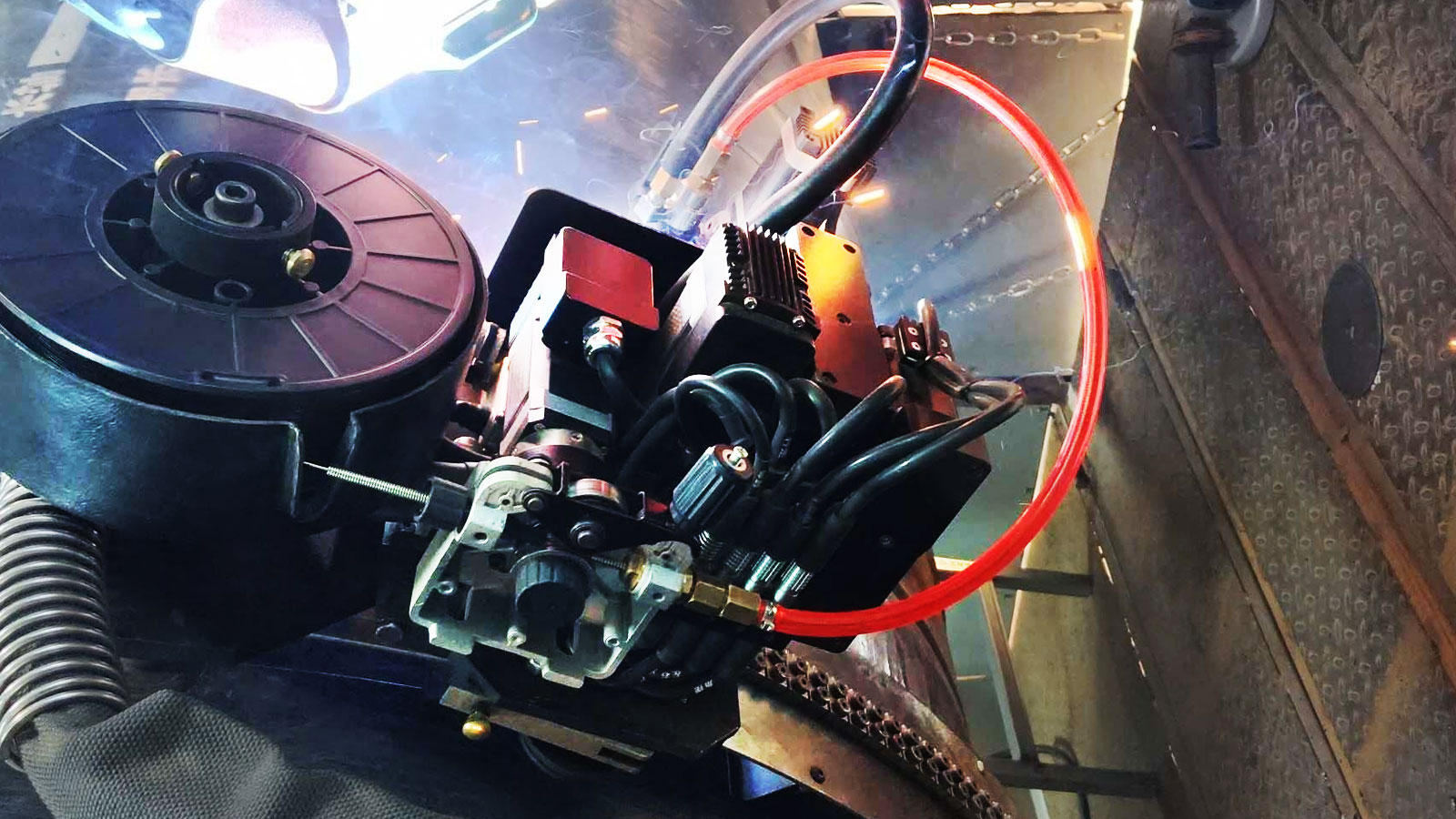
DW-EW-I single-torch external welder
- Perforated steel rack track with a lightweight, dust-protected welding carriage for quick deployment and stable travel on Φ219–Φ1422mm pipe.
- Single gear-and-rack drive with no slip and high transmission accuracy, so weld positioning stays precise — a direct control against localised lack of fusion.
- Multi-axis torch adjustment: vertical and horizontal torch position can be tuned against pool symmetry for uniform beads.
- Automatic parameter change by clock position: every point of the circumference follows the stored program, which is what makes all-position quality reproducible.
- Visual touch screen for setting, displaying, modifying and storing parameters, with upload and download for process records.
DW-EW-II dual-torch external welder
The dual-torch machine is the quality instrument of the two. It supports both straight-weave and angular-weave (oscillating) modes, switchable to match the qualified welding procedure, and its automatic arc tracking system follows the joint in real time, correcting deviation to keep the bead uniform and flat. That real-time correction is what suppresses the classic fill-pass defects — lack of side-wall fusion, irregular reinforcement and porosity caused by the arc wandering off the joint.
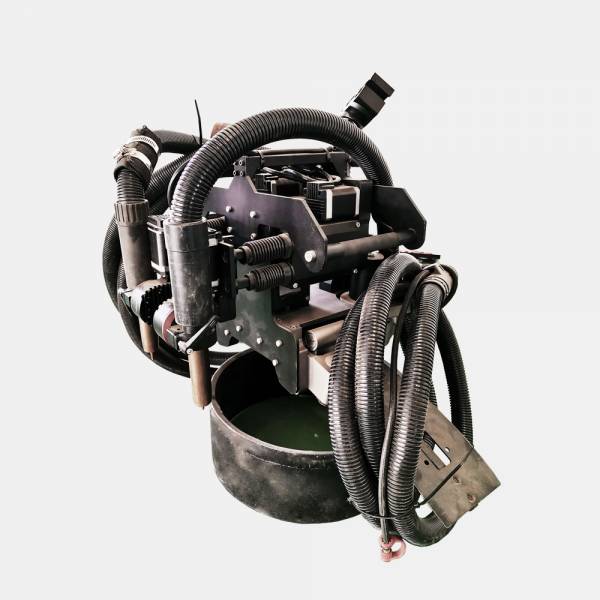
- Integrated digital control between welder and control box for precise response and stable output.
- Multi-channel internal storage, recall, import and export of welding procedure data — the traceability layer of a quality system.
- Standardised consumables across the fleet simplify maintenance and keep the process repeatable after spares replacement.
- Built for high-grade long-distance pipelines, national key energy projects and high-standard fabrication shops.
Stage 3 — Root Cleanliness and Cap Profile: Automatic TIG and Oscillated Cap Passes
An automatic TIG welding machine rotates the arc around the pipe on an orbital track with precise, repeatable control of current, travel speed and filler wire feed. Where a project demands a clean internal bead profile, thin-wall sections or stainless service, orbital TIG delivers penetration and cleanliness that manual work struggles to reproduce joint after joint. On the outside of the joint, the cap pass is where the dual-torch machine’s oscillating mode earns its place: controlled weave width, clock-position parameter change and arc tracking together prevent undercut and overlap while keeping the cap profile within radiographic acceptance.
Field Quality-Control Checklist for Automatic Welding
Before welding
- Verify bevel geometry, edge preparation and cleanliness; contamination at the bevel is a direct porosity source.
- Check alignment and high-low before the root — the internal machine’s expansion system can correct it, but it cannot invent fit-up that does not exist.
- Confirm preheat and interpass requirements, then confirm the stored welding procedure matches the qualified one.
- Inspect track or rail fitting and carriage clamping; a loose track is a hidden cause of arc deviation.
During welding
- Confirm the parameter program changes with clock position as programmed, and that arc tracking is active on fill and cap passes.
- Monitor shielding gas flow and travel speed — the two variables most often altered on site without documentation.
- Keep the operator outside the weld zone using wireless remote control, particularly in confined or mountain sections.
After welding
- Visual inspection of bead profile, undercut and surface porosity before the crew moves on.
- NDT sampling (RT / UT / AUT) as specified, with the joint number tied to its stored parameter record.
- Export and archive the weld procedure data so that acceptance and repair history travel with the project.
From Defect Rate to Acceptance Rate: What to Measure
| Defect | Control measure | Equipment owner |
|---|---|---|
| High-low / misalignment at root | Hydraulic expansion centring before the root is struck | DW48/56-8H-D internal welder |
| Lack of penetration / incomplete root fusion | Programmed root energy with stable travel and controlled heat input | Internal welder or automatic TIG |
| Lack of side-wall fusion on fill | Real-time arc tracking plus correct weave mode | DW-EW-II dual-torch welder |
| Irregular reinforcement, undercut, overlap | Clock-position parameter change and pool symmetry adjustment | DW-EW-I / DW-EW-II external welders |
| Deviation and rework after spares replacement | Multi-channel procedure storage, recall and export | Dual-torch external welder |
Conclusion
Weld quality is not a final inspection result; it is a design decision made when the welding system is configured. Put an internal welding machine on the root to eliminate misalignment and fit-up defects, use single-torch or dual-torch external welders with arc tracking for fill passes, and apply automatic TIG plus controlled oscillated cap passes where cleanliness and profile decide acceptance. Beijing Engine Welder Technology Co., Ltd. (DENOH Group) supplies the complete ENGINE WELDER automatic welding range and supports it with engineering selection and process advice.
Contact: Beijing Engine Welder Technology Co., Ltd. (DENOH Group) | Tel: 010-86468776 | Email: sales@denohgroup.com | WhatsApp/WeChat: 13521628344