
Long-distance pipeline projects celebrate the mainline production welds, but the line is not deliverable until valve stations, pig launcher and receiver stations, manifolds and tie-in welds are completed. Station piping is a different welding problem: short spools instead of long straights, fittings and flanges instead of plain pipe ends, mixed diameters from Φ219 mm up to Φ1422 mm, and almost every joint welded in a fixed position.
This guide maps the four DENVO / ENGINE WELDER automatic welding machines – the single-torch external welder, the dual-torch external welder, two internal welder models and the automatic TIG process – onto real station piping tasks, and sets out the discipline needed to keep quality and traceability when the rhythm of the mainline disappears.
Why Station Piping Breaks the Mainline Welding Rhythm
A mainline spread is optimized for repetition: one diameter, thousands of similar girth welds, rolling and fixed positions controlled by a familiar cycle. A station is the opposite. The table below contrasts the two environments.
| Aspect | Mainline pipeline | Station piping |
|---|---|---|
| Joint geometry | Girth welds on long straight pipe | Girth welds plus branch connections, flange necks, elbows, tees and reducers |
| Diameters | One or two diameters per spread | Many diameters mixed, commonly Φ219-Φ1422 mm |
| Welding position | Rolling plus controlled fixed positions | Mostly fixed position, in trenches, racks and structures |
| Access | Open right-of-way, external cages | Confined spacing between valves, supports and structures |
| Joint volume | Thousands of repetitive joints | Dozens to hundreds of unique joints |
The conclusion is practical: station work rewards equipment that can be redeployed quickly, adapts its parameters to position and diameter automatically, and keeps a record of every joint. It punishes any assumption that the mainline setup transfers unchanged.
Matching the Four Machines to Station Welding Tasks
| Machine | Best-fit station task | Key enabler |
|---|---|---|
| Single-torch external welder DW-EW-I | Fill and cap passes on most station girth welds, Φ219-Φ1422 mm | Split rack-type steel ring track installs and removes quickly; welding parameters change automatically with position |
| Dual-torch external welder DW-EW-II | Fill and cap on headers, manifolds and large-bore station runs | Dual torches with straight and angle oscillation, automatic arc tracking, multi-channel process data storage |
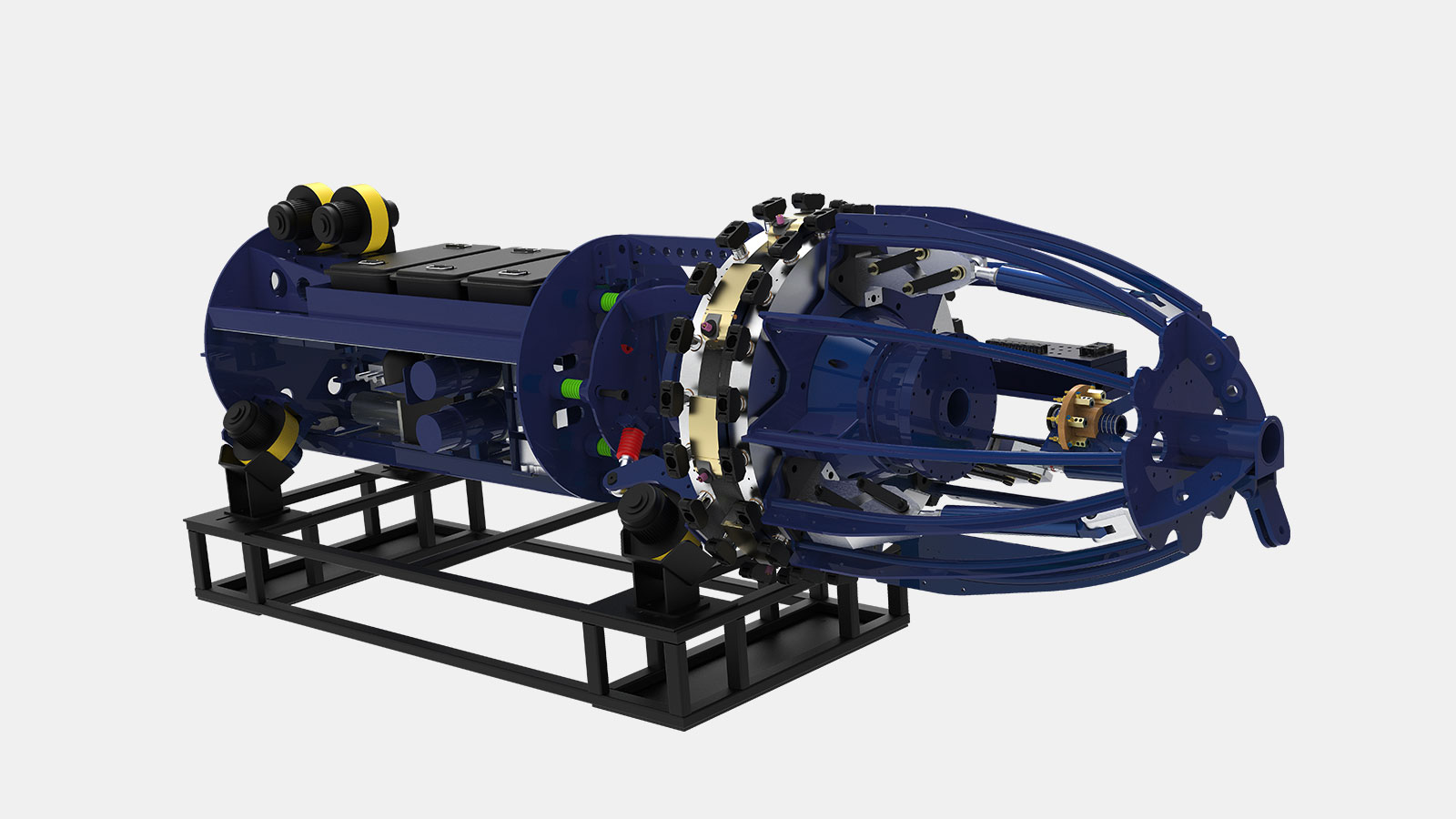
| Internal welders DW-EH48/56 and DW48/56-8H-D | Root pass on the mainline approach spools and long straight large-bore runs feeding the station | 8 welding units, pass time ≤90 s / ≤120 s, hydraulic expansion centering |
| Automatic TIG | Root and hot pass on small-bore, thick-wall and high-value joints | Low heat input, repeatable root quality; process accepted per project WPS |
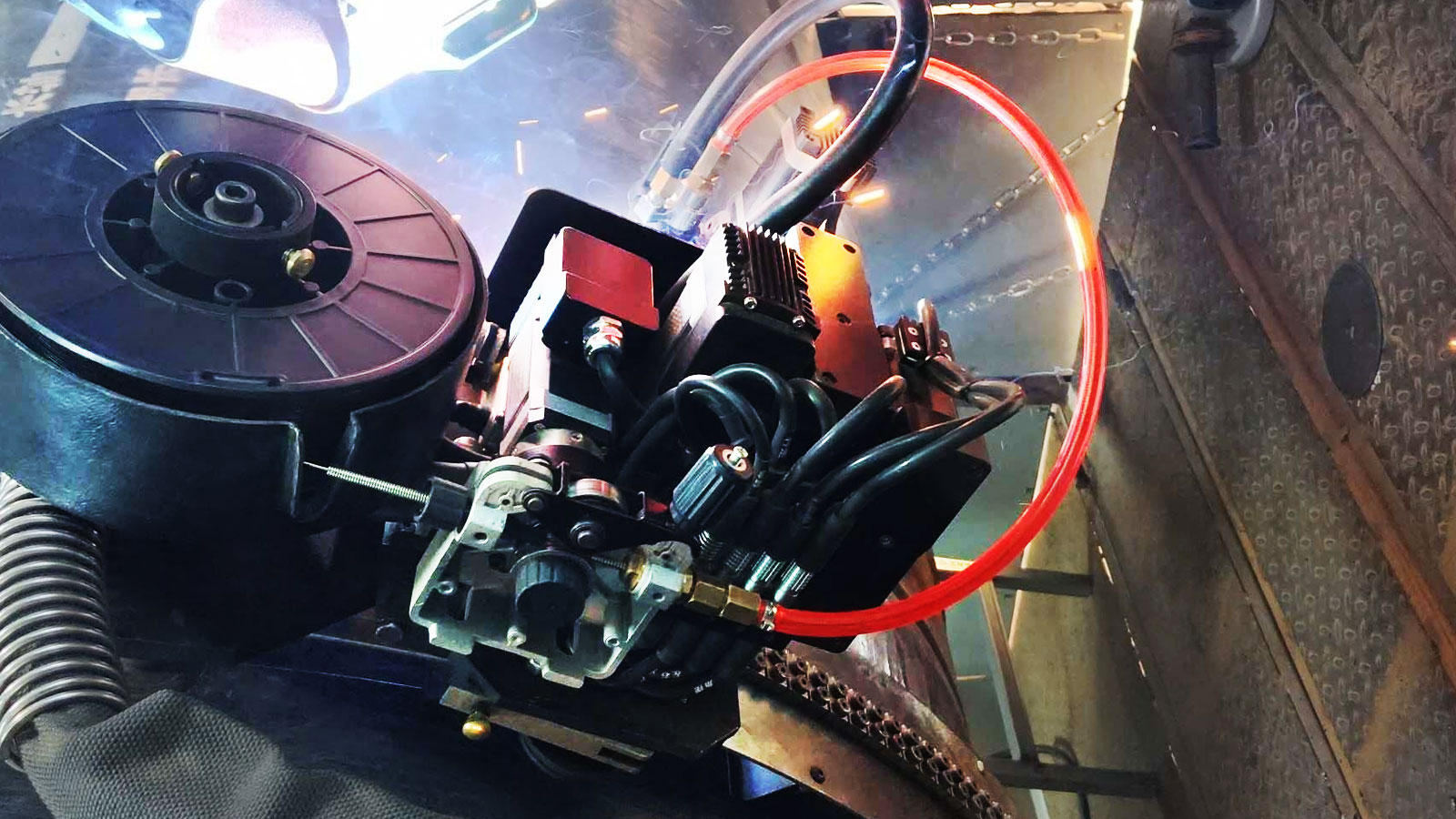
Single-Torch External Welder DW-EW-I: the Flexible Default
The rack-type steel track is rigid yet light, and the split ring design makes installation and removal fast – exactly what station work needs when the crew moves from one joint to the next. A single gear and rack drive keeps the carriage from slipping, so weld positioning stays precise even on short spools.
The torch is adjustable in both vertical and horizontal planes, so the operator can balance the pool when fit-up is not perfect. Around the circumference, welding parameters change automatically with position under the control program, and the visual touchscreen stores, uploads and downloads parameter sets. With the split ring track range, the machine covers Φ219-Φ1422 mm – nearly the whole diameter mix found in a station.
Dual-Torch External Welder DW-EW-II: Throughput on Headers and Manifolds
Where a station has repeated large-bore welds – manifold runs, header spools, launcher and receiver barrels – the dual-torch machine halves the number of external passes per joint. Two torches work in one pass with straight or angle oscillation, selectable per process requirement.
Automatic arc tracking follows the joint and corrects drift in real time, which matters on shop-fabricated spools where fit-up varies. Process parameters are managed in multiple internal channels with recall, import and export, so the crew stores one proven parameter set per diameter and calls it up as the work moves. Consumable parts are common across the machine, simplifying spares for a mixed-diameter site.
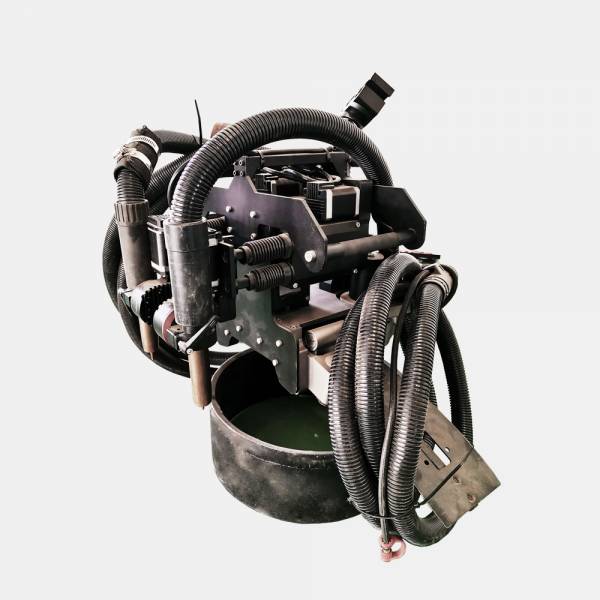
Internal Welders: Where They Work and Where They Stop
An internal welder needs an open, straight bore to travel through. Inside a station, valve bodies, tees and flow fittings block the internal carriage, so the machine cannot serve the station itself. Its role at the boundary is the root pass on the mainline approach spools and long straight large-diameter runs leading into the station, in Φ1219-Φ1422 mm only.
| Parameter | DW-EH48/56 (lithium) | DW48/56-8H-D (flexible) |
|---|---|---|
| Welding units | 8 | 8 |
| Pass time | ≤90 s | ≤120 s |
| Travel speed | 0-40 m/min | 0-60 m/min |
| Fit-up plus root | – | about 5 min |
| Power | Lithium battery + hydraulic, 5-7 MPa working pressure | 230 AH × 3 battery packs, DC 24 V |
| Machine weight | 2950 kg | 2400 kg |
| Temperature range | -40°C to 65°C | -50°C to 65°C |
| Altitude | ≤4000 m | 0-3500 m |
| Slope / bends | ≤30° slope, 5D bends | ≤30° slope, 5/6D bends |
| Wire diameter | – | Φ0.9-1.2 mm |
The hydraulic expansion system centers and corrects pipe misalignment, which protects root quality on approach spools where internal alignment is difficult to verify visually. Wireless remote control keeps operators clear of the weld zone – useful in the crowded space near a station boundary.
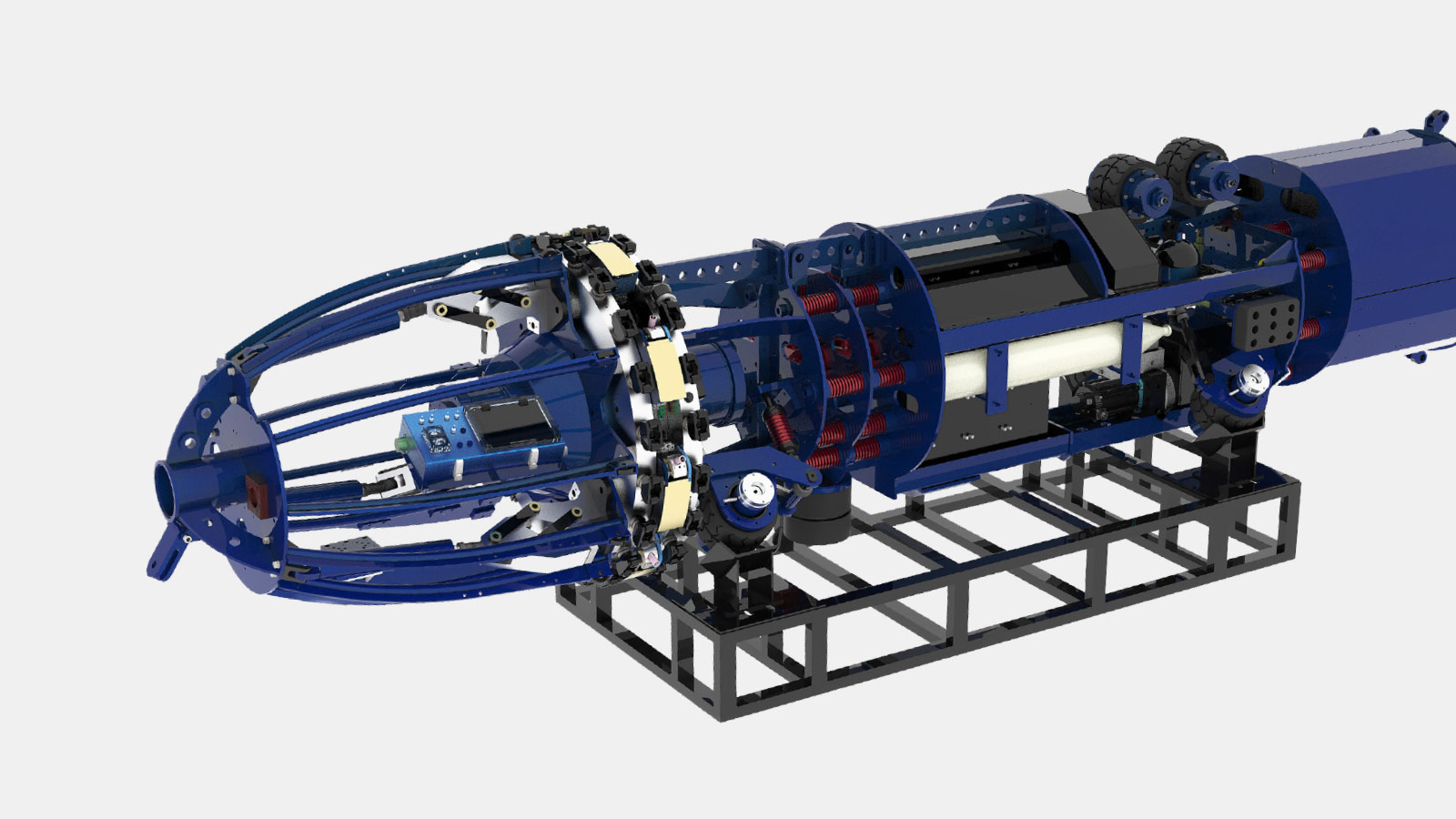
Automatic TIG: Root Quality on Small Bore and Critical Joints
Station piping always contains joints where the root decides everything: small-bore drains and vents, instrument connections, thick-wall high-pressure segments, and transition welds between material grades. Automatic TIG welding provides low heat input and a highly repeatable root bead on exactly these joints. There is no separate product data sheet for the automatic TIG process; its parameters and acceptance criteria follow the project WPS and PQR.
Fixed-Position Welding: How Automation Adapts
Most station welds are made with the pipe fixed in a trench, on supports or between flanges. The external machines handle this because their parameter programs vary automatically around the clock positions – the same capability that serves mainline fixed-position welding. To make it work in a station:
- Verify that the straight cylindrical band where the ring track seats is long enough on short spools and clear of fittings.
- Support and cradle each joint so the carriage is not fighting pipe deflection during the pass.
- Use angle oscillation on the dual-torch machine for cap passes near fittings and uneven groove faces.
- Plan gas protection for trenches and wind-exposed positions before the first arc, not after a porous root.
Tie-In Welds: the Boundary Between Mainline and Station
The tie-in weld – closing the last joint between the mainline and the station – is statistically among the highest-risk welds on the project. A disciplined sequence:
- Measure and cut the closing spool cold, with the line at rest temperature, to avoid locked-in misalignment.
- Confirm bevel angle, root gap and cleanliness against the chosen root process before anything is tacked.
- Choose the root method deliberately: an internal welder cannot reach the final closed joint, so use the single-torch external welder or an automatic TIG root instead.
- Verify alignment with gauges in at least four clock positions, since the internal expansion system cannot help here.
- Record the tie-in as-built data with the same rigor as production welds – it will be the first joint reviewed if the section fails testing.
Parameter Discipline Across Many Diameters
Station work cycles through diameters daily, so parameter management is a production system, not a convenience. On the DW-EW-II, proven parameter sets live in multi-channel storage and are recalled, imported and exported as the job moves. On the DW-EW-I, the touchscreen stores and downloads sets per diameter. Ring tracks should be labeled per diameter and inspected before each shift. A dedicated WPS per diameter group, approved before mobilization, prevents improvised parameter changes at the joint.
Seven Common Mistakes in Station Piping Automation
- Assuming one machine setup covers all station diameters without per-diameter parameter sets.
- Planning an internal welder for joints inside the station, where valves and fittings block the bore.
- Installing ring tracks on short spools without verifying straight seating length and support.
- Ignoring fixed-position support, so the carriage welds against a deflecting pipe.
- Skipping a dedicated WPS per diameter group and tuning parameters at the joint instead.
- Relying on arc tracking to compensate for fit-up that should have been corrected before welding.
- Leaving tie-in and station welds out of the data export routine, breaking joint traceability.
Ten-Point Readiness Checklist for Station Welding Automation
- Diameter and wall thickness list for every station weld, mapped to machine and WPS.
- Straight seating band verified for ring track installation on each spool.
- Root process decided per joint class: internal welder, external machine or automatic TIG.
- Parameter sets stored and named per diameter on the touchscreen or multi-channel memory.
- Support and cradle plan for fixed-position welding in trenches and racks.
- Gas protection plan for trench and wind conditions.
- Consumable and spare inventory covering the mixed-diameter workload.
- Data export routine covering station and tie-in welds, not only mainline production.
- Tie-in procedure rehearsed, including cold measurement and four-point alignment checks.
- Operator briefing on which machine serves which station zone, and on the no-go rules for internal welders.
Frequently Asked Questions
Can the external welders weld directly on elbows and fittings?
The ring track needs a sufficiently straight cylindrical band to seat and drive on. Girth welds close to fittings are welded on the straight section available; welds on the fittings themselves normally stay with manual TIG or SMAW under the project WPS. Specify this per joint during spool design.
Which diameters can the internal welders serve at a station?
Only Φ1219-Φ1422 mm straight, open runs – typically the mainline approach spools. Any joint behind a valve, tee or reducer is external work.
Do the single-torch and dual-torch machines share tracks and consumables?
Both external machines cover Φ219-Φ1422 mm, and the dual-torch machine is designed with common consumable parts to simplify spares. Track sets are diameter-specific; confirm the track inventory covers every diameter in the station scope.
How is the automatic TIG process documented?
There is no separate product data sheet. Qualify the process through the project WPS and PQR, and let the same document define parameters, acceptance criteria and operator requirements.
Conclusion
Station piping does not need a different philosophy of automation – it needs the same machines, applied with sharper discipline. The single-torch DW-EW-I brings fast redeployment and automatic position compensation across Φ219-Φ1422 mm. The dual-torch DW-EW-II concentrates throughput on headers and manifolds with arc tracking that absorbs fit-up variation. The internal welders own the root on large-diameter approach spools, and only there. Automatic TIG protects the small-bore and critical roots that no other process should touch.
Define the machine-to-zone map before mobilization, store parameters per diameter, and treat tie-ins with the documentation rigor they deserve – then the station, not only the mainline, delivers welds at production pace.
Contact Us
Beijing Engine Welder Technology Co., Ltd. (DENOH / ENGINE WELDER)
Tel: 010-86468776 | WhatsApp/WeChat: 13521628344
Email: sales@denohgroup.com
Website: https://www.denohgroup.com/contact/